14 May 2026
Commercial systems
Boardroom AV, meeting rooms, PA systems, announcement zones and commercial audio-visual planning for businesses, warehouses and hospitality spaces.
14 May 2026
29 July 2026
7 August 2026
Why the best meeting-room systems are not the most complex ones, but the ones people can start without calling for help.
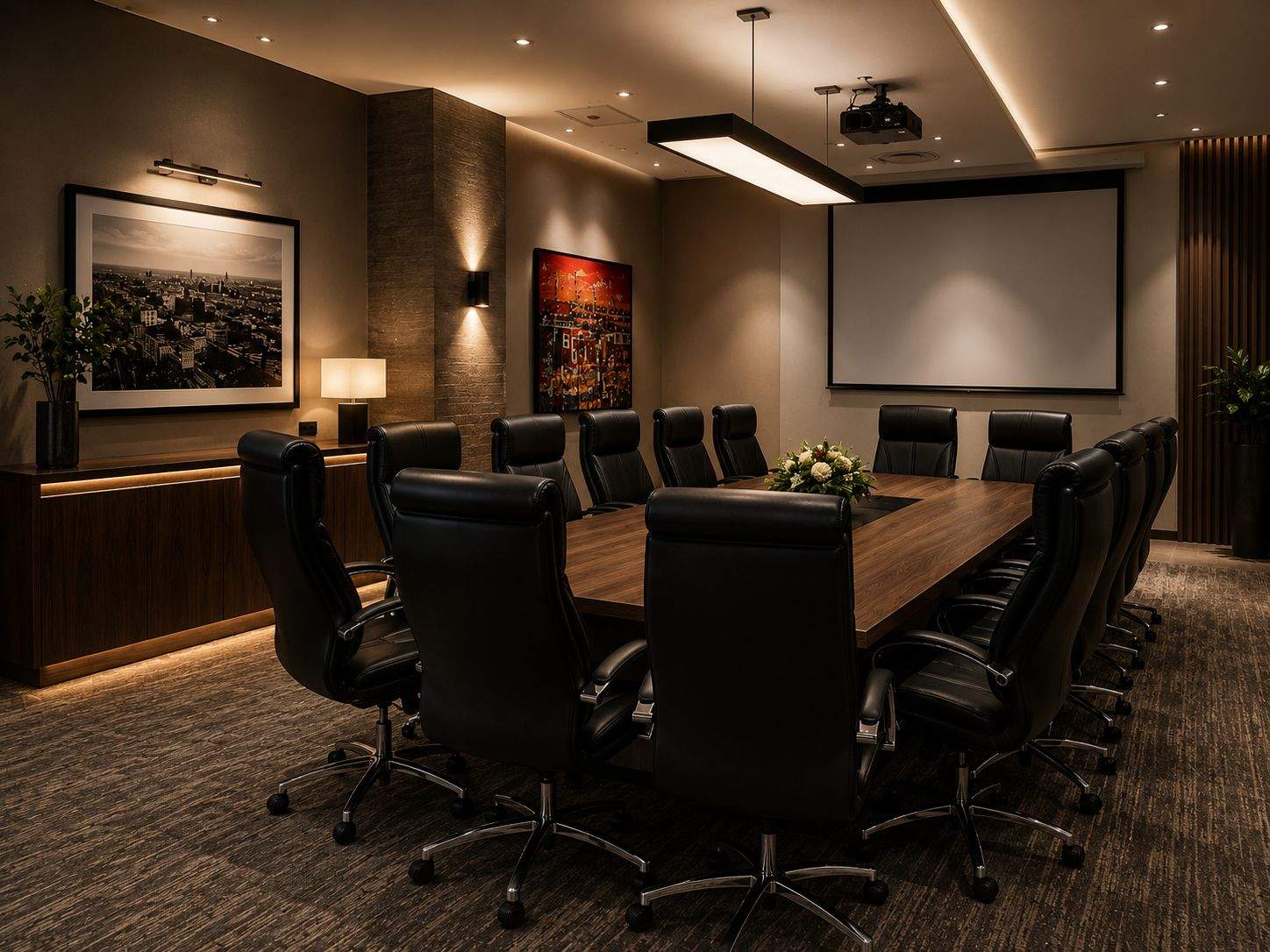
A boardroom AV installation should start with meetings, room layout, sound, camera position, control, cabling and network reliability, not only screen size.
PA systems for commercial sites need proper zone planning, source control and intelligibility. They should not be treated as just extra speakers.
Boardroom audio should be tested with presentations, calls and normal speech so microphones, speakers, source levels and room control work together in practice.
A school hall AV system should be designed around viewing distance, speech coverage, presentation content, lighting and the people operating it.
AV-over-IP can provide flexible routing for larger rooms and connected spaces, while simpler rooms may need a more direct signal path.
A reliable boardroom should have a clear everyday meeting path and a practical fallback for visitors, platform changes or presentation problems.
Warehouse PA systems affect operations, safety and communication, so ownership, paging rights, support contacts and zone responsibility should be clear.
An older commercial AV system should be mapped and tested before the client commits to replacing every component.
A later boardroom support visit can expose changes to cables, network paths, sources, furniture and control systems that were invisible at the original handover.
Room scheduling panels give staff immediate information about availability and help businesses manage several meeting spaces more clearly.
Different rooms place different demands on commercial AV equipment, so faults and upgrade needs may appear in one space before another.
Several meeting rooms can have different equipment while still sharing consistent naming, control logic, cabling records and support procedures.
Commercial public-address systems should be tested zone by zone so amplifier, cabling and speaker faults can be identified before handover.
Camera position, display size, participant sightlines and presenter location all affect the quality of a boardroom video meeting.
Boardroom AV drawings become useful when they reflect furniture, floor boxes, source routes, equipment positions and changes discovered during installation.
Large institutional AV deployments benefit from backup equipment, programming records and a recovery process that protects rooms when a component fails.
Training rooms and boardrooms may share technology, but their presenter position, viewing pattern, audio and content requirements are different.
A useful commercial AV site survey records the room, users, infrastructure, access, power, network and installation constraints before equipment is selected.
A commercial AV handover should leave the client with operating instructions, equipment records, labels, test results and a clear support path.
A multi-room workplace AV installation needs room-specific design, shared standards, coordinated cabling, testing and a clear handover.
Late furniture changes, missing network access, untested cables, unclear source names and unavailable users can delay commercial AV commissioning.
Hospitality boardrooms need polished guest operation, reliable presentation, clear audio, discreet equipment and support that works around the venue.
A room-by-room equipment schedule makes a commercial AV project easier to quote, install, test and support.
Commercial AV equipment, programming and commissioning depend on one another. Procurement decisions should leave enough time and information for the system to be configured properly.
Commercial AV quotations should identify assumptions about access, cable routes, existing infrastructure, power and working hours before the project begins.
Commercial AV in canteens, reception areas and shared spaces may require custom brackets, protected cable routes and mounting designed for the building.
Replacing a school PA amplifier requires checking the existing speaker cabling and loudspeakers before the new system can be trusted.
Boardroom AV works better when table power, HDMI, USB-C, network and cable access are planned before the furniture is manufactured.
In warehouses and cold-store environments, some cameras are not for general security. They are there to monitor specific racks, aisles or operational points.
School hall projector installations need brightness, screen size, audio, cable routes, mounting height, source control and service access planned properly.
A projector quote should explain the full AV system: screen, sound, HDMI or fibre, source points, control, mounting, power protection and future service access.
Industrial CCTV support should be planned around operating hours, dispatch, receiving, gate movement and production risk instead of treated like a normal callout.
A practical DG Technologies update on recent Crestron boardroom AV videos covering 1 Beyond i12D, Automate VX, Videobar 70 and DM NAX Intelligent Audio.
How to choose between a native Teams or Zoom room, wireless presentation, BYOD conferencing and a hybrid boardroom workflow.
How Crestron Automate VX, 1 Beyond i12D and intelligent video change the way remote participants experience a boardroom meeting.
A practical first-fix guide for boardroom AV: camera positions, microphones, speakers, display walls, table boxes, cabling, rack space and power.
Why larger boardrooms, multiple displays, flexible sources and hybrid meeting rooms often need proper AV-over-IP planning instead of another HDMI extender.
Why microphone placement, echo cancellation, room acoustics and speaker design matter more than most screen-first boardroom AV quotes admit.
Industrial sites that rely on CCTV, Wi-Fi, PA systems and access control should include basic technology status in shift handover.
Technology installation costs are affected by access, working hours, security rules, lifts, parking and whether the site is live or still under construction.
CCTV in cold stores and freezer environments needs more planning than normal camera work because temperature, moisture and access change the design.
A paging system can sound fine in an empty building and fail during real operations. PA systems should be tested under realistic site conditions.
Warehouse Wi-Fi for scanners, handhelds and operations needs different thinking from normal home Wi-Fi because roaming, coverage and uptime matter differently.
A redacted DG Technologies case study on the ECS2 Cornubia rollout for Ethekwini Cold Stores: CCTV, Wi-Fi, network infrastructure, PA announcements and after-hours recovery.
A redacted DG Technologies case study on the Ethekwini Cold Stores industrial CCTV project, covering fibre, PoE, cabinets, HikCentral, Jarrison and support.
Loading bays need CCTV views that show process, vehicle movement, faces, stock handling and handover points, not only a wide overview.
When CCTV is used to resolve stock, delivery, staff or access disputes, camera placement must answer business questions, not only show movement.
Boardroom AV failures usually come from weak design: poor audio, missing cables, unreliable networks, confusing controls and no support documentation.
Meeting room AV installation should make presentations and video calls simple for staff, guests and managers. Here is what Durban businesses should plan.
A practical guide to boardroom AV for Teams and Zoom rooms, covering audio, microphones, camera framing, displays, network and one-touch control.
What changes when CCTV is designed for cold stores, warehouses and industrial sites instead of normal homes.
What makes a good boardroom AV system: display size, sound, video conferencing, network reliability and one-touch control.
From infrastructure recovery to complex automation, we solve the deep technical problems.