Not every CCTV system is installed only to catch an intruder.
In businesses, warehouses, cold stores, factories and estates, CCTV often becomes part of operational memory.
Who received the delivery?
Which vehicle entered the yard?
Was the stock loaded?
Did the staff member use the restricted door?
Was the complaint accurate?
What happened before the access event?
These are not ordinary security questions. They are operational dispute questions.
They need a different kind of camera thinking.
Movement is not the same as evidence
A camera can show movement and still fail to answer the business question.
For example, a wide camera may show that people were near a dispatch area. It may not show which item was handed over. A yard camera may show that a truck arrived. It may not show the registration clearly. A warehouse camera may show a forklift moving. It may not show whether the correct pallet was loaded.
That difference matters.
Operational CCTV should be designed around the question that will be asked later.
If the question is “did someone enter the yard?”, a wide view may be enough.
If the question is “which vehicle collected that delivery?”, the camera may need a tighter vehicle or gate view.
If the question is “was the correct item handed over?”, the system may need a dedicated handover-point camera.
Each camera should have a job
On commercial sites, DG Technologies prefers to think in camera jobs.
Some cameras give context.
Some identify people.
Some identify vehicles.
Some protect a doorway.
Some show a process.
Some confirm activity after an access-control event.
Some support safety.
This avoids the common mistake of placing cameras only where they are easy to cable or where they give a pleasing wide view.
A camera should earn its place.
If nobody can explain what question a camera answers, the view may need to be reconsidered.
Operations happen in sequences
Disputes rarely involve one single moment.
They involve a sequence:
- vehicle arrives,
- gate opens,
- person enters,
- goods are moved,
- paperwork is signed,
- vehicle leaves.
If only one camera captures part of that sequence, the story may remain incomplete.
Good commercial CCTV design considers the path of movement through the site. The system should help the manager follow an event from one camera to the next without guessing.
This is where camera names, time accuracy and playback training become important.
Access control should have visual context
Access systems create records.
A tag was used. A biometric reader accepted someone. A gate opened. A door unlocked.
That record is useful, but it does not always prove who was physically present or what happened around the access event.
CCTV adds context.
If a restricted door opens, the camera should show the approach. If a gate opens after hours, the camera should show the vehicle or person. If a staff entrance is controlled, the view should help management understand the event.
This is why CCTV and access control should be planned together.
When they are designed separately, the business may have logs without useful pictures, or pictures without useful event context.
Retention must match when disputes are discovered
Operational disputes are often discovered late.
Stock does not balance. A client queries a delivery. A manager reviews paperwork. A staff issue is raised. A supplier disputes a handover.
By then, days or weeks may have passed.
If the recorder has already overwritten the footage, the system cannot help.
For operational CCTV, retention should be discussed honestly before installation. Camera resolution, frame rate, compression, motion settings, recording schedules and hard-drive capacity all affect how long footage remains available.
The right retention period depends on the business process, not only the camera count.
Export process should be part of the system
When a dispute happens, footage may need to be exported quickly.
The person doing that may not be the owner. It may be a manager, supervisor, administrator or security person.
They need to know:
- which cameras to check,
- how to search the correct time,
- how to export the clip,
- what format the system creates,
- who is allowed to release footage,
- how to preserve important clips before overwrite.
We wrote more about this in why CCTV footage export training should be part of handover.
For business systems, export is not a bonus feature.
It is part of the evidence workflow.
Industrial sites need infrastructure thinking
Once a CCTV system supports operations, it becomes infrastructure.
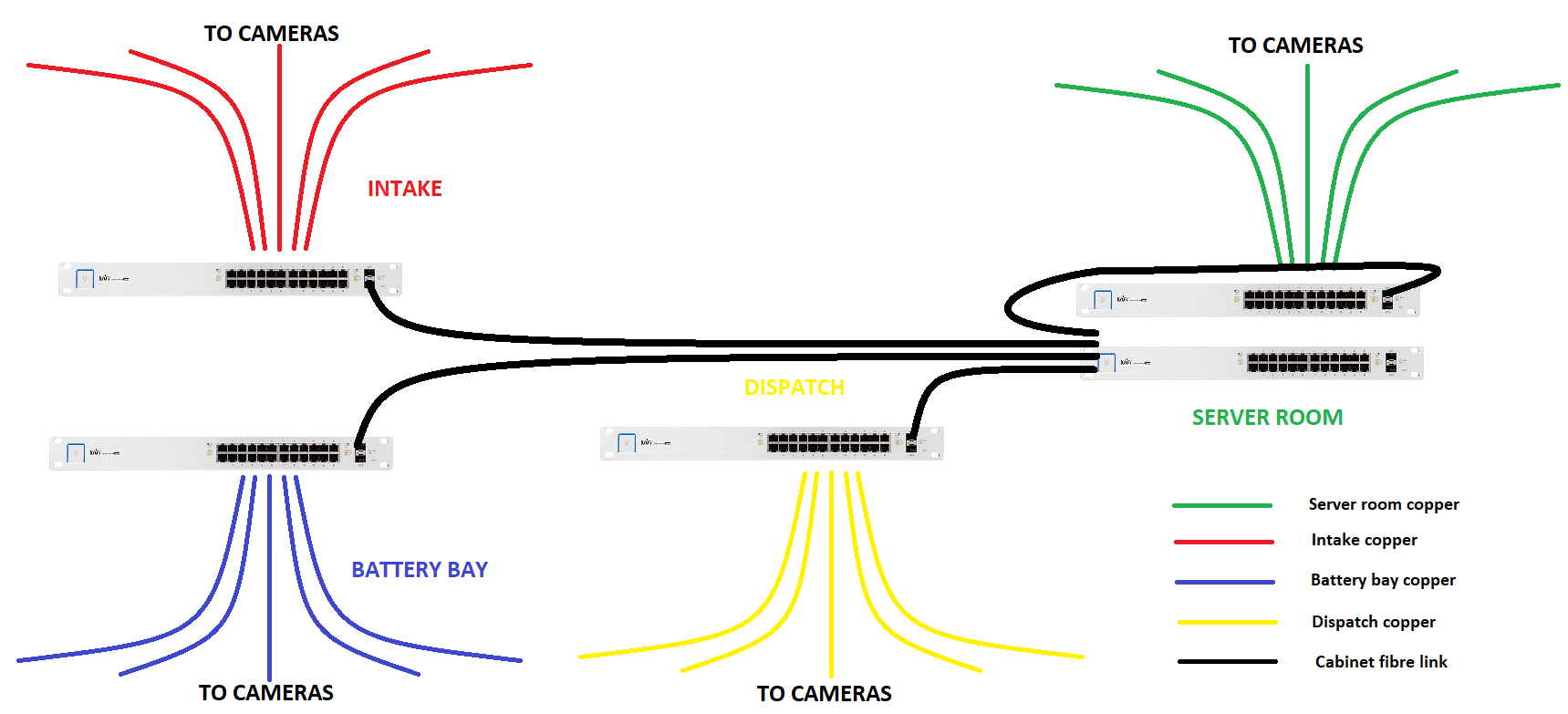
The design may include multiple cabinets, fibre links, PoE switches, UPS power, labelled patch panels, NVR storage planning, network segregation and documented camera allocation.
That is why large CCTV jobs should not be treated like a few cameras added to a building.
They require planning.
On projects such as ECS commercial CCTV, camera infrastructure, cabinet planning and network design mattered because the system had to operate at scale.
The goal is a system that answers questions
Good operational CCTV does not only show that something moved.
It helps the business understand what happened.
That means camera views, storage, naming, access control, playback, export and handover all have to work together.
For Durban and KZN businesses, DG Technologies designs CCTV with that end point in mind: when a manager opens the system after an incident or dispute, the footage should help answer the question.