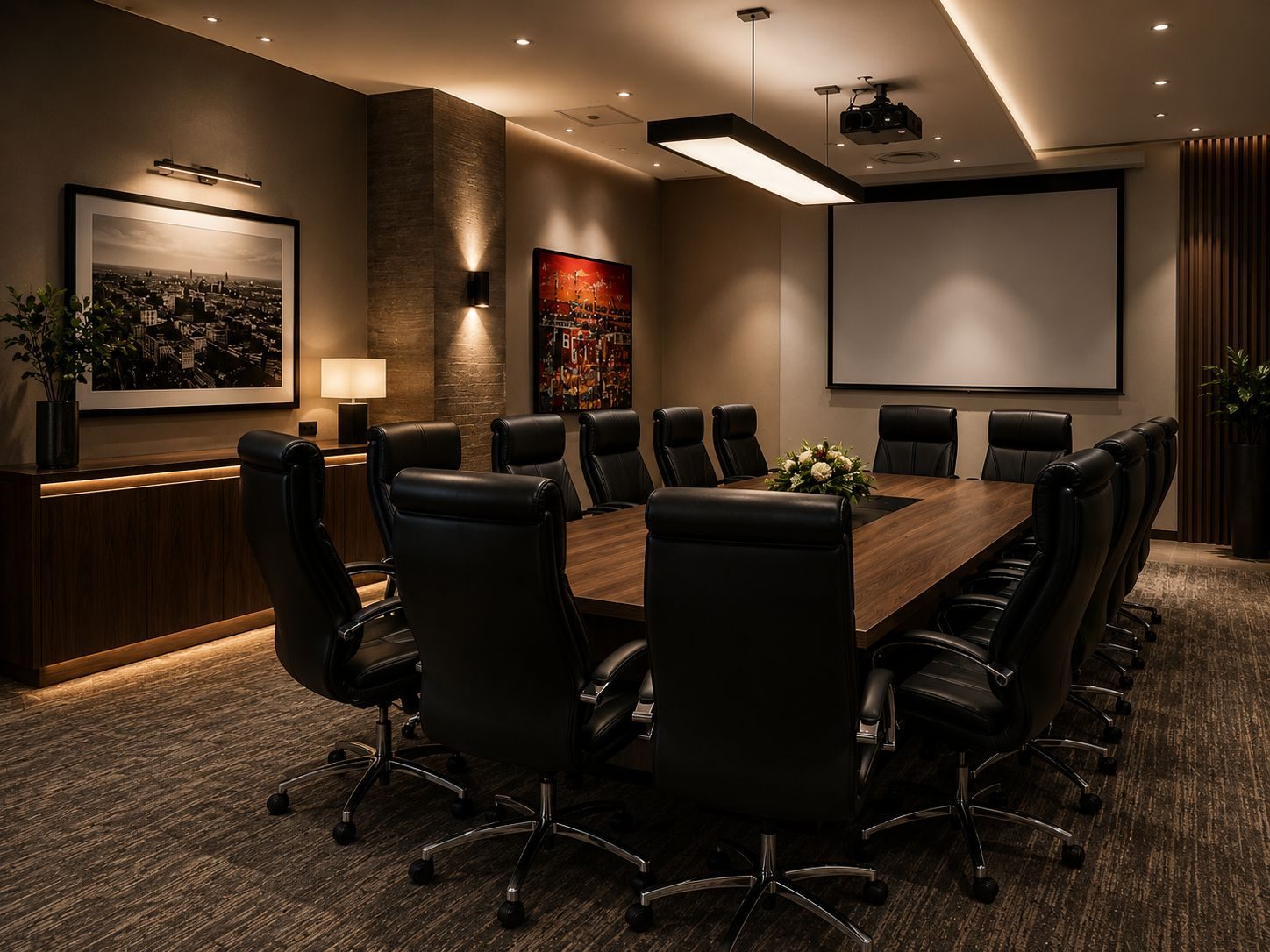
People usually notice the screen first.
Then the camera.
Then the touch panel.
But in a boardroom, the meeting usually succeeds or fails on the microphones.
If remote participants cannot hear the people at the table clearly, the system has failed. It does not matter how impressive the display is. It does not matter how sharp the camera is. It does not matter how expensive the table looks.
The room has become tiring to use.
That is why microphone strategy sits near the centre of proper boardroom AV installation.
Audio fails faster than video
People will tolerate average video for a while.
They will not tolerate unclear speech.
Poor boardroom audio creates very specific problems:
- the person at the far end of the table disappears
- people sound distant or hollow
- air-conditioning noise becomes part of the call
- the room echoes
- people talk over each other
- the far end hears keyboard taps and table noise
- the camera tracking struggles because speech pickup is unclear
Many clients describe this as a Teams or Zoom problem.
Often it is not.
It is a room audio problem.
Microphone distance is not negotiable
A microphone cannot ignore physics.
If the microphone is too far from the person speaking, the room becomes part of the sound. Reflections, glass, hard floors, high ceilings, air conditioning and table noise all become more obvious.
That is why a small huddle room can sometimes work with an all-in-one bar, while a formal boardroom may need table microphones, ceiling microphones, microphone pods, distributed speakers or a proper audio processor.
The correct answer depends on:
- table length
- seating positions
- ceiling height
- room finishes
- how many people speak
- whether people present from the front
- whether the room must look uncluttered
- whether the system needs to support intelligent camera switching
Table microphones are not automatically wrong
Some clients and designers do not like table microphones because they are visible.
That concern is valid.
But visible does not automatically mean worse. In some rooms, table microphones are the most reliable way to get speech pickup close to the people speaking. This can be especially true where ceilings are high, rooms are reflective or the table is very long.
The question is not whether table microphones look technical.
The question is whether the room can hear people properly.
Ceiling microphones are not automatically better
Ceiling microphones can be beautifully discreet.
They can also be wrong if the ceiling is too high, too noisy, too reflective or poorly positioned.
This is why ceiling microphone planning should happen early. The AV team needs to know where people sit, where speakers go, where air-conditioning grilles are positioned, where lighting tracks run and whether ceiling access will remain possible.
Moving a ceiling microphone after the boardroom is finished is not a small change.
Speakers are part of microphone design
Boardroom audio is not only about pickup.
The far-end voice must come back into the room clearly without creating echo or feedback. Speaker position, volume, coverage and echo cancellation all affect the result.
If the speakers are all at the display wall, people at the back may struggle. If the speakers are too loud, microphones may pick them up. If ceiling speakers are badly spaced, speech can become uneven or tiring.
The microphone and speaker design should be planned together.
Intelligent video needs good audio
This becomes even more important with intelligent video.
Systems such as Crestron Automate VX use microphone information as part of the camera-switching logic. If the room cannot reliably determine where speech is coming from, the video experience suffers.
That is why we do not treat intelligent video as only a camera discussion.
The camera strategy, microphone strategy and room layout must agree with each other.
For more on the camera side, read why one camera is not enough for a serious boardroom.
DM NAX-style audio thinking is interesting
Crestron’s DM NAX Intelligent Audio platform is interesting because it treats boardroom audio as part of a networked collaboration system rather than a random speakerphone added to the table.
The useful principle is not only the product name.
The useful principle is that the microphone, speaker, USB audio path, echo cancellation, room processor and conferencing platform should be designed as one system.
That is the difference between a boardroom that looks like it has AV and a boardroom that actually works.
What DG Technologies looks for
Before recommending a microphone strategy, we want to understand:
- where people sit
- how many people use the room
- whether the room is mostly internal, client-facing or hybrid
- whether the table is fixed
- whether the ceiling is accessible
- whether visible table devices are acceptable
- whether remote participants need speaker tracking
- whether the room is noisy or reflective
- whether Teams, Zoom or BYOD is the main workflow
That is the level of thinking a boardroom quote should include.
The standard
A good boardroom microphone system should not make people think about microphones.
People should speak normally. Remote participants should hear clearly. The far end of the table should not disappear. The room should not echo. The system should not require someone to lean toward a device like an old conference phone.
When the audio works, the meeting feels calm.
That is the point.