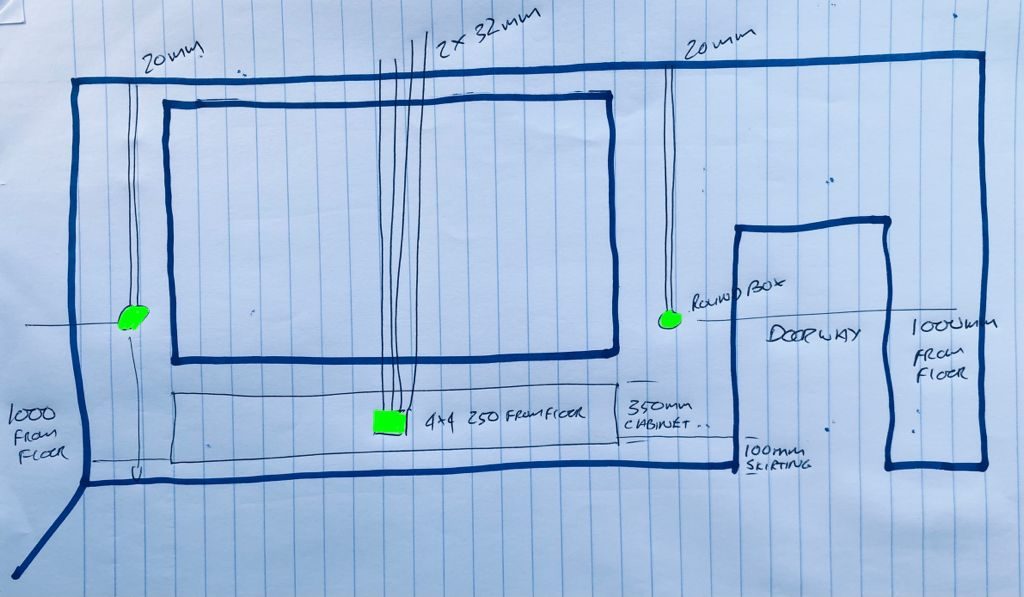
In a new build, spare conduit and data routes often matter more than spare gadgets.
That may sound strange because gadgets are the part everyone sees.
But gadgets change. Routes are built into the house.
A spare access point on a shelf does not help if there is no cable route to the weak Wi-Fi area. A better camera does not help if there is no route to the gate. A new video source does not help if the TV conduit cannot accept the cable. A future intercom upgrade becomes harder if the driveway route was never allowed for.
The spare route is what keeps the option alive.
The route is cheaper while the house is open
During construction, a conduit route is planning.
After construction, the same route can become damage.
That is the practical reason spare conduit matters. It gives the home options before walls, ceilings, paving, gardens and joinery make those options expensive.
The spare route does not need to be excessive.
It needs to be intelligent.
Put it where future work would be hard: TV walls, gates, driveways, outbuildings, roof spaces, access point positions, camera positions, fibre entry and equipment rooms.
Spare data should have a purpose
I do not like mystery cables.
If a spare data cable is installed, it should be labelled, documented and reserved for a likely future use.
That might be:
- future access point;
- future TV network point;
- future CCTV camera;
- future intercom;
- future solar/inverter monitoring;
- future outdoor audio controller;
- future office or study equipment;
- future outbuilding link.
Without labels and documentation, spare data can easily be used casually during construction and lost before the client ever needs it.
That is why spare data cables must be reserved and documented.
TV points need spare thinking
TV technology changes constantly.
The client may start with a simple local decoder or streaming device. Later, the room may need centralised video, a soundbar, a gaming device, a control processor, a camera feed, eARC, network control or a different display.
If the TV wall has a generous route back to the correct location, the room can adapt.
If it has a tight pipe, bad bends or no access, the upgrade becomes messy.
See TV points in a new build: what teams must agree on.
Gates and driveways deserve future routes
Driveways are expensive to revisit.
If there is any chance the property may later need another gate camera, intercom change, access reader, keypad, beam, network device or lighting-control route, it is worth considering spare conduit before the driveway is finished.
This does not mean turning every site into a cable farm.
It means identifying the places where future digging would be frustrating, visible or expensive.
That is why intercom and access control planning for new homes should happen early.
Outbuildings change the calculation
Cottages, garages, gatehouses, pool houses, offices and entertainment rooms often become technology problem areas because nobody allowed for them properly.
They may need Wi-Fi, CCTV, audio, TV, access control or intercom coverage.
If an outbuilding is part of the project, the route to that outbuilding should be planned as part of the main technology design.
Sometimes that means copper. Sometimes it means fibre between buildings. Sometimes it means a sub-cabinet.
The answer depends on distance, lightning exposure, cable route, equipment load and future support.
Spares must still be accessible
A spare conduit that disappears behind finished joinery with no draw access is not very useful.
Draw boxes, access panels, speaker holes, cabinet entries and reachable ceiling spaces all matter. Future-proofing is not only the pipe. It is the ability to use the pipe later.
That is why draw boxes must remain accessible after ceilings close.
Buy the route before the device
If the budget is tight, I would usually rather protect the difficult route than buy a device that can be added later.
That is the cleanest way to future-proof without overspending.
The route protects the building.
The device creates the feature.
Both matter, but they do not have to happen at the same time.
DG Technologies can help identify which spare conduits and data routes are worth keeping in a new-build technology plan, and which ones are unnecessary.
The goal is not to cable everything blindly.
The goal is to keep the right future options open.
Related reading: