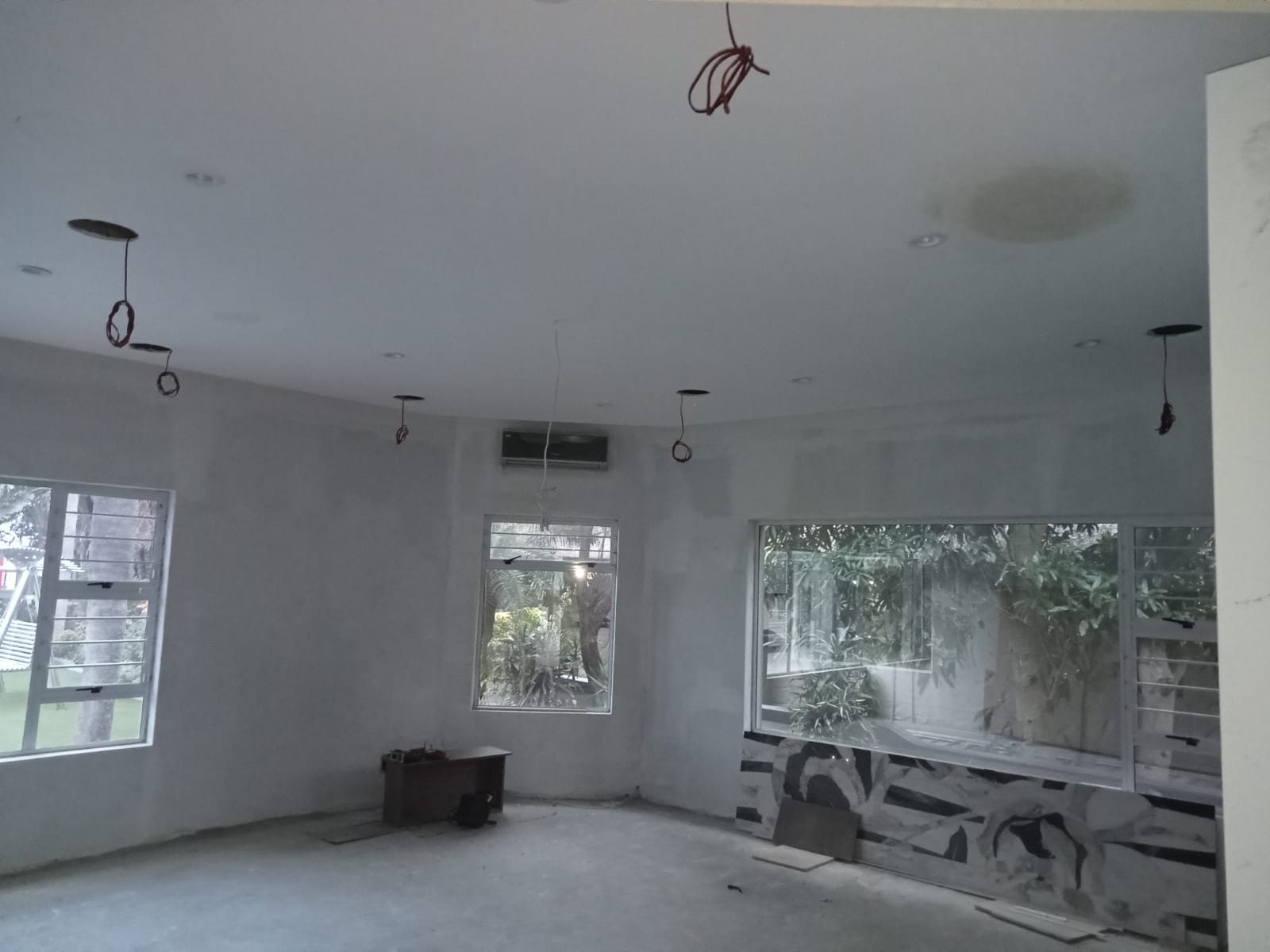
One Mount Edgecombe new build taught me something I still repeat to clients and builders: the best time to solve an AV problem is usually before the room looks like an AV room.
The brief was not simply to put speakers in a few ceilings. The house needed distributed audio, several television and DStv positions, a cinema room and a sensible way to bring sources into the rooms where they would be used. That meant the technology had to be discussed while the building could still accommodate conduit, cable routes, speaker positions and equipment access.
Start with how the home will be used
I planned the audio around four zones: the bar, veranda, study and main bedroom, with a smaller sub-zone for the main bathroom. The source discussion included mobile devices, radio, disc media and one of the decoders.
That detail matters because a room list does not automatically tell me how many independent audio zones the home needs. Spaces that are used together may sensibly share a source or amplifier channel. A bedroom suite or outdoor area may need different control. The design should follow the way the family uses the house, not just the number of rooms on the drawing.
The project also included a cinema room. That made the signal and equipment planning broader than a background-music installation. The cinema, distributed audio and television positions had to be considered as one residential AV layer, with clear routes and a place for the equipment to live.
For a deeper explanation of that approach, see our Mount Edgecombe multiroom audio and AV service.
Conduit is not a detail to leave for later
During the build I followed up on the conduit because the route had to be right before it disappeared into the construction. Once a ceiling, wall or slab is closed, a missed low-voltage route is no longer a small change. It can become visible surface work, a compromised speaker position or a decision to remove a feature altogether.
I want the AV plan discussed with the builder, electrician and other relevant trades while they can still coordinate it. That includes speaker cables, television and DStv routes, HDMI or structured cabling, equipment positions, power, cabinet access and the room details that affect the final finish.
The same principle applies to Wi-Fi and automation. A new home may eventually depend on the network for streaming, control, CCTV and remote support, so the Mount Edgecombe Wi-Fi and networking service belongs in the same conversation.
A real ceiling conflict changed the speaker position
The veranda provided a useful reminder that drawings and site conditions have to meet in the real room. My installer was cutting the speaker openings when we found an aluminium join running directly along the intended centre line. The ceiling team did not want that supporting join cut.
We moved the speakers slightly towards the garden and checked the revised positions with the client. It was a small adjustment, but it protected the ceiling construction and avoided forcing the project into a larger repair later.
This is why I do not treat a speaker as a mark on a plan. Its position has to work with ceiling joins, downlights, air-conditioning, beams, bulkheads, furniture and the visual balance of the room. The audio-zone planning guide covers the wider planning method; this project is the practical reason behind it.
Reuse can be the right engineering decision
The first proposal did not automatically mean replacing every existing component. In the final design discussion, I recommended using the client’s existing receiver with the new speaker and source arrangement. That was not a shortcut. It was a capability decision: the receiver remained suitable for the requested system, while its limitations were recorded and dealt with separately.
Later work on the property involved a more capable Russound arrangement, additional high-definition distribution and a professional vented AV cabinet with network panels, patching, cable management and infrared control. The system therefore developed as the home’s needs developed rather than being treated as a one-time equipment sale.
That is still how I approach an established or new-build home. I assess what is useful, what is limiting the result and what needs to be made serviceable. Our guide to when an existing amplifier is worth keeping explains that decision in more detail.
Plan the head-end and the future support path
Television distribution is easy to describe as a number of screens, but each screen still needs a source path, cable route, termination, control method and access to the equipment that serves it. The original planning for this home included five high-definition television positions, with some local and some longer runs.
That is the point at which the equipment location becomes important. A central, ventilated cabinet can keep the room clean, but only if the cable routes, patching, power and infrared control are planned properly. It also gives the next technician a chance of understanding and servicing the system without dismantling a finished room.
For new homes, I want the project team to record the routes, label the terminations and photograph the work before the finishes close. It is a modest investment compared with trying to reconstruct a hidden system years later.
The lesson I carried forward
This was a residential new build, but the lesson applies to every serious technology project in Mount Edgecombe: the visible equipment is only the last part of the work.
The useful decisions happen earlier. They are the audio zones that reflect real life, the conduit that remains usable, the speaker position that respects the ceiling, the receiver that is retained because it still makes sense, and the cabinet that leaves a supportable route into the future.
DG Technologies plans multiroom audio, television and DStv distribution, networking, cinema and automation as connected parts of the home. If you are still at the drawings or first-fix stage in Mount Edgecombe, that is the right time to involve the technology team.
See the Mount Edgecombe Estate technology and infrastructure record for the wider local context, or contact DG Technologies to discuss the technology plan for a new build.