The bigger the home, the more dangerous it becomes to treat every technology system as a separate job.
One company supplies the Wi-Fi. Another installs the CCTV. Someone else does DStv. The electrician runs a few cables. A security company handles the gate. An AV installer mounts the TVs. A cinema company arrives later. The fibre provider leaves a router wherever it was easiest. Then a home automation company is asked to make everything feel simple.
That approach can work in a small, simple house.
In a large home, it creates gaps.
The client does not experience the house as separate trades. They press a button, open an app, call the gate, play music, watch a camera, join the Wi-Fi, turn on a TV or change a lighting scene. To them, the technology either works or it does not.
That is why serious homes need a technology integrator, not only separate installers.
The systems are connected whether the trades are connected or not
Wi-Fi, CCTV, access control, audio, TV distribution, DStv, intercoms, lighting control and automation all depend on shared infrastructure.
They need network points, IP addresses, PoE, power protection, cabinet space, conduit, cable routes, labels, firmware, rack ventilation and remote support access.
If every installer only looks after their own piece, nobody owns the full picture.
That is where problems start.
A CCTV camera may technically be installed correctly, but it depends on the network switch. The network switch depends on the router. The router may have been replaced by the fibre provider. The automation processor may depend on fixed IP addresses. The audio system may depend on streaming services and network discovery. The gate intercom may depend on the same Wi-Fi or network backbone the client uses every day.
When something fails, the question becomes: who is responsible?
In a proper system, that question should already be answered.
One rack, one network, one technology plan
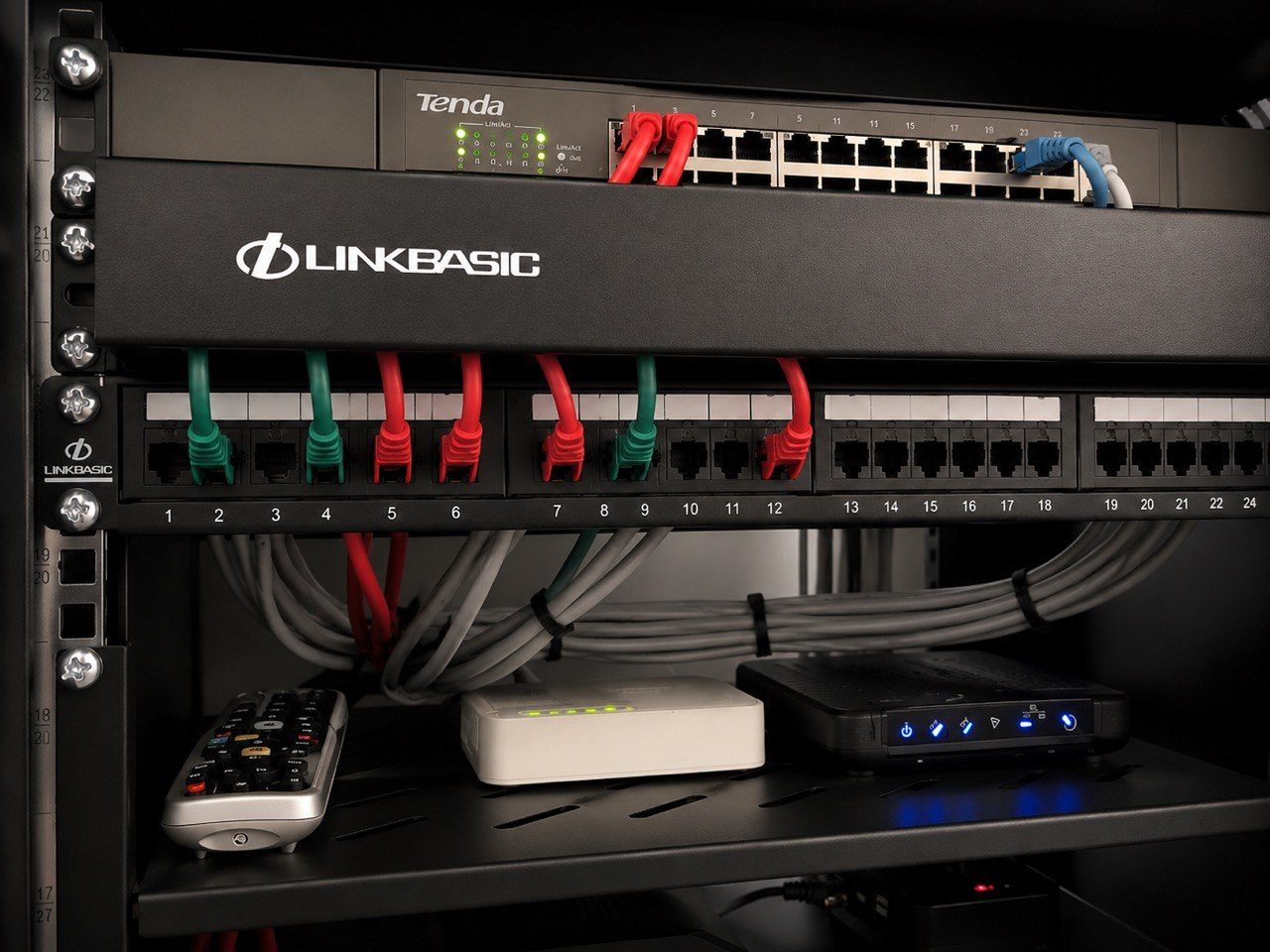
The rack is where separate decisions either become organised or become chaos.
In a large home, the rack or head-end may contain:
- fibre equipment;
- router and firewall;
- network switches;
- Wi-Fi controller;
- patch panels;
- CCTV recorder;
- automation processor;
- audio amplifiers;
- video distribution;
- DStv equipment;
- UPS or online power protection;
- service loops and labelled cables.
If the network installer, CCTV installer, AV installer and automation installer all treat that rack as their own temporary workspace, it eventually becomes difficult to support.
DG Technologies prefers to treat the rack as a single technology environment. Cables should be labelled. IP reservations should be managed. Power should be considered. Equipment should be reachable. Heat should be allowed for. Future changes should not require guessing which cable belongs to which room.
This is not about making the rack look pretty for a photograph.
It is about making the system serviceable five years later.
For the physical planning side, see our smart-home equipment room and rack space guide.
Router and IP management cannot be casual
I have seen this problem many times.
A client calls because the radio will not turn on, a touch panel is not finding a source, cameras are missing, or an app is not seeing the system properly. Then we arrive and find that the fibre provider or IT person replaced the router and all the IP reservations disappeared.
The hardware did not fail.
The system lost its map.
In a basic home, that may be irritating. In a large integrated home, it can break audio, CCTV, remote access, control processors, network devices and support workflows.
That is why the person responsible for the technology system should understand and manage the network properly. A large home is not just a few phones and laptops. It can easily become a small commercial-grade network with dozens or hundreds of connected devices.
We explain this in more detail in what is a router doing on my home automation quote.
Separate installers create separate handovers
Another issue is handover.
Each installer may hand over their own system:
- the CCTV app;
- the Wi-Fi password;
- the alarm or gate app;
- the DStv remotes;
- the audio app;
- the lighting keypad;
- the cinema remote;
- the automation touch panel.
On paper, every system has been handed over.
In real life, the family still has to work out how the house behaves as one home.
Who should have access to the CCTV app? Which Wi-Fi network do guests use? Which remote controls the guest bedrooms? What happens when the house manager needs to report a fault? Which rack equipment may be rebooted and which should not be touched? Who knows the passwords? Who has the backup documentation?
These are not small details. They decide whether the home feels simple after everyone has left site.
That is why we have written about smart-home handover and house manager technology checklists.
The electrician is important, but the electrician cannot own the whole experience
A good electrician is critical on a large project.
But electrical work and technology integration are not the same discipline.
The electrician is usually thinking about power, lighting circuits, switching, DBs, compliance and general wiring. The technology integrator must think about how the systems communicate, how the client uses the rooms, which cables must be replaceable, where equipment is serviced, how IP devices are managed, how audio zones behave, how camera views are used, and how the whole system is supported after handover.
The best projects happen when the electrician and technology integrator coordinate early.
They should not be working against each other. They should be solving different parts of the same home.
For project teams, our builder and architect planning page exists to make that coordination easier.
Interior design also affects the technology
The interior designer is often protecting the feel of the house.
That matters.
Nobody wants a beautiful home full of visible boxes, messy cabling, badly placed speakers, awkward access points, exposed remotes or hot equipment hidden in a sealed cabinet.
But clean design still needs service access.
A Wi-Fi access point can often be hidden. A speaker opening can sometimes become a useful access point. A TV cabinet can look clean and still be ventilated. A keypad can sit neatly in a wall finish if the position is agreed early. A rack can be discreet without becoming impossible to work on.
That only happens when the technology integrator is part of the design conversation before the finishes are locked in.
Related reading: speaker, TV and access point planning for clean interior design.
The client should not become the project manager for every technology gap
When separate installers do not coordinate, the client often becomes the person stuck between them.
The CCTV company says it is a network issue. The network person says the camera is faulty. The AV installer says the router changed. The fibre provider says the internet is working. The automation company says the IP address moved. The electrician says the cable was installed where it was shown.
The client did not build a luxury home to referee technology trades.
On a large home, one company should be responsible for the technology layer as a whole, even when specialist equipment or outside services are involved.
That does not mean one company physically manufactures every product or performs every possible trade. It means one accountable team understands the design, documentation, network, rack, cabling, control logic, handover and support implications.
That is the difference between buying installations and building a system.
A technology integrator can also save money
Using one technology integrator is not automatically more expensive.
Often, it prevents wasted spending.
If nobody understands how the rooms will actually be used, a home can end up with too many dimmers, too many audio zones, duplicated network equipment, unnecessary local source devices, poor cable routes, undersized conduits or expensive rework after finishes are complete.
An experienced integrator should be able to say:
- this room needs premium control;
- this room only needs simple switching;
- these two audio zones can sensibly play together;
- this existing amplifier can still be used;
- this TV needs a better route;
- this rack needs more depth;
- this access point should move now, before the ceiling closes;
- this camera view will not help you later;
- this cable should be replaced now because it will be painful later.
That judgement is where the saving often sits.
Our article on where to save money on a smart-home quote explains this philosophy more directly.
The best time to appoint the integrator is before first fix
If the home is already finished, DG Technologies can still help.
We often repair, tidy, document, upgrade and rescue systems that were installed by others. But the cleanest result is always achieved when the technology plan is created before walls, ceilings, joinery, paving and landscaping make every decision harder.
Before first fix, the technology integrator can coordinate:
- Wi-Fi access point positions;
- CCTV and gate routes;
- TV conduits and source locations;
- fibre and DStv entry paths;
- audio zones and speaker positions;
- lighting-control requirements;
- rack space and ventilation;
- UPS and protected power;
- documentation and future service access.
That is the reason our new luxury home technology checklist exists.
Large homes need fewer assumptions
The larger the home, the less room there is for casual assumptions.
The system must be designed around the building, the family, the staff, the guests, the network, the power environment, the finishes and the way the home will be supported for years.
Separate installers can each do good work and still leave the client with a fragmented result.
A technology integrator’s job is to make the whole thing behave like one home.
For new builds and major renovations in Durban, Umhlanga, Ballito, Zimbali, Simbithi, Mount Edgecombe and the wider KZN region, DG Technologies can review the plans before first fix and coordinate the complete low-voltage technology layer: home automation, networking, CCTV, access control, DStv distribution, multi-room audio, cinema rooms and lighting control.