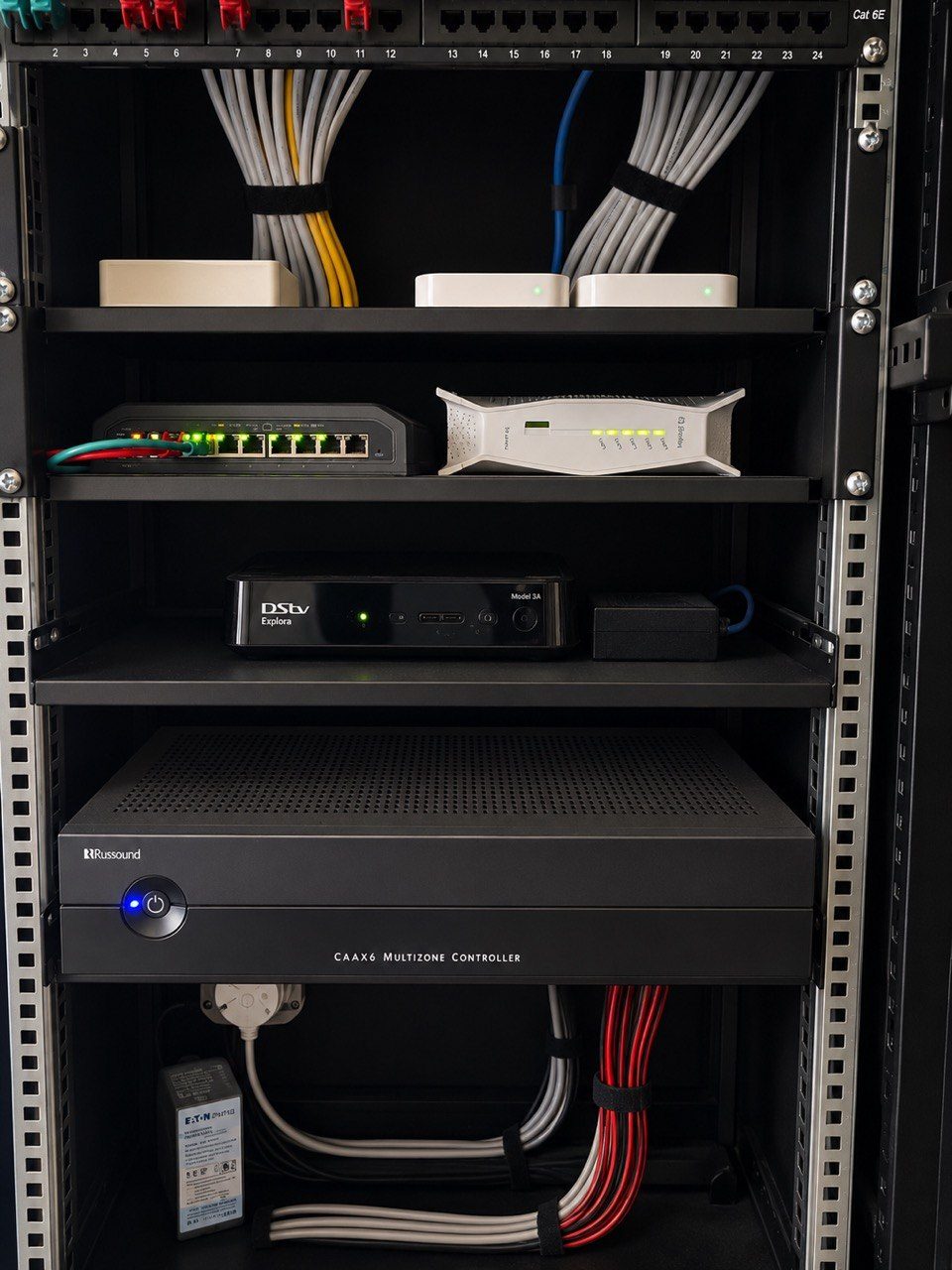
The equipment rack is often treated as the hidden part of a smart home.
That is understandable. The client sees the touch panels, app, speakers, cameras, lighting scenes and finished rooms. The rack sits behind a door, in a cupboard, in a plant room or in a service area.
But hidden does not mean unimportant.
In many premium homes, the rack is the technical centre of the property. It may contain network switches, routers, fibre equipment, CCTV recorders, audio equipment, control processors, power supplies, HDMI distribution, streaming devices, amplifiers and backup equipment.
If that space is badly designed, the rest of the home eventually feels it.
Heat is not a small issue
Electronics create heat.
Amplifiers create heat. Network switches create heat. Recorders create heat. Power supplies create heat. Processors create heat. Put enough equipment into a small closed cupboard and the temperature can climb quickly.
Heat is not always dramatic. It may not cause an immediate failure. Instead, it slowly creates instability: devices restart, fans work harder, hard drives age faster, network equipment becomes unreliable, audio equipment shuts down, and support issues become intermittent.
Intermittent faults are some of the most frustrating faults to diagnose because the system may behave perfectly while someone is watching it.
Then it fails later.
A neat rack still needs airflow
A rack can look neat and still be wrong.
Cable management is important. Labelling is important. Clean patching is important. But airflow matters just as much. Equipment should not be packed into a space that traps heat without intake, exhaust or sensible spacing.
Good rack planning asks:
- Where does cool air enter?
- Where does warm air leave?
- Is the rack in a cupboard with a closed door?
- Does the cupboard need ventilation?
- Are amplifiers stacked too tightly?
- Can fans move air without becoming noisy?
- Can equipment be serviced without pulling the whole rack apart?
- Is there enough depth for cables and airflow?
These are practical questions, but they affect reliability directly.
Rack location should be planned early
Rack problems often start long before equipment is installed.
During construction, a rack may be left for later. A cupboard is chosen because it is convenient. The space looks big enough on a drawing, but nobody checks depth, heat, access, power or cable entry. By the time the AV team arrives, the home is finished and the technical centre has to fit into whatever space remains.
That is backwards.
The rack should be part of the early design discussion, especially on larger homes. It affects conduit routes, electrical requirements, ventilation, cabinetry, network topology and future service access.
We wrote about this broader planning issue in why builders need the AV team before electrical first fix.
Poor ventilation becomes a support problem
When a rack overheats, the client rarely says, “My rack ventilation is poor.”
They say the Wi-Fi is unstable, the cameras are slow, the music stopped, the app froze, or the system behaves strangely after a few hours.
That is why fault finding has to consider the physical environment, not only the software or equipment brand. A reliable home automation system depends on equipment operating within sensible conditions.
This links to why smart-home fault finding should start with the network. The network may be the visible technical layer, but the rack environment may be what keeps that network stable.
Service access matters too
Ventilation is not the only rack issue.
Access matters.
If equipment cannot be reached, support becomes slow and messy. If cables are too tight, tracing faults becomes difficult. If devices are hidden behind other devices, every small change becomes risky. If the rack has no working space, future upgrades become more invasive than they should be.
A professional rack should be designed for the person who may need to support it years later.
That is one of the reasons we believe smart-home racks should be designed for the next technician.
Luxury should not mean fragile
In a premium home, technology should feel calm and reliable.
That does not happen by accident.
It comes from practical engineering decisions that clients may never see: airflow, labelling, power planning, rack spacing, cable management, documentation and service access.
DG Technologies designs networking, multiroom audio, CCTV and smart-home systems with the rack treated as part of the product, not a leftover cupboard.
Because the hidden work is often what keeps the visible experience working.