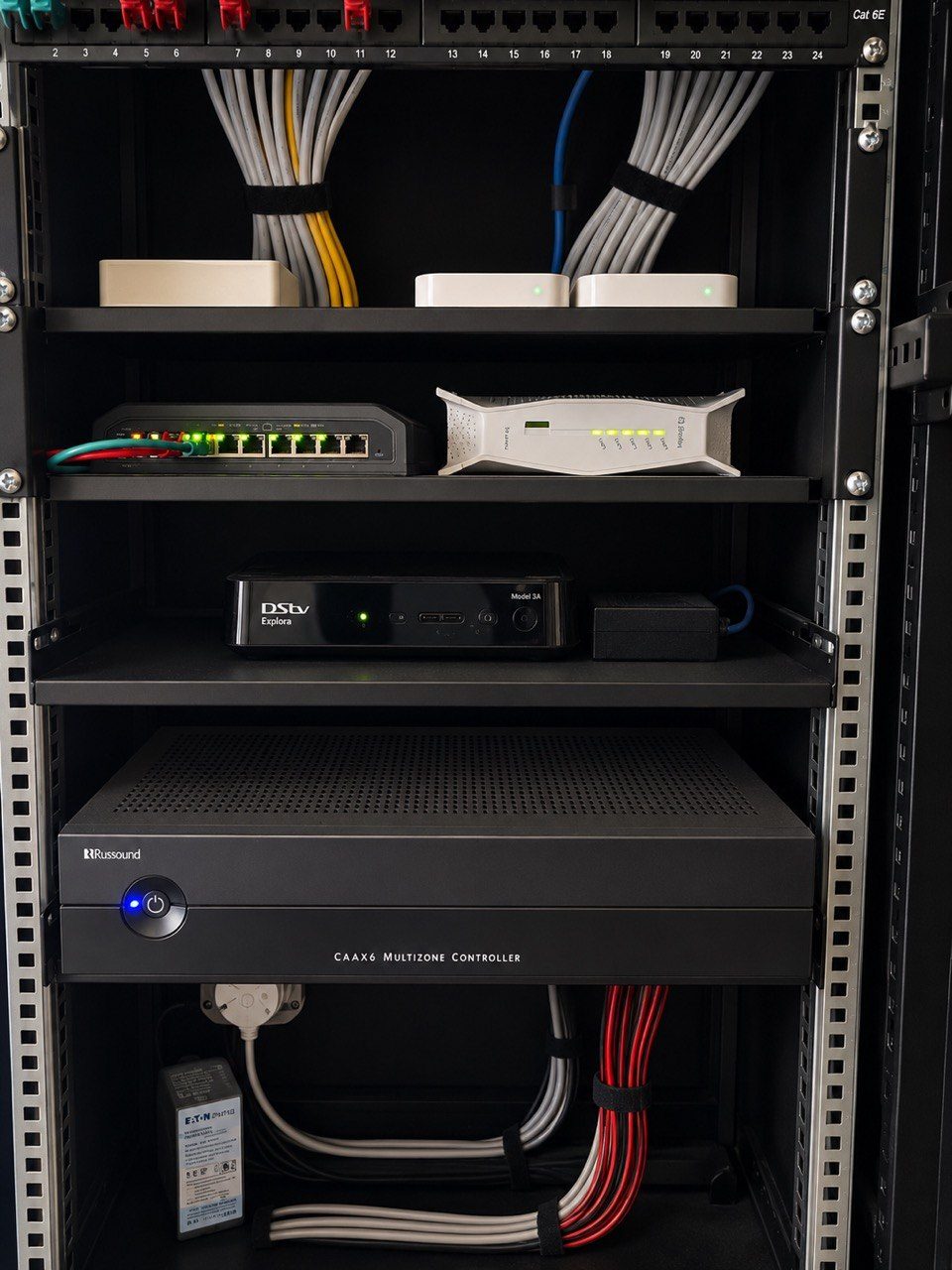
Most smart-home racks are hidden away.
They sit in a cupboard, garage, plant room, server room or passage cabinet. The homeowner may only see them when the internet drops, a decoder needs replacing, or someone asks where the Wi-Fi equipment lives. Architects and builders may see the rack space as a practical allowance on a plan, then move on to finishes, joinery, lighting details and site coordination.
But the rack is not a back-room detail. It is one of the clearest signs of how seriously the smart-home system was designed.
In a premium KZN home, the rack often holds the network, automation processor, CCTV recorder, fibre equipment, audio matrix, amplifiers, control interfaces, patch panels, UPS power and the equipment that connects the visible experience together. The touch panels, speakers, cameras, lights, gate controls and Wi-Fi access points all depend on what happens in that rack.
That is why a smart-home rack should not only be designed for the installer who builds it. It should be designed for the next technician.
The next technician is not an insult
Some installers take offence at the idea that someone else may one day work on their system. We see it differently.
Homes change. Owners sell. Children move into different rooms. Wi-Fi standards improve. CCTV requirements shift. Streaming devices are replaced. A builder opens a wall for a renovation. An architect extends a wing of the house. A lightning event damages a network switch. A client decides to add a cinema, a study, a cottage or a gym.
The next technician may be the same company returning years later. It may be a different team. It may even be a future member of the original team who has never seen that particular project before.
Good rack design respects that reality.
It says: here is the logic of the system, here is where each cable goes, here is how power is distributed, here is how heat is managed, here is where spare capacity exists, and here is what can be changed without taking the whole home apart.
That is professional pride. Not secrecy. Not complexity for its own sake. Not making a system dependent on one person’s memory.
Layout should explain the system
A rack layout should have an internal logic that someone can read.
Network equipment should be grouped sensibly. Patch panels should sit where short, clean patch leads can reach the switch. Audio equipment should have the space and ventilation it needs. Power should be accessible without burying plugs behind heavy equipment. Fibre equipment, routers, controllers, NVRs and control processors should not be scattered wherever there happened to be a gap on installation day.
Good layout reduces fault-finding time. If a camera is offline, the technician should be able to identify the recorder, network switch, patch panel port and field cable without pulling half the rack apart. If a bedroom touch panel has no network, the route should be traceable. If a source device is replaced, its HDMI, network and control connections should be obvious.
This matters to homeowners because support time is paid time. It matters to architects and builders because a well-planned rack needs enough wall space, depth, clearance, power, cooling and cable entry before finishes close. The rack cannot be treated as the place where every unresolved technology decision gets hidden.
For larger homes, the rack is part of the networking design, not an accessory to it. Wi-Fi, CCTV, automation and streaming all rely on the same backbone. If the rack is compromised, the whole technology experience becomes harder to support.
Cable labelling is a form of respect
Unlabelled cables are one of the fastest ways to turn a premium installation into guesswork.
A cable label should not be vague. “Bedroom” is not enough if the house has multiple bedroom outlets, an access point, a keypad, a TV point and a camera nearby. Labels should connect the rack to the drawings and the actual room or device. They should be durable, readable and applied consistently.
The same principle applies to patch panels. A patch panel gives structure to the system. Instead of field cables being punched straight into equipment or left loose in the cabinet, they terminate in a fixed, organised place. From there, short patch leads connect services to switches, routers, processors or recorders.
That makes the rack easier to service and safer to change.
If a TV point needs to move from one VLAN to another, or a camera needs to be isolated during testing, the technician can make a controlled change at the patch panel and switch. If an access point is upgraded later, the field cable remains protected. If a network switch is replaced, the fixed cabling does not have to be disturbed.
For DG Technologies, this is part of the difference between simply making something work and engineering something that can keep working.
Ventilation is not optional
Premium homes in Durban, Umhlanga, Ballito, Zimbali, Simbithi and Mount Edgecombe often have warm plant rooms, compact cupboards and coastal conditions that are not kind to electronics.
Racks generate heat. Amplifiers, switches, recorders, processors, UPS units and power supplies all add to the thermal load. If that heat cannot leave the space, equipment lifespan and reliability suffer.
Ventilation should be planned with the builder and architect early. Is the rack in a closed joinery cupboard? Is there fresh air? Is there an extraction path? Can the doors breathe? Will the room get afternoon sun? Is there enough clearance behind and above the rack? Can a technician reach the rear of equipment without dismantling joinery?
These questions may feel unglamorous during design meetings, but they are the questions that protect the system years later.
A beautiful cupboard that cooks the network switch is not a premium outcome. It is a maintenance problem waiting to happen.
Service access should be designed, not hoped for
Some racks look neat from the front but are almost impossible to service.
Equipment is packed too tightly. Heavy amplifiers block access to connectors. Cable bundles are tied so aggressively that nothing can move. Power supplies are hidden behind devices. There is no rear access, no sliding rails, no spare rack units and no sensible way to replace a failed component.
That kind of neatness is only visual. It is not good engineering.
A rack designed for the next technician allows normal work to happen without drama. Devices can be removed. Cables have service loops where appropriate. Patch leads can be replaced. Fans can be checked. UPS batteries can be serviced. Network switches can be upgraded. Spare ports and spare rack space are visible.
This is especially important in homes where the technology is expected to last through several phases. A homeowner may begin with Wi-Fi, CCTV and basic automation, then add distributed audio, lighting control, solar integration, gate intercom upgrades or a cinema later. The rack should make those future upgrades practical.
Drawings and documentation complete the rack
Even the best physical rack is incomplete without documentation.
Drawings, rack elevations, cable schedules, IP addressing records, device lists, login handover processes and commissioning notes all help the next technician understand the system faster. They also help the homeowner avoid being locked into confusion.
We have written separately about why smart-home documentation matters years later, because the issue reaches beyond the rack. Documentation is how the physical installation becomes a system that can be maintained, audited and improved.
For architects and builders, documentation also reduces ambiguity on site. Everyone can see where technology spaces are, what routes are needed, what equipment needs ventilation, and what should not be boxed in by joinery or finishes.
For homeowners, it provides confidence. If there is ever a support call, an upgrade or a sale of the property, the system is not a mystery.
The rack reveals the original thinking
We have also written about why the equipment rack reveals the quality of a smart home. This article takes that idea one step further.
The best rack is not only tidy. It is understandable.
It shows restraint. It shows that the installer thought about airflow, load, cable paths, service access, documentation and future change. It shows that products were not simply added until the quote looked impressive. It shows engineering judgement.
That matters because premium smart homes are not judged only by how they behave on handover day. They are judged by how they behave after years of use, after upgrades, after storms, after renovations, and after the original excitement has become normal daily living.
At DG Technologies, our approach is shaped by that long view. We prefer systems that can be explained. We prefer rack layouts that make sense to the next person. We prefer original thinking over copied equipment lists. We would rather ask a difficult design question early than leave a homeowner with a difficult support problem later.
That is also why we encourage clients and professional teams to understand what it is like working with DG Technologies before the project is too far down the road. The best results come when the rack, network, cabling, drawings and support model are considered as part of the architecture of the home, not as an afterthought.
A good rack is quiet proof of care
Most guests will never see the smart-home rack. They will notice the Wi-Fi works, the cameras record, the music plays, the lights respond, and the home feels simple to use.
The homeowner may rarely open the rack door.
But when something needs attention, the difference becomes obvious.
A rack designed for the next technician saves time. It reduces risk. It protects the original investment. It makes upgrades cleaner. It helps the homeowner avoid unnecessary replacement. It gives architects and builders a clearer framework for coordinating technology properly.
Above all, it reflects professional pride.
Not the kind that says, “only I can understand this.”
The kind that says, “any competent professional should be able to understand why this was done.”
That is the standard premium smart homes deserve.