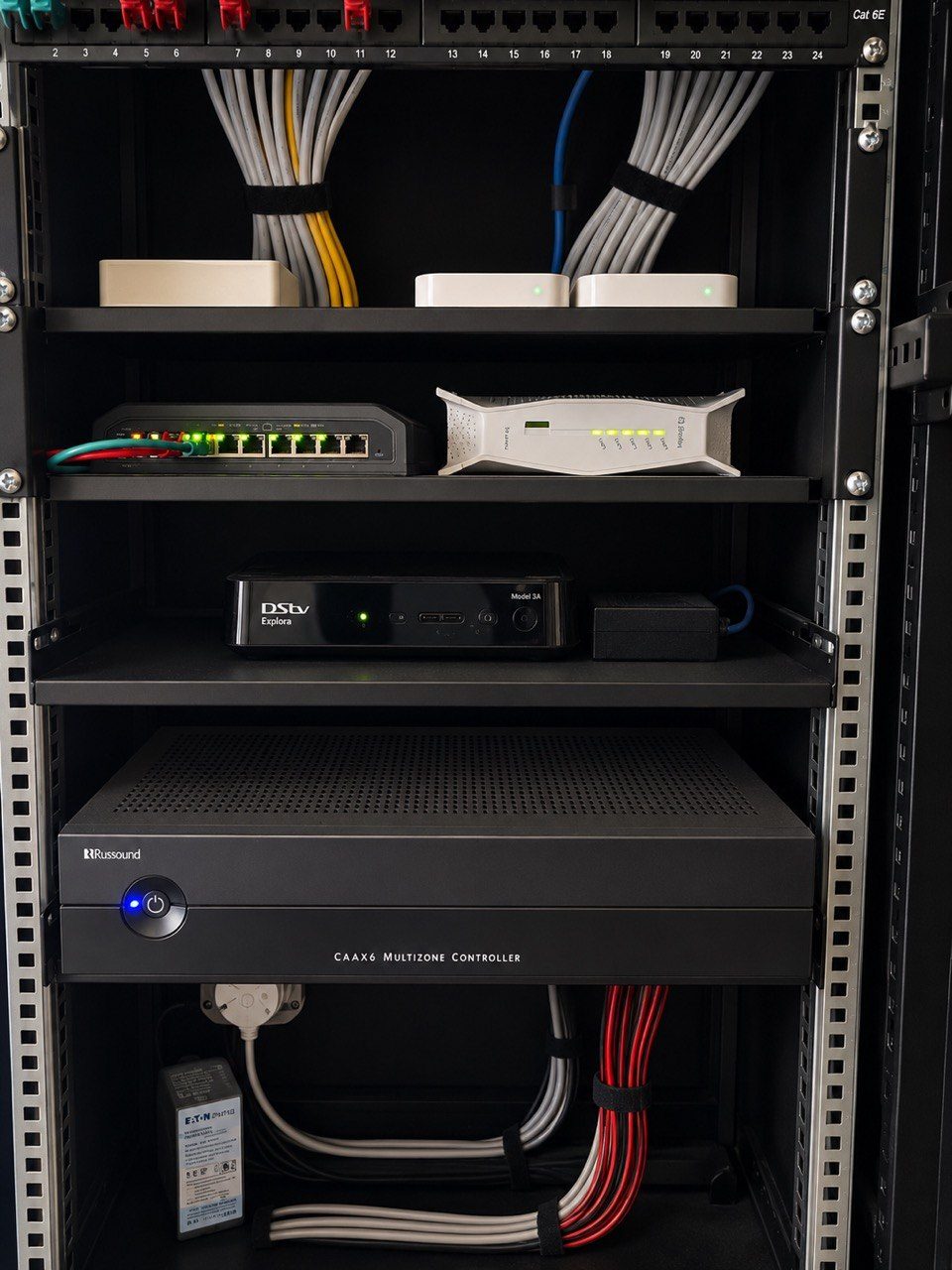
Most homeowners do not spend much time looking at the equipment rack.
They see the app. They see the keypads. They see the speakers, cameras, TVs, lights and touch panels. If the system is working properly, the rack may sit quietly in a cupboard, comms room or plant room and almost disappear from daily life.
But for anyone who understands smart homes, the rack says a lot.
It tells you whether the system was planned or improvised. It tells you whether the installer was thinking about future support. It tells you whether the network is treated as the backbone of the home or as an afterthought. It tells you whether the client will be protected later when something needs to be changed, serviced or upgraded.
At DG Technologies, we often learn more from opening the rack than from looking at the visible controls.
A smart home may look impressive from the lounge, but the rack shows how it was really built.
The rack is where separate systems become one system
A modern premium home is not made up of one technology product.
It may include Crestron Home and lighting control, multiroom audio, CCTV, Wi-Fi, access control, cinema, gate control, streaming devices, network switches, routers, UPS power, audio amplifiers and recording equipment.
To the client, these should feel simple.
Behind the scenes, they all need somewhere to meet.
That place is usually the equipment rack or head-end.
When the rack is designed properly, the system has structure. Power is considered. Heat is considered. Cable routing is considered. Network ports are considered. Service access is considered. Labelling is considered. Future expansion is considered.
When the rack is treated as a dumping place for equipment, the opposite happens. Devices get stacked wherever there is space. Power supplies hang loose. Network cables become impossible to trace. HDMI, audio, speaker, control and data cables cross each other without logic. No one knows which cable feeds which room.
That may still work on day one.
The problem comes later.
Mess is not only an aesthetic problem
A messy rack is not just ugly.
It can create real support problems.
If a camera drops offline, someone needs to trace it. If a touch panel fails, someone needs to check network, power and processor communication. If a TV source stops working, someone needs to understand the signal path. If a room has no audio, someone needs to identify the amplifier channel, speaker cable, input source and control logic.
When the rack is disorganised, every one of those tasks takes longer.
Longer fault-finding means more cost, more frustration and more disruption inside the home.
In some cases, messy work also hides deeper issues:
- Undersized or overloaded power supplies
- Poor ventilation around amplifiers and network equipment
- Unlabelled cables that cannot be traced
- Consumer network equipment used in a large home
- Temporary adapters that became permanent
- Old equipment left connected without a clear purpose
- No allowance for future additions
This is why we do not treat rack work as a cosmetic exercise.
Clean work is easier to understand. Easier to understand means easier to support.
The rack shows whether the installer thought about the next person
One of the strongest signs of professional work is whether the next technician can understand it.
That may be the original installer years later. It may be another technician. It may be an electrician checking a power issue. It may be a builder or project manager trying to understand what can and cannot be moved during renovations.
Good rack work leaves clues.
Labels. Drawings. Logical grouping. Sensible cable routes. Equipment mounted properly. Enough slack to service devices without pulling cables apart. Clear separation between network, power, speaker, control and AV cabling where practical.
Bad rack work often says the opposite.
It says the installer was trying to finish the day, not protect the client ten years from now.
That distinction matters.
We have written before about why smart-home documentation matters years later. The rack is part of that documentation. It is physical evidence of how the system is connected.
If the rack contradicts the drawings, the drawings lose value. If there are no drawings and the rack is unclear, the whole system becomes harder to support.
Good racks make future upgrades less painful
Homes change.
The client may add a cinema room. A new outdoor area may need audio. A CCTV system may need more cameras. Wi-Fi coverage may need to extend to a gatehouse, staff quarters or garden. A Crestron processor may need to be replaced. A fibre provider may change the router. A child’s bedroom may become a study.
These changes are normal.
A good rack makes them easier.
There should be a clear place for the network. There should be a way to identify spare ports. There should be enough physical space and ventilation for sensible expansion. There should be documentation showing what each important cable does.
This is one reason we like planning the rack early, not at the end of the project.
In construction, the visible finishes often get most of the attention. Cabinetry, stone, lighting fittings, flooring and interior details all matter. But if the technology is being built into the home, the rack and conduit planning matter too.
That is why the conduit plan is often the real smart-home plan.
If the cables do not arrive in the right place, with the right space and service access, the rack becomes a compromise before the equipment is even installed.
Heat, power and access are part of the design
Premium AV and automation equipment needs a proper environment.
Amplifiers generate heat. Network switches generate heat. Recorders, processors and power supplies need ventilation. UPS units need space and access. Some equipment needs to be reachable without dismantling half the cupboard.
This sounds basic, but it is often missed.
A beautifully designed cupboard can become a bad comms room if there is no airflow, no access and no practical way to service the equipment inside it.
That is why architects, interior designers, builders and automation specialists should speak early.
The goal is not to make the rack the focus of the home. The goal is to hide the technology properly without suffocating it or making it impossible to maintain.
Good design balances both.
The home must look right, but the system must also survive real use.
The rack can reveal when a system needs rescue
Many legacy smart-home problems start with a simple complaint.
The lights flicker. The app is unreliable. The music is inconsistent. Cameras drop off. The Wi-Fi is weak. The client has lost confidence in the system.
When we investigate, the rack often tells the story.
Sometimes the problem is old equipment that has genuinely reached the end of its life. Sometimes the equipment is still good, but the installation around it has become confused through years of changes. Sometimes different contractors have added to the system without understanding the original design. Sometimes the network was never strong enough for the size of the home.
This is where legacy Crestron and smart-home rescue work becomes less about replacing everything and more about understanding what exists.
We do not believe every older system should be stripped out automatically.
The rack helps us decide what can stay, what must be corrected and what is causing the real problem.
That decision can save the client a significant amount of money.
A good rack supports a calm home
The homeowner should not need to think about the rack every day.
That is the point.
But the fact that they do not see it does not make it unimportant.
The quietness of a good smart home is often created by things the client rarely looks at: cable routes, rack layout, network design, power, documentation and support planning.
When those details are handled properly, the visible experience feels simple. The app works. The keypads make sense. The cameras are available. The music plays. The cinema starts. The Wi-Fi holds. The system can be serviced without drama.
That is what good rack work contributes.
It is not there to impress visitors.
It is there to make the home dependable.
The hidden work is often the real work
In smart-home design, the most valuable work is not always the most visible.
A touch panel is visible. A lighting keypad is visible. A cinema screen is visible. A speaker grille may be visible.
But the decisions behind those items are what make the system succeed.
Where does the cable run? How is it labelled? What network switch supports it? What happens during a power failure? How will someone service it later? Is there space for expansion? Can the next technician understand it without phoning three people?
Those questions are not glamorous, but they are the questions that protect the client.
At DG Technologies, we see the rack as part of the finished product, even when it is hidden away.
Because a smart home that cannot be supported properly is not truly finished.
It is only temporarily working.