When a smart home starts behaving badly, the visible symptom is rarely the whole problem.
The app may be slow. Cameras may fail to load. Music may cut out. A touch panel may feel unresponsive. Lighting scenes may work one moment and not the next. The owner understandably describes the problem by what they see.
“The cameras are not working.”
“The audio is dropping.”
“The automation is unreliable.”
“The app is slow.”
Those statements are useful, but they are not always the root cause.
Very often, the first place to look is the network.
Modern smart homes depend on the network
Older AV systems could sometimes operate in isolation. A source connected to an amplifier. A remote controlled a device. A TV played from a decoder. The system may have been complicated, but not everything depended on IP communication.
Modern homes are different.
CCTV, control processors, touch panels, mobile apps, streaming services, Wi-Fi access points, switches, routers, intercoms and sometimes lighting control all depend on network reliability. If the network is weak, overloaded, poorly segmented, badly wired or unstable after power failures, the symptoms can appear anywhere.
That is why network infrastructure is not a background item.
It is the foundation.
A camera problem may not be a camera problem
If a CCTV app takes too long to load, the camera may be blamed.
But the issue could be upstream.
It could be weak Wi-Fi at the phone. It could be poor upload speed at the property. It could be a router struggling under load. It could be a switch issue. It could be a bad cable. It could be duplicate IP addressing. It could be power to a PoE switch. It could be a remote access configuration problem.
Replacing the camera without checking those items may not fix anything.
This is why DG Technologies approaches CCTV installation as part of the wider property system, especially in larger homes and estates. Cameras need good placement, but they also need a reliable path back to recording, remote viewing and support.
Audio and streaming are network systems too
Multiroom audio used to be mainly about amplifiers, speakers and source selection.
Those items still matter, but many homes now rely on streaming music services, mobile app control, networked players and Wi-Fi-connected devices. If the network is unstable, the audio system can feel unstable even when the amplifier and speakers are fine.
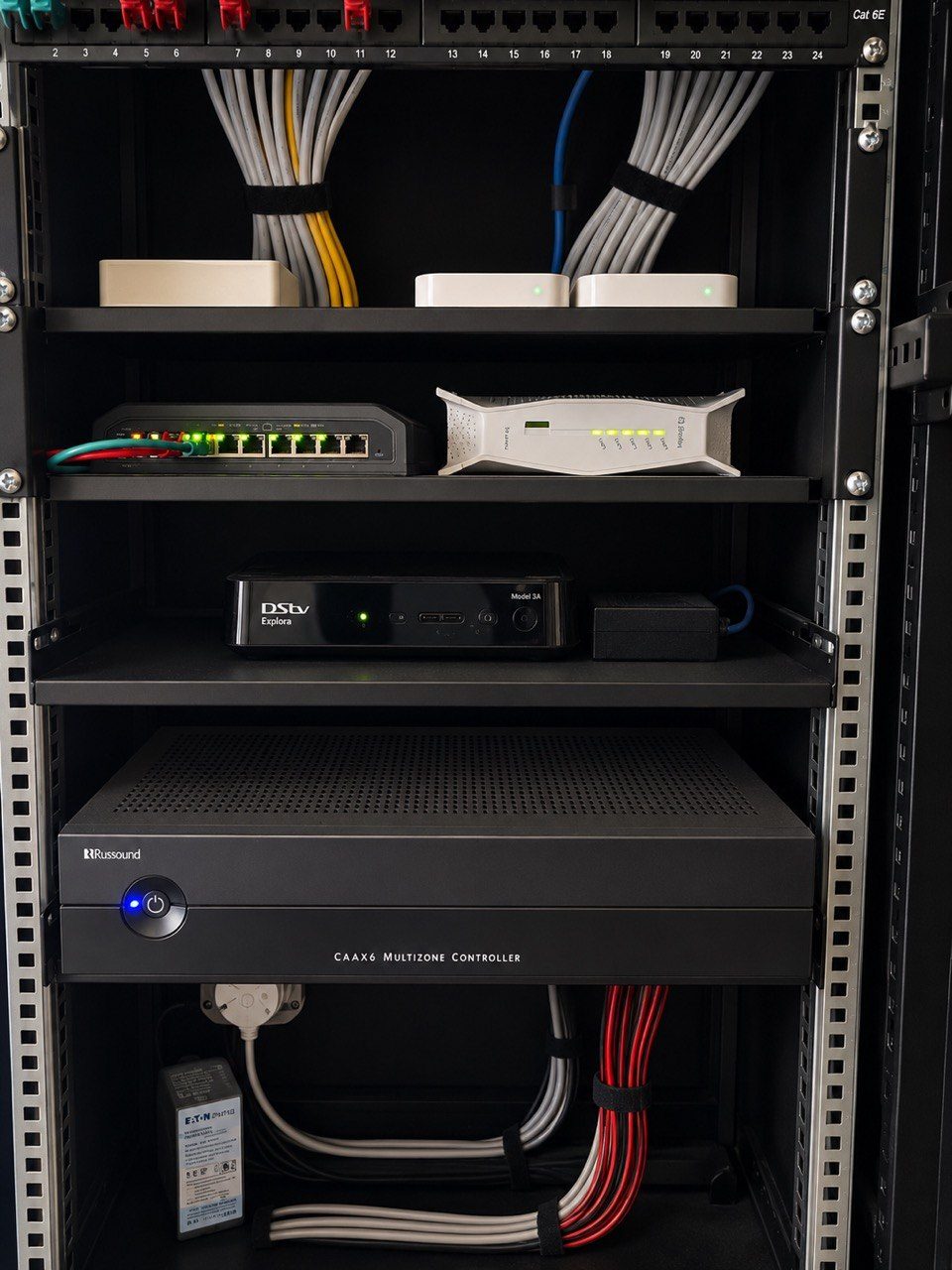
This is why we often look at switching, Wi-Fi coverage, device addressing, rack layout and power recovery when diagnosing audio problems.
A high-quality speaker system will still frustrate the client if the control path is unreliable.
Crestron Home needs a stable foundation
Crestron Home is a strong residential platform, but no control system performs well on poor infrastructure.
If touch panels, processors, mobile devices, lighting modules or network devices cannot communicate consistently, the user experience suffers. That does not mean the Crestron equipment is poor. It may mean the environment underneath it needs attention.
For this reason, a proper Crestron assessment should include the network and rack condition, not only the processor or programming.
Good fault finding asks:
- Is the network stable?
- Are the switches suitable?
- Are devices powered correctly?
- Are cables labelled and terminated properly?
- Is Wi-Fi coverage planned?
- Does the system recover cleanly after a power event?
- Is remote access configured responsibly?
Those questions prevent expensive guesswork.
Power interruptions expose weak design
In South Africa, a system that only works in perfect conditions is not good enough.
Power interruptions, inverter changeovers, router restarts and fibre outages can all expose weaknesses in a smart-home design. A system may work beautifully after a fresh restart, then become unreliable after several outages if the network devices do not recover in the correct order.
That is not a luxury problem.
It is a design problem.
Power, network and automation need to be considered together.
Good support starts by understanding the system
The temptation during a fault is to replace the most obvious item.
Sometimes that is correct.
But often the better first step is to understand how the system is connected. Where does the device get power? What switch does it connect to? What controls it? What depends on it? Has anything changed recently? Is the issue constant or intermittent? Does it happen after outages? Does it affect one room or the whole property?
That is why DG Technologies treats supportability and documentation as part of the installation, not extras.
The better the technical record, the faster the fault can be understood.
The network is not glamorous, but it matters
Clients rarely ask for a beautiful switch configuration.
They ask for the home to work.
They want cameras that load, music that plays, lights that respond, apps that feel quick and systems that recover after normal South African conditions. That experience depends heavily on network discipline.
For premium homes in Durban, Umhlanga, Mount Edgecombe, Zimbali, Simbithi and across KZN, DG Technologies designs home automation with the infrastructure underneath it in mind.
Because a smart home is only as reliable as the systems it stands on.