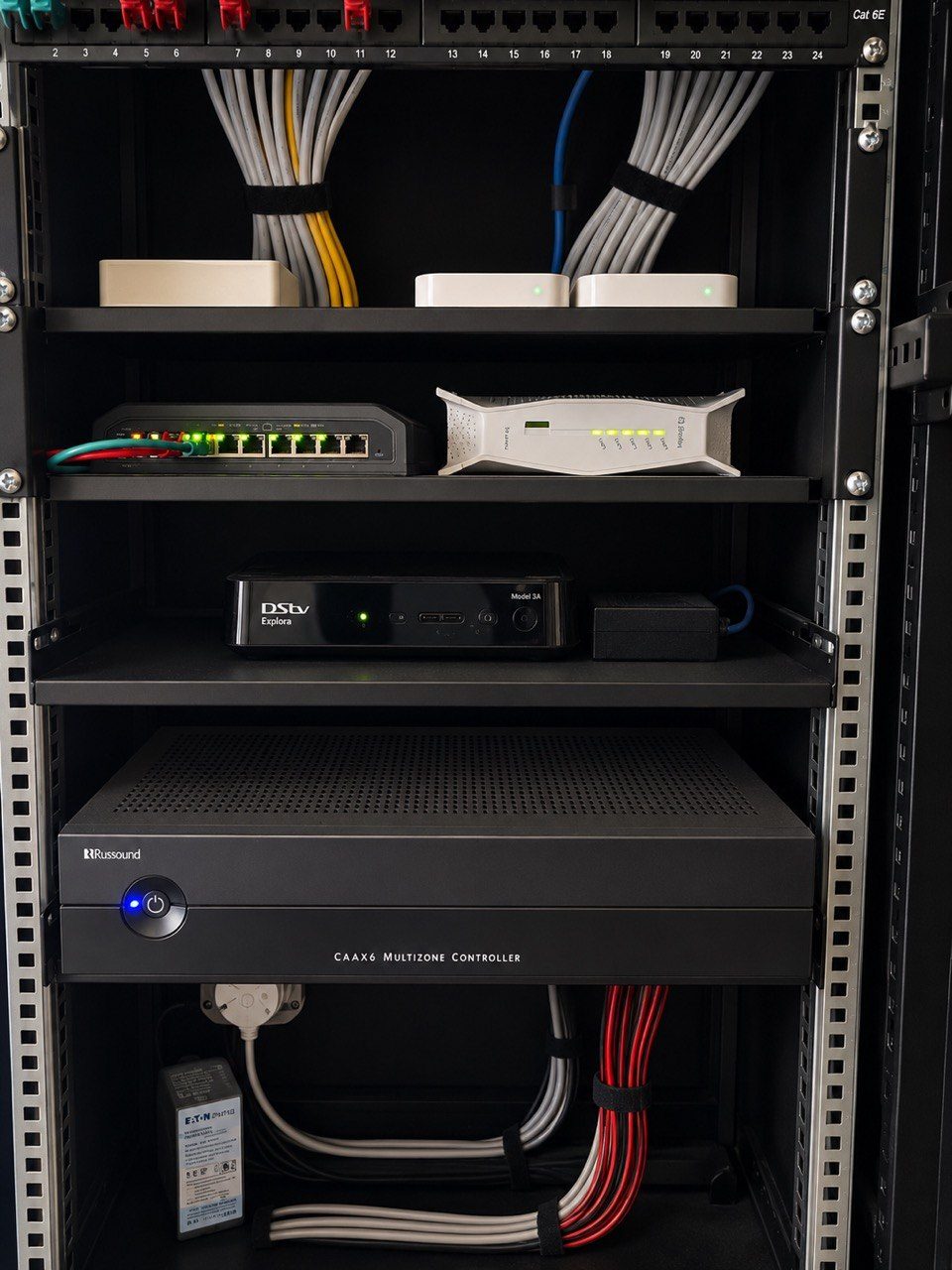
Spare cable length at the head end is often misunderstood.
Too little cable is a problem. Too much cable is also a problem. The correct amount is not waste. It is serviceability.
The head end is where the system becomes real: patch panels, network switches, CCTV recorders, audio amplifiers, control processors, fibre equipment and power protection all meet in one place. If the cables arrive badly, the whole rack starts badly.
Short cables create permanent pressure
If a cable is too short, the installer has very few options.
It may not reach the patch panel cleanly. It may need a join. It may pull tight across equipment. It may be impossible to move the rack forward. It may prevent a neat dressing path. It may make future retermination difficult.
Short cables create stress on connectors.
Stress becomes faults.
Excess cable must be controlled
Leaving spare cable does not mean dumping a coil behind the rack.
Uncontrolled excess cable blocks airflow, hides labels, traps power supplies, makes tracing difficult and turns future service into a mess. Spare length should be planned, dressed and managed.
The goal is controlled service length.
Not clutter.
Different systems need different service length
Not every cable should be treated the same.
Data cables to patch panels need a different dressing approach from speaker cables, fibre, HDMI extenders, control cabling and power-related connections. CCTV cables may need clean patching and identification. Audio cables may need separation from noisy power routes. Fibre needs careful bend radius.
The installer should understand what each cable is for before dressing the rack.
Future replacement is part of the design
Equipment will change.
Switches get replaced. Routers change. CCTV recorders are upgraded. Audio amplifiers are swapped. Control processors move. Fibre devices are replaced by service providers. If there is no service length, every replacement is harder.
Good cable length gives the rack a future.
Labels and photos complete the picture
Service length is most useful when it is paired with labels and documentation.
The next technician should know what each cable does, where it goes and how much movement is available. Rack photos at handover also help preserve the state of the installation before future changes happen.
A neat rack should be understandable, not just attractive.
DG Technologies’ view
DG Technologies treats head-end cable length as part of the quality of the installation.
The client may never ask how much spare cable is behind the rack. But they will feel the result when future support is faster, cleaner and less disruptive.
The right amount of cable is not waste.
It is respect for the system’s lifespan.