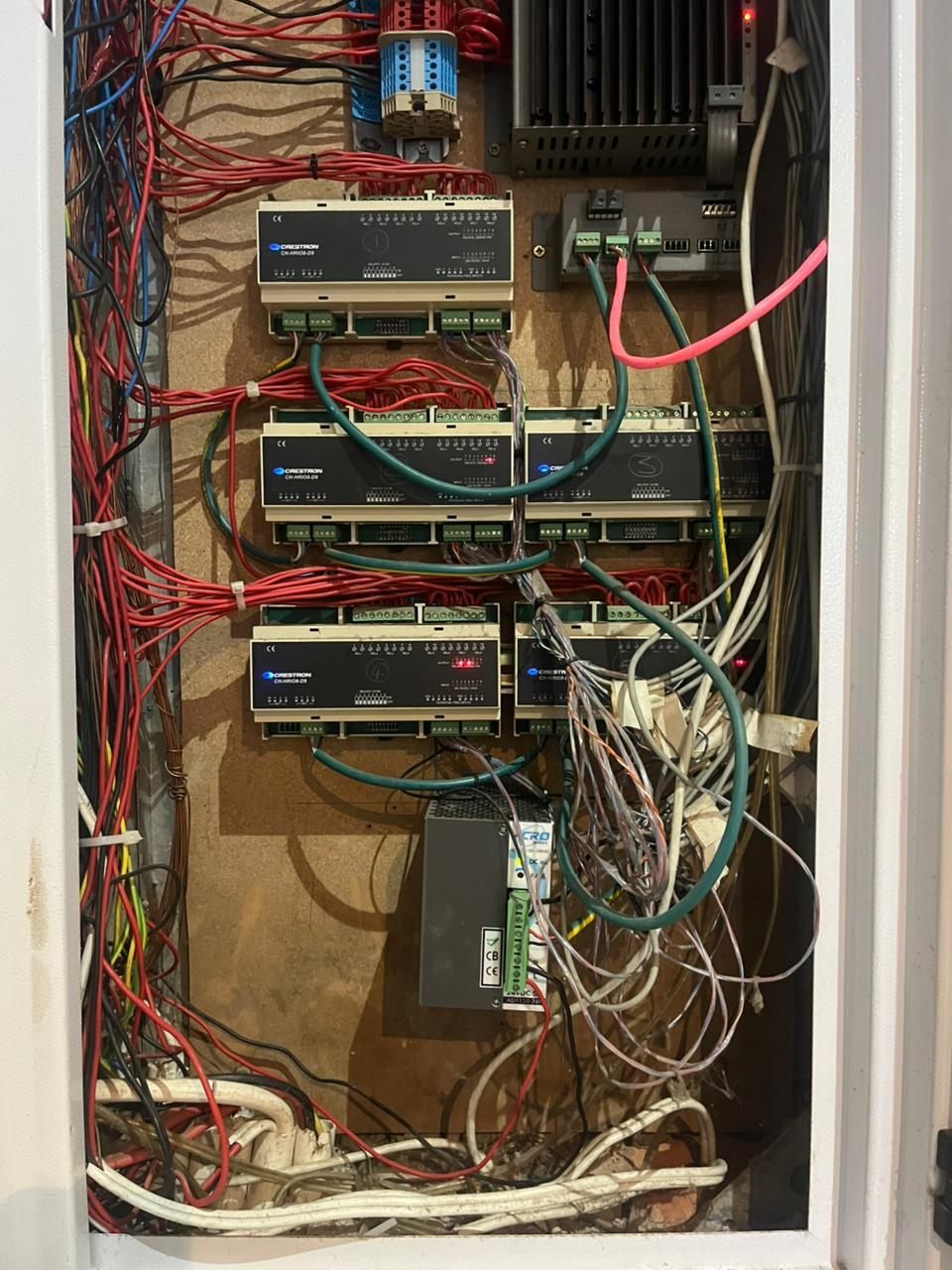
When a Crestron system stops working properly, the temptation is to start replacing things.
Replace the processor. Replace the touch panels. Replace the lighting modules. Replace the app. Replace the amplifiers. Replace the network. Replace everything that looks old.
Sometimes equipment does need to be replaced.
But in our experience, proper Crestron recovery work should not begin with a shopping list. It should begin with understanding the original design.
That is especially true in large homes across Durban, Mount Edgecombe, Umhlanga, Ballito, Zimbali, Simbithi and the wider KZN market, where Crestron may be controlling lighting, audio, gates, cinema rooms, HVAC, blinds, security interfaces and multiple zones across a large property. In those homes, one bad assumption can turn a repair into an expensive rebuild.
At DG Technologies, we prefer to assess first, then recommend. A legacy system may look untidy, outdated or frustrating, but it often contains useful decisions that should not be thrown away too quickly.
Old does not always mean useless
A system can be old and still contain value.
A good power amplifier is still a good power amplifier if it is working properly and suitable for the speakers it drives. Existing keypads may still be in useful positions. Cable routes may be difficult to replace but perfectly usable. Some lighting circuits may need modern relay control rather than full dimming. Some rooms may not need the level of control they were originally given.
This is why we are careful before recommending wholesale replacement.
A proper Crestron repair and upgrade starts by asking what still serves the home. What is reliable? What is causing faults? What is obsolete? What can be reused? What needs to be simplified? What does the client actually use every day?
Those questions can save a homeowner a serious amount of money.
We have written about this broader philosophy in how DG Technologies decides what to keep and what to replace. The principle is simple: do not remove value just because it is easier to quote new equipment.
The original wiring tells a story
Before changing a Crestron system, the wiring needs to be understood.
Where do the lighting loads return? Which circuits are dimmed? Which circuits are switched? Which keypads are on Cresnet or another control bus? Which rooms are grouped? Which amplifiers feed which speakers? Which network points are still active? Which cables are spare? Which cables are undocumented?
The answers are often hidden in cupboards, DB boards, ceiling spaces, racks and old drawings.
This is where recovery work becomes more like investigation than installation.
If the original documentation is missing, the system has to be mapped carefully. Labels need to be checked. Cable routes need to be tested. Lighting circuits need to be identified. Audio zones need to be confirmed. Network dependencies need to be understood. Only then can the system be redesigned responsibly.
This is also why smart-home documentation matters years later. Good documentation is not paperwork for the installer. It is protection for the homeowner.
Lighting recovery needs engineering judgement
Lighting is one of the most important parts of Crestron recovery work because it affects the home every day.
It is also one of the areas where old assumptions can become expensive.
Many older homes were designed around incandescent or halogen lighting. Modern LED lighting behaves differently. Some dimmers that worked well years ago are not suitable for every modern LED load. Flickering, ghosting, buzzing, unreliable dimming and premature lamp failures can all appear when the wrong control method is used.
The answer is not always to install more dimmers.
In some cases, a relay module is the better engineering choice. If a circuit does not need dimming, or if the load is not suitable for reliable dimming, switching it cleanly may be more dependable. That can reduce cost, simplify the system and improve long-term reliability.
We explored this in why not every light in a smart home should be dimmed. The important point is that the design should be based on how the room is used, not on the assumption that every circuit must have the most expensive control method.
Good lighting control is not about selling the maximum number of modules. It is about choosing the correct control method for each circuit.
The user experience may need simplifying
Many legacy systems were impressive when they were installed.
Over time, they can become difficult to live with.
Touch panels may show too many pages. Room names may no longer match how the home is used. Audio zones may be split in ways that make little practical difference. Controls may be duplicated across panels, remotes and apps. Guests and staff may not know what to press. The owner may only use ten percent of the system.
Recovery work is a chance to simplify.
That does not mean removing useful features. It means removing confusion.
Crestron Home can be a sensible option for many residential projects because it provides a modern, app-friendly, maintainable platform for the type of control most homeowners actually need. It is not the answer for every technical situation, but for many homes it can reduce unnecessary custom complexity and make long-term support easier.
That distinction matters. The goal is not to prove that the old system was bad. The goal is to create a system the homeowner can use confidently.
Replacement should follow evidence
There are times when replacement is the right answer.
Processors fail. Touch panels become unsupported. Networks become unstable. Cabling may be damaged. Lighting modules may be unsuitable. Old programming may be unavailable. A previous installation may be unsafe, undocumented or impossible to support properly.
But replacement should follow evidence.
When we assess a legacy system, we want to know why each item is being replaced. Is it failed? Is it unsupported? Is it unsafe? Is it unreliable? Is it incompatible with the new design? Or is it simply old?
Those are different answers.
An honest recovery plan separates them clearly.
That is why before you replace a legacy Crestron system, get it assessed properly. A good assessment protects the client from both extremes: spending too much on unnecessary equipment, or spending too little and leaving the real faults untouched.
Good recovery work respects the home
A large Crestron system is not just equipment.
It is connected to the way the home was designed, built and lived in. It affects daily routines, lighting moods, family spaces, entertainment areas, staff access, security behaviour and the owner’s confidence in the property.
That is why recovery work must be careful.
The best result is not always the most dramatic before-and-after photograph. Sometimes the best result is a homeowner who stops thinking about the system because it finally behaves properly again.
For DG Technologies, that is the real measure of a successful recovery.
Understand the original design. Keep what still has value. Replace what genuinely needs replacing. Simplify what has become unnecessarily complicated. Document the result so the next person is not left guessing.
That is not flashy.
It is just good engineering.