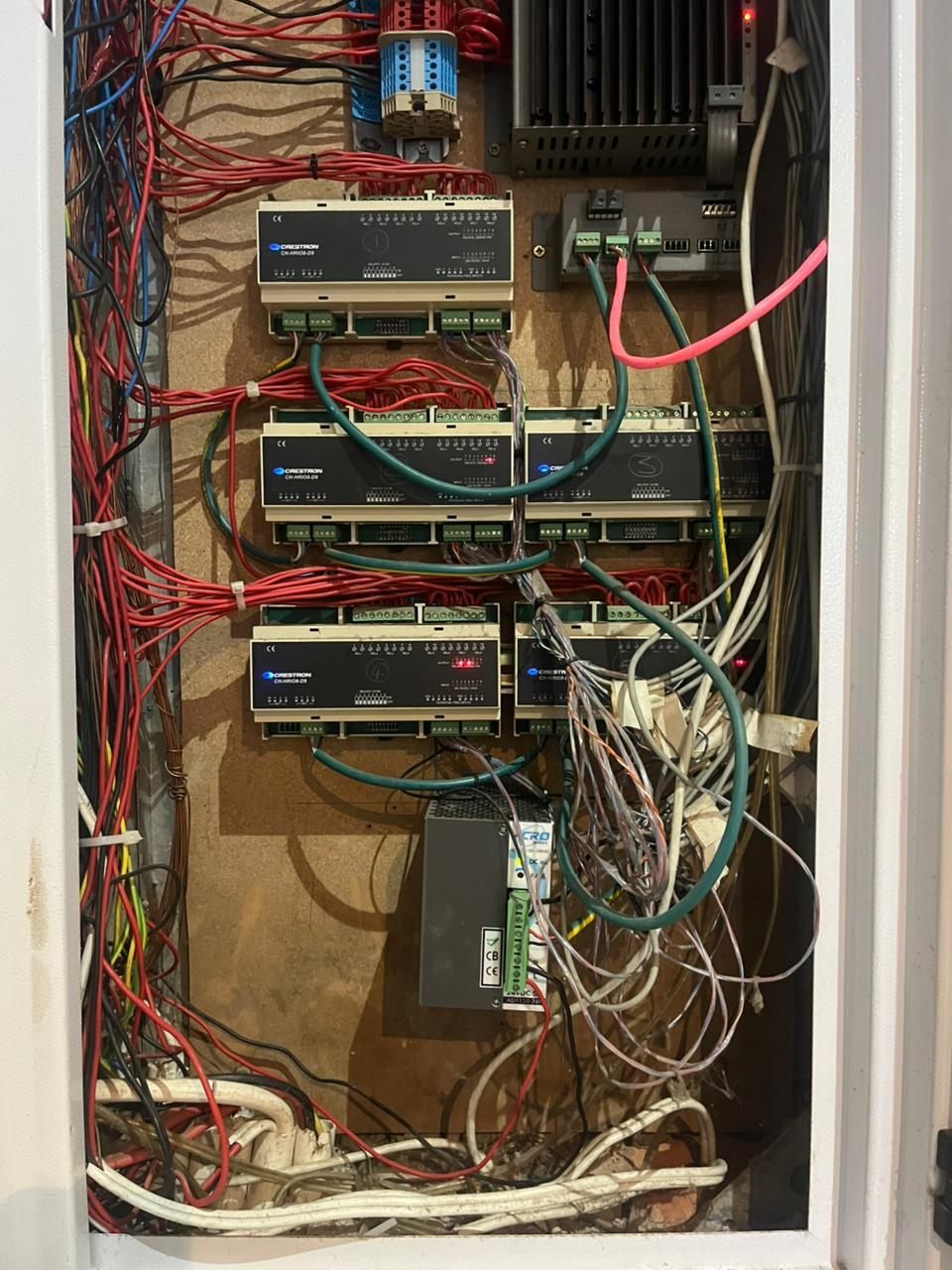
When Crestron lighting stops working, it can feel urgent.
Lights are not like a cinema room or a music zone that can wait until the weekend. If a bedroom keypad stops responding, a passage light stays on, an exterior scene behaves strangely, or a circuit will not switch, the client notices immediately.
The danger is that lighting faults are often diagnosed too quickly.
“The keypad is faulty.”
“The dimmer is gone.”
“The Crestron is old.”
Any of those may be true, but they are not the only possibilities. A proper lighting-control fault-finding process should check the whole path from the button to the load.
Start with the actual symptom
The first question is simple: what exactly is not working?
There is a big difference between:
- one button on one keypad not responding
- an entire keypad being offline
- one lighting circuit not switching
- a dimmed LED load flickering
- a scene working from the app but not from the wall
- a light working manually but not from automation
- a whole lighting enclosure being offline
- exterior lights behaving differently after load shedding
Those symptoms point in different directions.
If a keypad is offline, the issue may be communication or power. If one circuit flickers, the issue may be the load or dimming compatibility. If a scene is wrong, the issue may be programming or how the client actually wants the room to behave. If a whole panel is dead, the issue may be power, module failure or protection.
Good diagnosis starts by describing the problem accurately.
Keypad faults are not always keypad faults
A wall keypad is the part the homeowner touches, so it often gets blamed first.
But a keypad is only one part of the control chain.
Before replacing it, the technician should ask:
- Is the keypad receiving power?
- Is it communicating with the system?
- Are other keypads on the same bus working?
- Has the keypad address changed?
- Is the button programmed for the expected function?
- Is the controlled lighting module online?
- Does the circuit work from the app or another keypad?
In some older homes, a keypad reset may bring a device back online temporarily, which tells you something useful. It may not prove the keypad is healthy forever, but it does suggest the fault should be investigated before replacement.
LED loads changed the lighting-control conversation
Many older Crestron lighting systems were designed around incandescent or halogen lighting. Those loads behaved differently from modern LED lamps and drivers.
When homes are upgraded over time, electricians often replace lamps and fittings without reviewing the original dimming hardware. The result can be flickering, minimum-load problems, poor dimming curves, buzzing, nuisance tripping or circuits that behave inconsistently.
This is where judgement matters.
Sometimes a dimmer is still the right solution. Sometimes a relay module is better because the circuit is simply being switched on and off. A passage, scullery, garage, store room or utility space may not need dimming at all.
DG Technologies often asks a practical question:
Will the client actually dim this circuit?
If not, removing unnecessary dimming can improve reliability and save money.
That is not downgrading the system. It is choosing the right control method for the load.
Scenes can fail because the home changed
Not every lighting problem is a hardware problem.
Homes change. Furniture moves. New LED strips are added. Exterior areas are enclosed. A patio becomes a glass room. A passage gets new fittings. A client starts using a room differently from how it was originally programmed.
Suddenly, the old scene no longer feels right.
That does not mean the Crestron system has failed. It may mean the programming needs to catch up with the way the home is now being used.
This is why smart-home support should include small adjustments, not only emergency repairs. A well-supported system evolves with the house.
Check the lighting enclosure properly
The lighting DB or enclosure tells a story.
Good technicians look for:
- labelled circuits
- clean terminations
- correct load separation
- stable power supplies
- heat issues
- damaged modules
- overloaded circuits
- signs of previous rushed work
- inaccessible wiring
- undocumented changes
If the enclosure is messy, unlabelled or difficult to access, every future fault becomes harder to diagnose.
That is why DG Technologies places so much emphasis on documentation and neat rack or DB work. The client may never stare at the lighting enclosure, but the quality of that enclosure affects the speed and accuracy of future support.
Do not replace parts before proving the fault
Crestron parts are not cheap. Replacing them without evidence is poor engineering.
A proper lighting fault-finding visit should narrow the problem down. Is it the keypad, bus, module, power supply, load, wiring, programming, network or user expectation?
Only then does replacement make sense.
There are cases where old hardware genuinely needs to be retired. There are also cases where the better answer is recommissioning, relabelling, reprogramming, changing a lighting load, replacing a faulty power supply or simplifying a circuit.
The value is knowing the difference.
Lighting control should feel boringly reliable
The best lighting-control systems do not feel impressive every day.
They simply work.
You press a button and the room behaves the way you expect. Scenes make sense. Exterior lights come on when they should. Manual overrides are clear. Guests and staff are not confused. The app matches the room names. The system recovers after power interruptions.
That kind of simplicity requires technical discipline behind the scenes.
If your Crestron lighting has started behaving strangely, do not start by assuming the entire system needs replacement. Start with a proper diagnosis.
The fault may be smaller, more specific and more solvable than it looks.