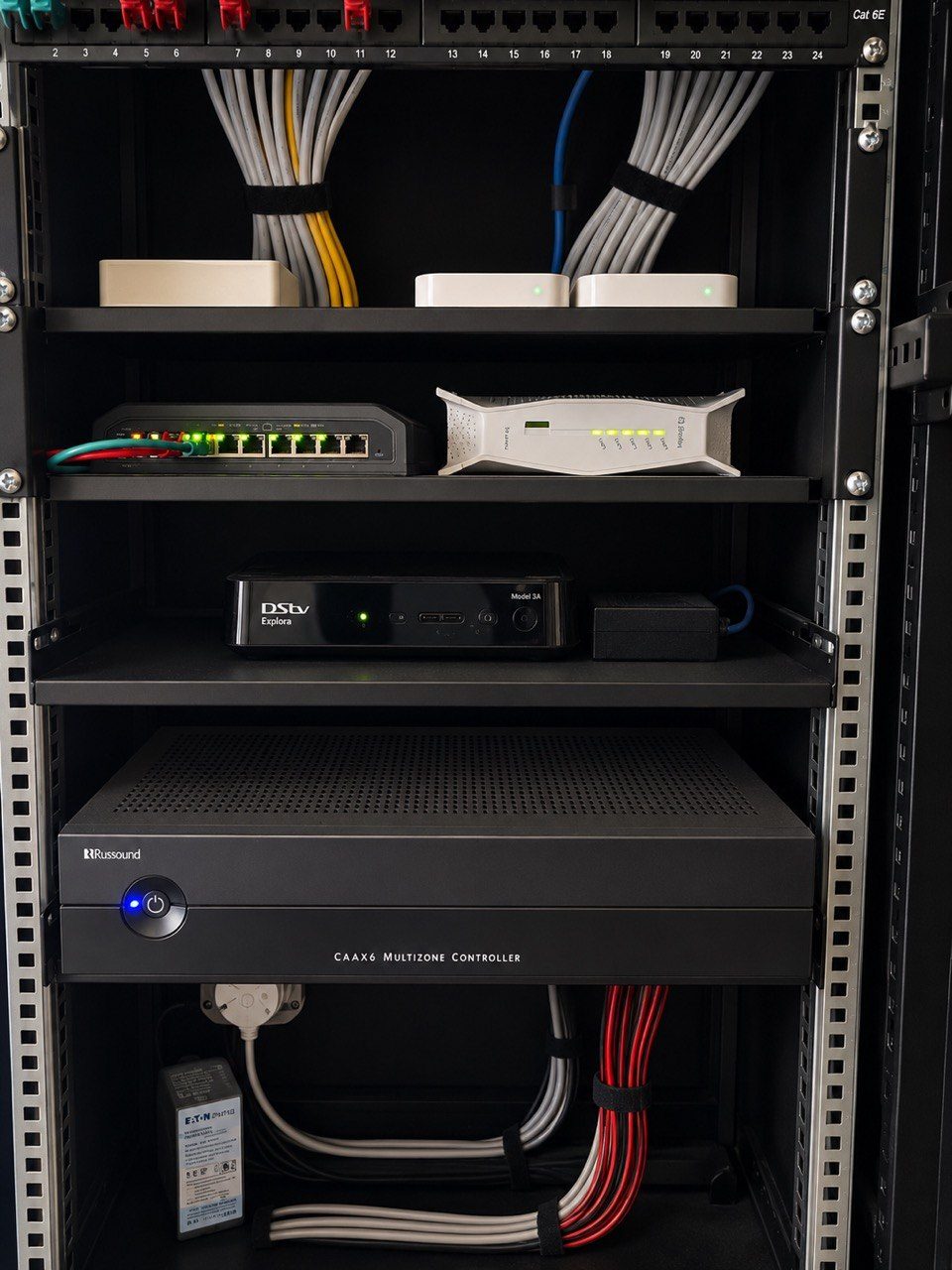
South African smart homes have to live in South African conditions.
That means power interruptions, inverter changeovers, fibre outages, router restarts, batteries, generators, surge events and the occasional device that does not come back online cleanly.
For a premium home, it is not enough for the system to work in perfect conditions.
It has to recover.
Power recovery planning is one of the most overlooked parts of smart-home design, and it affects almost every major subsystem: Wi-Fi, CCTV, access control, audio, lighting control, automation processors and remote support.
A restart can reveal the real design
Many systems work well after being manually restarted by the installer.
The real test is what happens after an outage when nobody technical is standing in front of the rack.
Does the router come back online?
Do the switches restart correctly?
Do the access points reconnect?
Does the Crestron processor see the devices it needs?
Do cameras return to recording?
Does the owner still have remote access?
Does the system recover in the correct order?
If the answer is uncertain, the system may be too fragile for real-world use.
Not everything should be on the same backup plan
Power backup is not only about keeping everything on.
It is about deciding what matters most.
Some devices may need uninterrupted power. Some may simply need clean restart behaviour. Some may not need backup at all. The network core, router, fibre equipment, key switches, control processor and selected CCTV hardware may be more important than powering every entertainment device during an outage.
The design should ask:
- Which systems must stay online?
- Which systems can shut down safely?
- Which devices need surge protection?
- Which devices need UPS support?
- What should restart first?
- What can be remotely supported after power returns?
These questions are part of system design, not only electrical design.
The network is usually the first priority
If the network does not recover, many other systems appear broken.
Cameras may be online locally but unreachable remotely. The control app may stop seeing the processor. Streaming audio may fail. Touch panels may become slow. Remote support may not be possible.
That is why DG Technologies often treats the network as the first recovery priority. A strong network infrastructure design gives the rest of the smart home a better chance of behaving properly after power changes.
This also links to our article on why smart-home fault finding should start with the network.
CCTV needs recording and access decisions
CCTV power planning is not only about cameras.
The cameras may need PoE power from a switch. The recorder may need backup. The router may need to stay online for remote viewing. The fibre equipment may need power. The owner may need to decide whether the priority is local recording, remote access, or both.
For some homes, recording during outages is critical. For others, the main requirement is that the system returns cleanly when power comes back.
Those decisions affect design and budget.
This is why CCTV installation should be planned as a system, not just a camera list.
Automation should fail gracefully
A good smart home should not become confusing when power conditions change.
Lighting, access, cameras, Wi-Fi and control should be designed so the homeowner is not left guessing what is offline, what should recover automatically and what needs support.
For Crestron Home and other professional systems, that means the control layer should be built on reliable infrastructure. It also means owners should understand which functions are backed up and which are not.
The goal is not to promise that everything will run forever during an outage.
The goal is to design honestly and recover predictably.
Documentation matters after a power event
When a system fails after an outage, documentation becomes extremely valuable.
Which switch powers which device? Which UPS supports which rack? Which router handles remote access? Which devices should be restarted first? Which cameras are on which PoE switch? Which circuits affect the automation rack?
Without that record, support becomes slower.
This is why a smart home needs a single technical memory.
South African conditions should shape the design
Premium smart homes in Durban, Umhlanga, Mount Edgecombe, Zimbali, Simbithi and across KZN need to be designed for local conditions.
That does not mean making the system complicated.
It means making it practical.
Power backup, network recovery, remote access, surge protection, rack layout and support procedures should all be considered before handover.
DG Technologies designs home automation, CCTV, networking and AV systems with the reality of ownership in mind.
Because the real test is not whether the system works once.
It is whether it comes back properly when life happens.