Every smart home has a history.
The problem is that the history is often scattered.
Some of it sits in old quotations. Some of it sits in project communication. Some of it sits in the memory of the installer. Some of it sits in a supplier invoice. Some of it sits in a drawing folder that nobody has opened for years.
That may be manageable on installation day.
It becomes a problem later.
When a premium home needs support, the question is rarely only, “What is broken?”
The better question is, “What was built here, why was it built this way, and what has changed since then?”
That is why a smart home needs a single technical memory.
Memory should not live only in people’s heads
Good installers remember details.
But no professional system should depend entirely on memory.
People move. Companies change. Staff change. Suppliers change. Apps update. Equipment is replaced. Fibre providers alter routers. Builders renovate rooms. Electricians add circuits. Owners change phones. Years pass.
If the system record does not exist, every future support visit starts with discovery.
That costs time.
It can also create bad decisions. A technician may replace equipment without understanding what it controls. A network change may break cameras. A lighting issue may be treated as a programming problem when it is actually a load or driver issue. An amplifier may be removed even though it is perfectly serviceable.
We have written about this in how DG Technologies decides what to keep and what to replace. You cannot make that decision responsibly without understanding the original system.
What should the technical memory include?
The record does not have to be complicated, but it should be complete enough to support the home.
For a proper smart-home installation, the technical memory may include:
- system drawings,
- equipment schedules,
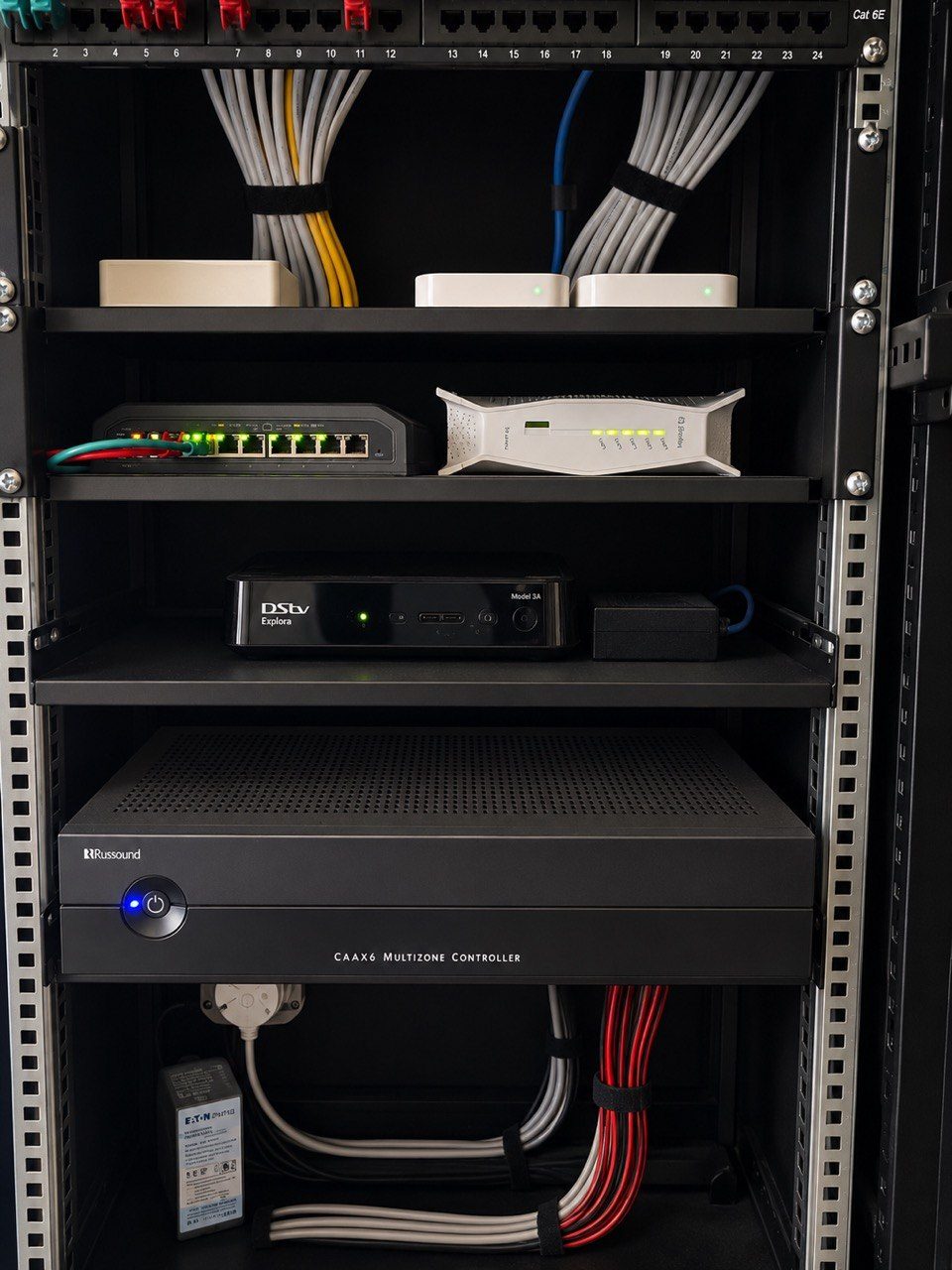
- rack layouts,
- cable labels,
- network structure,
- Wi-Fi access point locations,
- camera locations,
- lighting circuit notes,
- keypad and touch-panel locations,
- audio zone descriptions,
- source and input assignments,
- warranty information,
- remote access notes,
- support history,
- and handover notes.
Some of that information is for the homeowner. Some is for the support team. Some is for the next contractor who opens the rack years later.
All of it has value.
A technical record protects the client from starting again
One of the most expensive phrases in smart-home work is “we do not know.”
We do not know where that cable goes.
We do not know what that relay controls.
We do not know why that amplifier was installed.
We do not know what the previous programmer did.
We do not know which device is causing the fault.
When the technical memory is missing, the homeowner pays for investigation before they pay for improvement.
That does not mean every old system is bad. Many older systems contain useful infrastructure. Good cabling, good amplifiers, good speaker routes, good rack space and good lighting wiring can often still add value. But only if someone can understand them.
That is one reason a Crestron system should be assessed before it is replaced. The goal is not to preserve old equipment blindly. The goal is to avoid waste and make decisions based on evidence.
Documentation helps the home evolve
A premium home does not stay frozen.
Rooms change. Families change. Entertainment habits change. Cameras are added. Wi-Fi standards improve. Streaming services change. Security needs change. Lighting preferences change.
A good technical record allows the home to evolve without being rebuilt from scratch every time.
If the rack is labelled, the network is understood and the drawings are kept up to date, future upgrades become cleaner. If everything is undocumented, every upgrade becomes a small rescue project.
This is part of why DG Technologies treats supportability as part of the product. A system should make sense after installation, after handover and years later.
The best smart homes leave a trail
Not a public trail.
Not a marketing trail.
A private, practical, technical trail that helps the right people support the home properly.
That is the kind of documentation that does not always look exciting on a website, but it matters deeply in real life. It is the difference between a system that works only because one person remembers it and a system that can be responsibly maintained.
For DG Technologies, that is part of professional home automation, networking and AV support.
The technology should not lose its memory every time someone leaves the room.