The best way to save money in a new-build technology plan is not usually to buy the cheapest equipment.
It is to make better decisions earlier.
By the time a home is finished, many of the expensive mistakes have already happened. The routes are fixed. The ceilings are closed. The joinery is built. The DB is wired. The TV positions are committed. The access point locations are either there or they are not.
At that point, saving money often means compromising.
Before construction locks those decisions in, saving money can mean designing properly.
Do not remove the foundation first
When a quote feels heavy, the first instinct is often to remove visible items: access points, speakers, cameras, control points, TV routes or spare cabling.
That can be the wrong place to start.
Infrastructure is usually the part I am most careful about cutting, because it is the part that becomes expensive after the walls and ceilings are finished.
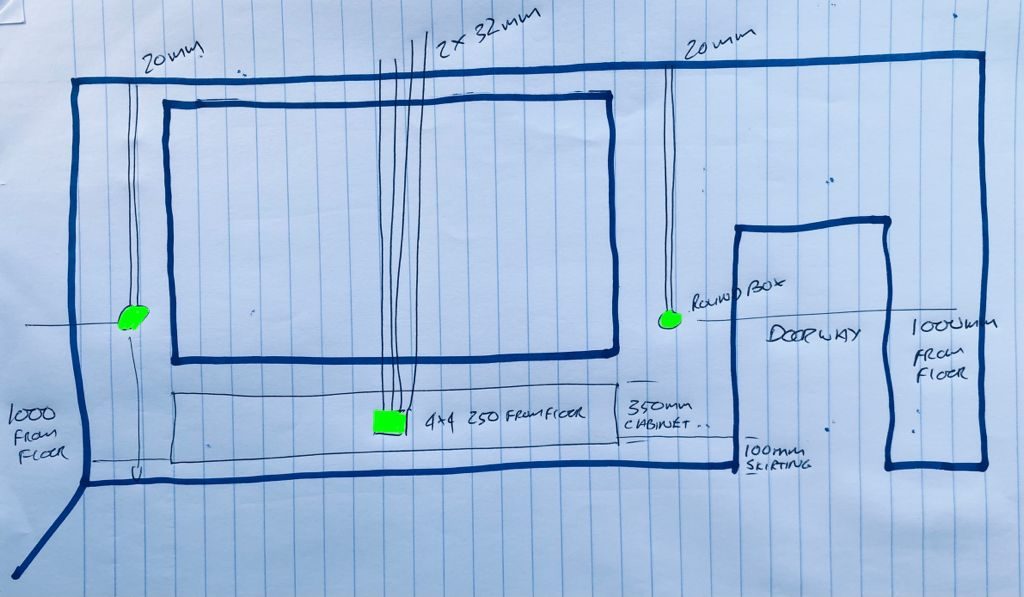
Cable routes, conduits, head-end space, cabinet depth, fibre entry, TV routes, speaker wiring and access point routes are the foundation. Equipment can often be added later. Missing routes are much harder to add later.
So when a client asks where we can save money, I do not start by weakening the backbone.
I start by looking at use.
Save on circuits that do not need dimming
Lighting control is a good example.
Not every light in a smart home needs to be dimmable. A passage, utility room, garage, store room or service area may only need reliable on/off control. Making every circuit dimmable because it looks impressive on paper can waste money without improving daily life.
A dimmer belongs where dimming changes the experience.
A relay belongs where the circuit simply needs to switch.
That distinction can save money while keeping the system strong.
Read why not every light in a smart home should be dimmed.
Save on audio zones that will always play together
Audio is another place where good judgement matters.
Architectural drawings show rooms. People live in spaces.
The kitchen and dining area may almost always play together. A bar and lounge may behave as one entertainment zone. Some bedrooms may not need distributed audio at all. Outdoor spaces may need independent volume because neighbours, wind and late-night use change the requirement.
The saving is not blindly removing speakers.
The saving is designing zones around real behaviour.
That is why audio zones in a new build should follow how the home will actually be used.
Stage the equipment, not the wiring
In a new build, there is a big difference between wiring for a future feature and buying the equipment for that feature now.
A client may not need every amplifier, camera, TV source, outdoor speaker or automation feature on day one. But if the cable route is practical during construction, it may be worth putting the route in while access is easy.
That keeps the future option alive.
The saving comes from staging the active equipment while protecting the infrastructure.
This is how to reduce upfront cost without making the finished home harder to upgrade.
Keep existing equipment only when it makes sense
Sometimes a client already owns useful equipment from a previous home.
That can create a genuine saving, but only if the equipment is compatible, reliable and appropriate for the new design.
I am happy to reuse equipment when it does not compromise the result. I am also careful about reusing old equipment just because it exists.
The question is not whether something can be connected.
The question is whether it should be part of the system the client will live with for years.
See when existing amplifiers are worth keeping.
Do not save money by hiding bad service access
A shallow cabinet, sealed joinery or awkward rack location can look like a saving during construction.
It is usually not.
If equipment overheats, if cables cannot be reached, if a technician cannot work properly, or if the router and switches are buried behind finished furniture, the saving becomes a support cost.
Good service access is not a luxury. It is part of the product.
That is why a new build needs a head-end room before it needs gadgets.
Ask where the money changes the experience
The most useful budget question is not “what can we remove?”
It is:
Where does this money change the experience, reliability or future serviceability?
If an item gives daily value, protects the system or prevents expensive future work, I am cautious about cutting it. If an item is impressive but unlikely to be used, it is worth discussing.
That is a better conversation than comparing two quotes line by line without understanding what each line does.
The right system is not always the largest system
DG Technologies is not interested in building the most expensive version of every home.
The goal is the right system.
That means a strong network, sensible head-end, proper cabling, practical lighting-control decisions, audio zones that match real use, camera positions that matter, and a technology plan that can grow.
If there is a way to save money without damaging the experience, I would rather discuss it before the quote is approved and before construction makes the decision more expensive.
Related reading: