One of the most dangerous sentences on a smart-home project is also one of the most ordinary:
“Plastering has started on site already.”
That sentence changes everything.
Before plastering, skimming and ceiling closure, the project still has options. Routes can be checked. Conduits can be corrected. Speaker wires can be confirmed. TV points can be adjusted. Access point positions can be moved. Rack routes can be reconsidered. Draw wires can be added. A missed cable can still be pulled without damaging finished work.
After plastering, every change becomes more expensive, more disruptive and more emotionally loaded.
The client sees finished surfaces beginning to appear. The builder wants progress. The electrician wants to close his scope. The ceiling team wants to skim. The interior designer is thinking about finishes. The AV team is now under pressure to either sign off what exists or ask everyone to slow down.
That is why AV sign-off before finishes matters.
The AV team is not only checking cables
When DG Technologies reviews a site before plastering or ceiling closure, we are not only asking, “Is there a cable?”
We are checking whether the route still makes sense.
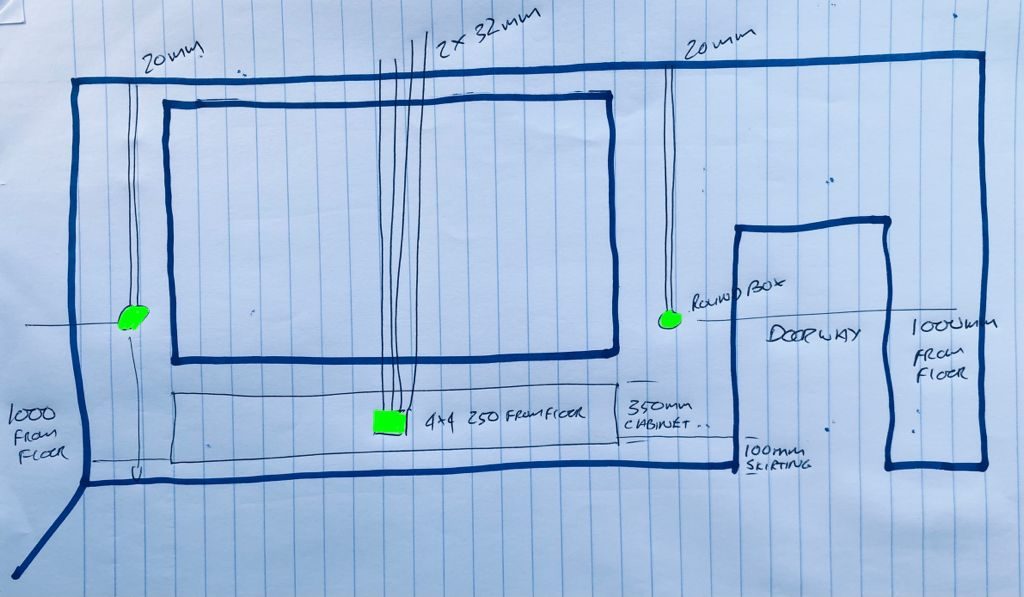
A cable in the wrong place can be almost as bad as no cable at all. A TV conduit that arrives too low, too small or on the wrong side of a cabinet can force visible trunking later. A Wi-Fi access point route that cannot be accessed after ceiling closure makes future replacement harder. A speaker cable in the wrong part of the ceiling can put sound in the wrong place for the room. A camera route may exist, but still miss the face view the client actually needs.
The sign-off is therefore practical.
It asks:
- Are the TV routes correct?
- Are the conduits large enough?
- Are draw boxes accessible?
- Are speaker positions aligned with the ceiling plan?
- Can access points be reached later?
- Are CCTV points aimed at useful views?
- Does the rack location still work?
- Has the head-end route been protected?
- Are there spare routes where future upgrades are likely?
- Do the electrical and low-voltage plans agree?
Those questions are easier before finishes.
A closed ceiling can hide a small mistake for years
The problem with low-voltage mistakes is that they often remain hidden until the client needs the system to do something.
The home may look beautiful at handover.
Then a few months later the client wants a TV moved. Or an extra speaker zone. Or another access point. Or a camera replaced. Or a cable fault traced. Or a different source connected. Suddenly everyone discovers that the route was never accessible, the conduit was too small, the draw box was plastered over or the cable was looped in a way that makes replacement difficult.
That is why DG Technologies sees first fix as part of long-term support, not only installation.
If a ceiling hole, speaker position or service opening can become a future access point, it should be discussed before the ceiling is closed. If a conduit has more than a sensible number of bends, the draw point must remain accessible. If a route may need future replacement, it cannot be treated like permanent building fabric.
The client may never see the route.
But the route decides whether future work is simple or painful.
Builders also benefit from proper sign-off
This is not only an AV-company preference.
Builders benefit when AV sign-off happens properly.
Without it, late changes can create arguments about who missed what. The client may blame the builder because the wall is finished. The builder may blame the AV contractor because the cable was not requested clearly. The electrician may be asked to reopen work he believed was complete. The interior designer may have to accept visible compromises on a finished wall.
Clear sign-off reduces that pressure.
It gives the builder a simple checkpoint:
“Before we close this area, has the technology team confirmed the routes?”
That one step can prevent weeks of irritation later.
The right sign-off should be specific
A vague “AV checked” message is not enough for a serious home.
The sign-off should identify what was checked and what remains open.
For example:
- main TV conduit confirmed,
- patio speaker wiring confirmed,
- cinema speaker wiring still awaiting final check,
- access point route to head-end confirmed,
- CCTV route at garage requires adjustment,
- rack cabinet depth still to be confirmed,
- draw wire missing on gate route,
- spare conduit recommended before plastering.
That kind of language is useful because it creates a shared record.
Everyone can see what was agreed, what was not agreed and what still needs action before finishes proceed.
This is also why AV drawings need to make sense to every trade. A drawing that only the AV installer understands does not protect the builder.
Plastering should not be the first deadline
On many projects, plastering becomes the moment everyone suddenly asks what is missing.
That is too late.
The better approach is to build AV review into the programme before plastering, skimming and ceiling closure are imminent. The smart-home team should have enough time to walk the site, compare the plan to the actual building, speak to the electrician, check difficult routes and give practical feedback.
If that conversation only starts when the plasterer is waiting, everyone is already under pressure.
Pressure is where expensive compromises happen.
The finished home depends on unfinished-stage discipline
The client experiences the finished home through simple things:
The TV works.
The Wi-Fi is strong.
The cinema sounds right.
The lights respond.
The cameras show useful views.
The rack can be serviced.
The app makes sense.
But those simple experiences are protected during unfinished stages of the build. Before plastering. Before skimming. Before ceilings close. Before the wall becomes expensive to open.
For premium homes in Durban, Umhlanga, Mount Edgecombe, Zimbali, Simbithi, Ballito and the wider KZN area, DG Technologies can review AV, smart-home, CCTV, Wi-Fi and speaker routes before first-fix decisions disappear behind finishes.
Start with our low-voltage first-fix requirements for architects or our builder and architect coordination page.