A smart home quote can look impressive when it is full of equipment.
Processors, touch panels, lighting modules, amplifiers, switches, access points, cameras, remotes, keypads, racks and cables all have their place. On a serious home automation project, some of that equipment is essential. Some of it is useful. Some of it may be unnecessary.
The difficult part for a homeowner is that an equipment list does not always show the quality of the thinking behind it.
Two quotes can both mention Crestron Home, lighting control, Wi-Fi, CCTV and multiroom audio. One may be carefully designed around the house, the existing infrastructure, the client’s habits and long-term support. The other may simply be a list of boxes that technically fit the brief.
That difference matters.
At DG Technologies, we believe a smart home quote should explain decisions, not just equipment. The value is not only in what we supply. It is in the judgement behind why something is included, why something is left out, why something can be reused, and why another item should be replaced before it becomes a problem.
That is where honest engineering sits.
A quote should explain the problem being solved
Home automation is not one product. It is a set of systems working together.
Lighting, audio, cinema, CCTV, Wi-Fi, gate access, climate control, shading and app control all depend on cabling, networking, power, programming, documentation and support. If those background decisions are wrong, expensive equipment can still feel unreliable.
So the first job of a good quote is not to show how many devices can be fitted into the project.
The first job is to explain the problem being solved.
For example:
- Is the project a new build where cabling can still be planned properly?
- Is it a renovation where ceilings and finishes limit cable routes?
- Is there an existing Crestron or AV system that needs assessment?
- Is the client trying to simplify a home that has become too complicated?
- Is the main issue reliability, ease of use, future expansion or budget control?
- Does the home need a full control system, or only selected areas automated properly?
Those questions change the design.
A quote for a new home in Zimbali, Simbithi, Mount Edgecombe or Umhlanga should not be built the same way as a quote for rescuing an older system that already has equipment, wiring and programming in place. A family home used every day should not be quoted the same way as a holiday home that needs remote access, stable security and simple guest operation.
The equipment list should follow the thinking, not lead it.
The real value is judgement
Clients often ask, quite reasonably, what equipment they are getting for the money.
That matters. Hardware quality matters. Brand support matters. Warranty matters. We care about those things.
But the more valuable question is this: what decisions are being made on the client’s behalf?
Should the existing amplifier stay? Should old speakers be reused? Is the current rack good enough, or will it make future support painful? Does every room need a touch panel? Should every lighting circuit be dimmed? Is Crestron Home the right platform for the whole home, or should some smaller functions remain independent? Can the network carry the load, or will automation faults actually be Wi-Fi and switching faults later?
These are not minor details. They are the project.
Good judgement can reduce cost. It can also increase cost in the right places. Both can be correct.
There are times when we tell a client, “keep this, it is still doing its job.” There are also times when we say, “this needs to be replaced, because leaving it in place will cost you more later.” The important part is that the reason is clear.
That same thinking sits behind our article on how DG Technologies decides what to keep and what to replace. Reuse is valuable when it is responsible. Replacement is valuable when it solves a real problem. Neither should be automatic.
Keeping good equipment is not a compromise
Some clients worry that reusing existing equipment means they are getting a second-best system.
Not necessarily.
If an amplifier is reliable, correctly matched, properly ventilated and easy enough to integrate, replacing it may add cost without improving daily life. If existing speakers sound good and are installed in the right positions, they may still be perfectly serviceable. If a rack can be cleaned, labelled and reorganised properly, it may not need to be thrown away.
The same can apply to selected cabling, network cabinets, screens, camera positions, keypads and power infrastructure.
But reuse must be tested and explained.
It is not enough to say, “we will use the existing cable.” The better question is whether the cable is the right type, in the right place, undamaged, terminated properly and suitable for what the new system needs to do. It is not enough to say, “the old speakers can stay.” They need to be checked against the room, the amplifier, the client expectation and the control design.
Responsible reuse protects the budget without weakening the system.
Unexamined reuse does the opposite. It leaves old faults hiding inside a new quote.
Replacing equipment should have a reason
On the other side, replacement should not be used as a shortcut for thinking.
It is easy to quote a full replacement. It can look clean on paper because everything becomes new. Sometimes that is the correct answer, especially when equipment is unsupported, unreliable, badly installed or no longer suitable for the client.
But “new” is not the same as “better” unless the replacement removes a real limitation.
If an old control processor cannot be supported properly, replacing it may be sensible. If a lighting system was designed around loads that no longer exist, replacing or redesigning parts of it may be necessary. If the network is unstable, unmanaged and undocumented, new access points alone may not solve anything unless the switching, cabling and rack are addressed too.
A smart home quote should explain those decisions plainly.
It should say why a product is being replaced, what risk it removes, what improvement the client will feel, and what would happen if that item was left in place.
Without that explanation, the client is being asked to trust a shopping list.
Crestron Home should be right-sized
DG Technologies often recommends Crestron Home for serious residential automation projects because it gives a strong, professional platform for lighting, audio, climate, shading, security integration, app control and room control.
But specifying Crestron Home properly does not mean adding the maximum amount of hardware everywhere.
The better question is how the home should actually be controlled.
Some rooms need keypads because lighting scenes must be quick, physical and reliable. Some rooms may benefit from a touch panel because the family uses that space often and needs control over several systems from one place. Other areas may be better served by the Crestron Home app, a well-positioned keypad, a handheld remote or a simpler control point.
A touch panel in every room can sound premium. In daily use, it may be unnecessary.
The same applies to zones, scenes, audio areas and lighting loads. A large open-plan area may not need to be split into more zones than the family will ever use. Not every lighting circuit needs dimming. Some modern LED loads are better handled with reliable relay control, depending on the fitting, driver and expected behaviour.
This is especially important in lighting control, where good design is not about making every circuit complicated. It is about choosing the correct control method for the space, the light fitting and the way the client lives.
Right-sizing is not downgrading. It is engineering restraint.
Avoiding unnecessary touch panels and over-complex hardware
One of the most common ways a smart home quote becomes inflated is by adding control points that do not improve the owner’s life.
Touch panels are useful in the right places. In a main living area, cinema, master suite or central family space, a touch panel can make sense. It can give fast access to lighting scenes, audio, TV, climate, cameras and other common functions.
But a touch panel is not a trophy.
If the room only needs lights on, lights off and one scene, a keypad may be better. If the client naturally uses a phone for deeper control, the Crestron Home app may already cover the occasional task. If guests use the space, simpler physical buttons may be more reliable than asking them to navigate a screen.
Over-complex hardware creates another problem: it increases the support load.
More devices mean more firmware, more power requirements, more network dependencies, more interface design, more mounting locations and more future service points. That is acceptable when the feature is genuinely needed. It is poor design when it is there only because the quote needed to look impressive.
A professional system should feel simple at the surface because the decisions underneath were made carefully.
A cheaper quote is not always better value
There is also a different danger: a quote that looks cheaper because the thinking has been removed.
It may leave out rack ventilation. It may skip labelling. It may assume the existing network is fine. It may quote cameras without discussing what the client needs to identify. It may use wireless links where cables should be installed. It may avoid mentioning future expansion because that would add cost today.
That kind of quote can win on price and lose on ownership.
We wrote more about this in why the cheapest smart home quote can cost more later. The short version is that the saving is only real if the system still works properly, can be supported, and does not need to be rebuilt when the first limitation appears.
Good value is not the lowest number. It is the right balance between reliability, usability, budget and future support.
Sometimes that means reducing the quote. Sometimes it means spending properly on the parts nobody sees: cabling, switching, patching, power, documentation and rack layout.
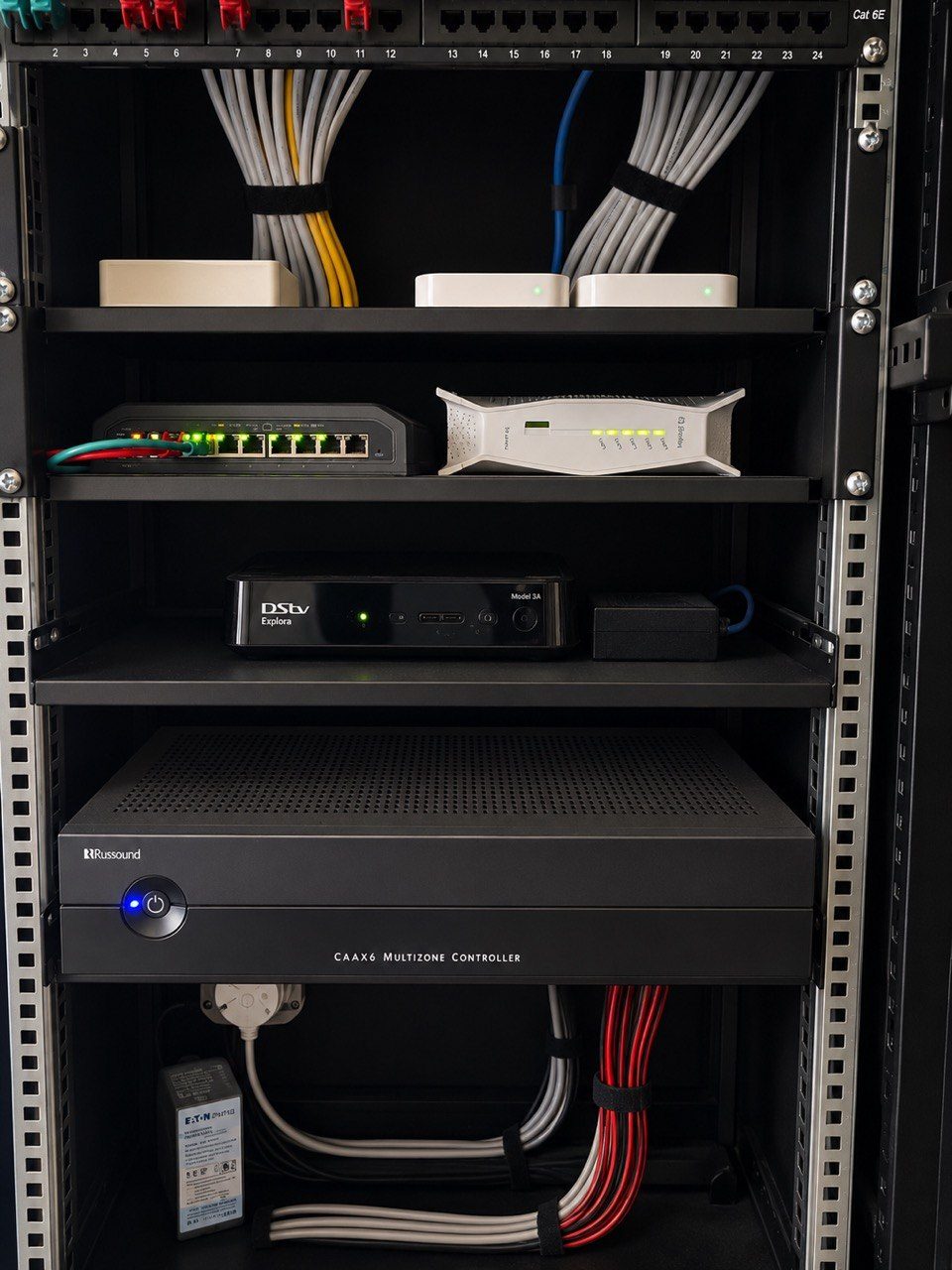
The rack tells the truth
Many smart home decisions eventually meet in the equipment rack.
The rack shows whether the project has been thought through. It shows whether there is proper space, labelling, ventilation, patching, service access, spare capacity and separation between systems. It shows whether the installer expected someone to support the home later.
This is why the rack cannot be treated as an afterthought.
A client may never look inside it, but they will feel the consequences of the decisions made there. Poor rack work can turn small faults into long callouts. Missing labels can make future upgrades slower. Overcrowded equipment can run hot. Unmanaged cabling can make a simple change risky.
A quote that includes rack planning is not adding unnecessary detail. It is acknowledging where the system lives.
The same applies to drawings, cable schedules, network notes, lighting schedules and handover information. Documentation is part of the installation because it reduces future uncertainty.
The homeowner should understand the trade-offs
A proper quote should leave the client more informed, not more confused.
That does not mean every homeowner wants to become a technician. Most do not. They want a clear explanation of the major trade-offs.
For example:
- “We can reuse this amplifier, but we should replace the control interface.”
- “We can reduce the number of touch panels without reducing daily usability.”
- “This cable route is worth doing now because it will be expensive after ceilings close.”
- “This lighting circuit should not be dimmed because the load is not suitable.”
- “Crestron Home makes sense for the main system, but this small function can stay simple.”
- “The cheaper camera will record movement, but it will not identify faces well in that position.”
Those explanations build trust because they show the client what the installer is protecting.
They also make budget conversations more honest. If a client wants to reduce the project cost, we can talk about what changes. We can phase work. We can remove non-essential features. We can reuse reliable equipment. We can simplify control in rooms where simplicity is better.
What we should not do is pretend that removing infrastructure has no consequence.
This is part of how we work
DG Technologies is owner-led, and that shapes how we quote.
We are not interested in making a home look clever on paper and frustrating in real life. We would rather have a direct conversation early than leave a client with a system that is hard to use, hard to support or more complicated than the home needs.
That is why our process starts with understanding the site, the client and the existing infrastructure before deciding what the system should become. It is also why we put emphasis on documentation, handover, support and practical design.
You can see more of that approach on working with DG Technologies and our home automation Durban and KZN service page.
The best smart home quote is not the one with the longest equipment list.
It is the one where the decisions make sense.
It should show where the money is being spent, where money is being saved, what is being reused, what is being replaced, what has been simplified and what has been protected for the future.
That is what clients are really buying.
Not just equipment.
Judgement.