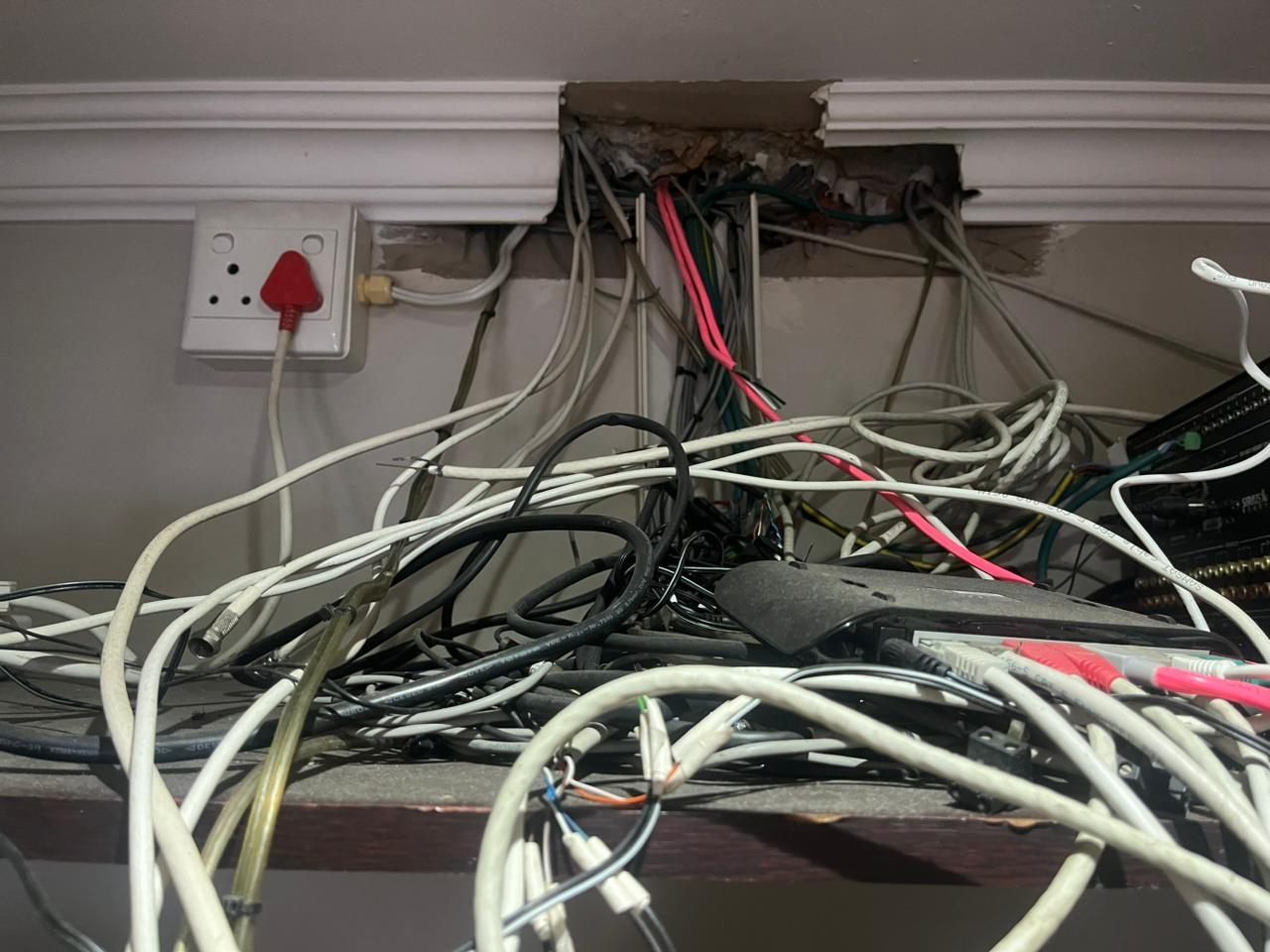
The cheapest quote is tempting. That is true whether you are building a new home, renovating an existing one, adding CCTV, upgrading Wi-Fi or planning a proper home automation system.
But in smart-home and AV work, the cheapest quote is not always the cheapest system.
Part of the confusion is terminology. A quote for a few smart devices is not the same as a quote for a planned home automation system. We explain that difference in our smart home terminology guide.
The problem is that technology installations are full of hidden dependencies. A camera is not just a camera. A Wi-Fi access point is not just a white disc on the ceiling. A Crestron keypad is not just a switch. Every device depends on cabling, power, networking, placement, programming, support, documentation and future service access.
When those parts are ignored, the saving often appears on day one and the cost arrives later.
That is where many homeowners get caught.
Cheap can mean different things
There is a big difference between a cost-effective solution and a compromised one.
A cost-effective solution is carefully chosen. It does the job properly without unnecessary extras. It may reuse existing equipment. It may reduce the number of zones. It may choose a simpler control method. It may avoid hardware that looks impressive on paper but adds little to daily life.
A compromised solution is different. It removes the parts that make the system reliable.
That might mean using thinner cable than the job deserves. It might mean relying on an existing cable route that does not have enough cores. It might mean installing one router in a cupboard and hoping it covers the whole home. It might mean choosing a cheaper camera range with poor low-light performance. It might mean skipping cabinet space, patch panels, labelling or spare network capacity.
On the quotation, those decisions can look like savings.
On site, they become limitations.
The cable you do not see often matters most
Most clients naturally focus on visible equipment: TVs, speakers, touch screens, cameras, keypads and projectors.
That is understandable. Those are the things they can see and use.
But many failures start with the parts hidden in the walls and ceilings.
If a CCTV system needs four cables and only two usable cables exist, there is no clever quotation trick that changes the engineering reality. Either the correct cabling must be installed, or the system must be redesigned around the limitation.
If a long HDMI run needs proper extenders, the cost is not just about buying another box. It is about making sure the picture still works reliably at the other end of the house.
If a Wi-Fi access point needs a proper cable back to the head end, that cable route matters more than the brand logo on the access point.
The best time to solve those issues is before walls close, ceilings are finished and cabinets are full.
That is why DG Technologies takes prewire and infrastructure planning seriously. Our smart home installation checklist covers many of these decisions before they become expensive to correct.
Good quotes explain why, not just what
A useful quotation should not only list equipment.
It should explain the thinking.
Why does this room need a wired access point instead of a Wi-Fi extender? Why should the NVR be in the cabinet rather than next to a TV? Why do we need spare network ports? Why should a lighting circuit use a relay instead of an old dimmer? Why can an existing amplifier stay, but an old processor should be replaced?
Those explanations matter because the client is not buying boxes. The client is buying decisions.
On a proper project, some of the most valuable decisions are the ones that stop unnecessary spending:
- keeping an existing amplifier if it is still reliable,
- removing a touch panel if the mobile app gives the same daily control,
- consolidating audio zones where the rooms are naturally used together,
- reusing cabling where it is tested and fit for purpose,
- replacing only the equipment that creates reliability or support problems.
That is very different from simply choosing the cheapest line item.
Where cheap Wi-Fi becomes expensive
Wi-Fi is one of the easiest places to underquote and one of the hardest places to fix neatly afterwards.
A large Durban or KZN home often has thick walls, concrete slabs, multiple levels, outdoor entertainment areas, garages, staff areas, cameras, TVs, streaming devices and smart-home controllers. One router will not handle that properly.
Wi-Fi extenders may help in a small home, but they are not the same as a planned network with correctly positioned access points, proper cabling, managed switching and enough spare capacity.
For premium homes and estates, DG Technologies normally prefers professional networking equipment such as Ubiquiti UniFi because it gives us better control over coverage, roaming, management and future support.
The real saving is not buying the cheapest Wi-Fi product. It is installing a network that does not need to be redone when the family adds cameras, smart TVs, streaming devices, solar monitoring, gate control or more automation later.
For more on this, see our networking and wireless infrastructure service and Wi-Fi installation service.
Where cheap CCTV becomes expensive
CCTV is another area where a cheap quote can look attractive.
The problem is that CCTV quality is not only megapixels. A good system also depends on lens choice, low-light performance, camera position, cable routes, recording capacity, app usability, playback speed, NVR location, backup power and whether the system can be serviced later.
If cameras are placed where they are easy to install rather than where they actually identify people, the system may record footage that is technically clear but practically useless.
If the cable routes are poor, future cameras become expensive to add.
If the wrong camera type is chosen, the homeowner may get motion alerts all day but still struggle to find the one event that mattered.
This is why a proper CCTV installation should start with the question: what do we need to see, identify and retrieve later?
Not: what is the cheapest camera we can put on the wall?
Where cheap automation becomes expensive
With Crestron Home and professional automation, cheap mistakes can be even more painful because everything is connected.
Lighting, audio, climate, CCTV, access control, networking and touch panels all rely on each other. A weak network can make a good automation system feel unreliable. Poor lighting-load choices can make premium keypads feel like the problem. Missing documentation can make future support slow and expensive.
Older homes are especially sensitive to this.
Sometimes a legacy system should not be replaced immediately. It should be assessed first. There may be equipment worth keeping, equipment that must be replaced, and equipment that only needs recommissioning.
That is why DG Technologies has a dedicated approach for legacy Crestron and smart home system rescue. The goal is to separate real faults from unnecessary replacement.
A better question than “can it be cheaper?”
Clients are allowed to ask whether a quote can be reduced. They should ask.
The better question is:
What changes if we reduce the price?
Sometimes the answer is harmless. We can remove a non-essential feature, phase the project, reuse existing equipment or choose a simpler control method.
Sometimes the answer is serious. Reducing the price may mean poorer cable, weaker Wi-Fi coverage, less recording capacity, no spare ports, no future expansion, harder servicing or equipment that falls outside what we would confidently recommend.
That is the line DG Technologies tries to protect.
We are happy to value-engineer a system. We are not comfortable pretending that a compromised system is the same as a properly designed one.
What to check before accepting the cheapest quote
Before choosing the lowest quote for a smart-home, CCTV, Wi-Fi or AV installation, ask:
- Does the quote explain the cable routes and head-end location?
- Are spare network ports and future expansion allowed for?
- Are the cameras positioned for identification, not just coverage?
- Is the Wi-Fi based on access points or consumer extenders?
- Does the system include labelling, cabinet planning and documentation?
- Are existing items being reused for a reason, or ignored because nobody tested them?
- If a cheaper product is suggested, what is being sacrificed?
- Will the installer support the system in two or five years?
- Can a future technician understand what was installed?
If those questions are not answered, the quote is not complete yet.
The DG Technologies approach
DG Technologies does not believe the most expensive system is automatically the best one.
We also do not believe the cheapest system is automatically good value.
The right system is the one that fits the home, the budget, the client and the long-term support reality. Sometimes that means spending more on the invisible parts: cabling, networking, power, rack space, documentation and commissioning. Sometimes it means spending less by removing features that do not improve daily life.
Good engineering is not about making the quote bigger.
It is about making the system make sense.
If you are planning a new home, renovation, CCTV system, Wi-Fi upgrade or Crestron installation in Durban or KwaZulu-Natal, start with the thinking before the equipment list.
You can explore our home automation services, home automation installation in Durban and KZN, or request a project quote.