When someone asks what a home automation system includes, the honest answer is: it depends on what the house needs to do.
For a small flat, it may be a few app-controlled lights and a smart speaker. For a serious South African home, especially a large Durban, Umhlanga, Mount Edgecombe, Zimbali, Simbithi or Ballito property, home automation should be treated as a planned technology system. It includes the parts the client touches, but it also includes the hidden infrastructure that makes those parts reliable.
That hidden side matters. The beautiful touch panel is only useful if the network, rack, cabling, power and programming behind it have been done properly.
What does home automation include at the user level?
At the surface, a home automation system may include:
- lighting scenes,
- keypad and touch-panel control,
- mobile app control,
- music zones,
- TV and source control,
- cinema-room control,
- gate, garage and intercom integration,
- CCTV viewing,
- access control,
- climate control,
- blinds or curtains,
- outdoor entertainment areas,
- guest and staff controls.
Those are the things people normally ask for first. They want to press one button, turn music on, start a movie, open a gate, check cameras or switch the house into an evening scene.
The client should not have to think about processors, IP addresses, relays, PoE switches, cable routes or service loops. That is our side of the work.
What does a home automation system include behind the scenes?
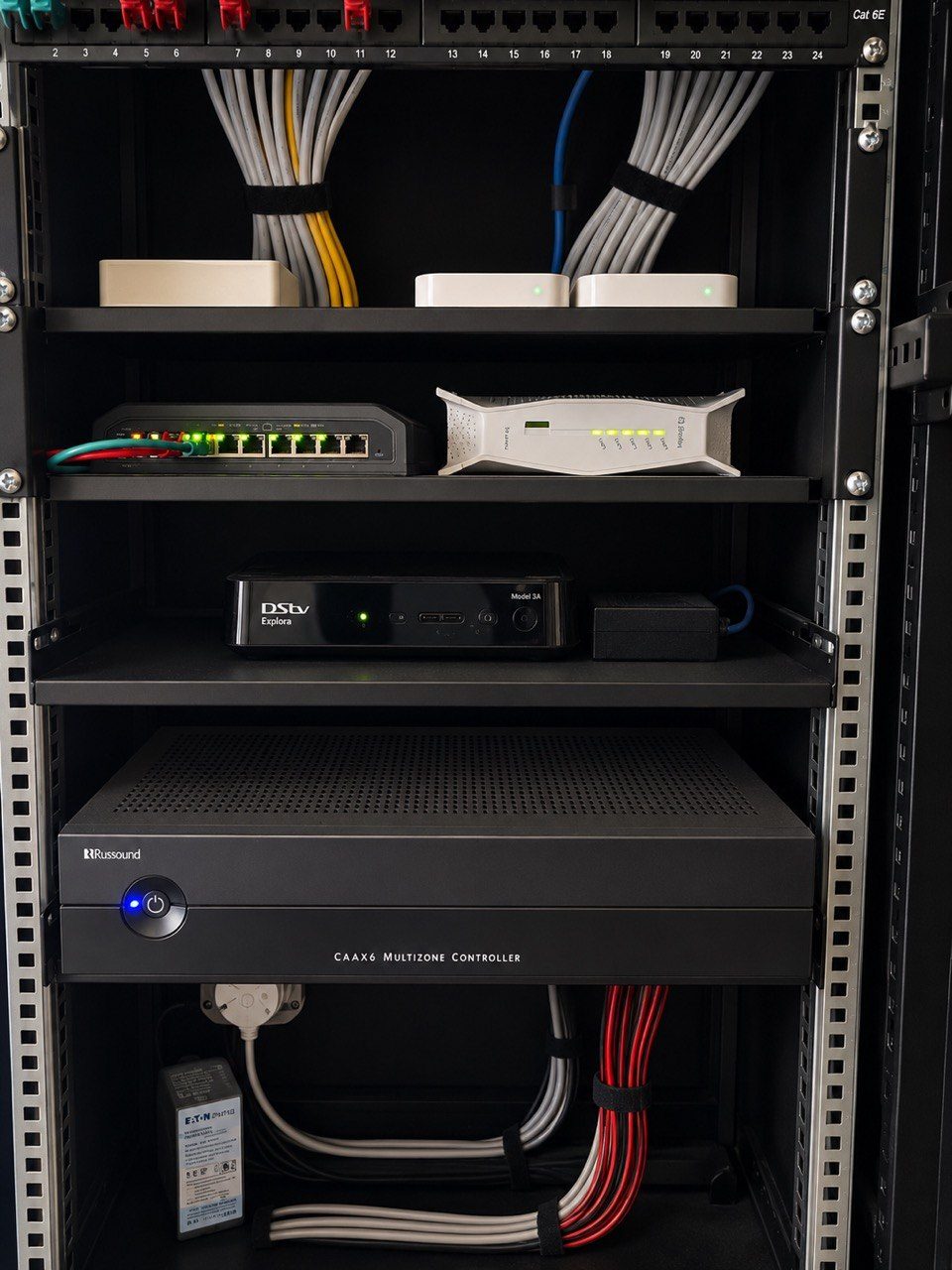
Behind the scenes, a proper system usually includes:
- a central rack or head-end,
- structured cabling,
- managed network switches,
- Wi-Fi access points,
- automation processors,
- lighting modules,
- audio amplifiers,
- source equipment,
- CCTV recording equipment,
- power protection,
- labels and documentation,
- remote-support access,
- handover notes.
This is where many projects succeed or fail.
A home can have expensive equipment and still be frustrating if the cabling is messy, the router was never planned, the equipment overheats, the Wi-Fi is weak, the rack has no space, or nobody knows what each cable does. In our work, the rack often tells the truth about the installation before the app is even opened.
Lighting control
Lighting control is often the first part of home automation that clients feel every day.
It is not only about dimming lights from a phone. It is about deciding which circuits should dim, which should simply switch, what scenes the room needs, how pathways behave at night, and what happens when the home is occupied by guests or staff.
Not every circuit deserves expensive dimming. Sometimes the right decision is to save the client money and use a relay where dimming adds no real value. That kind of judgement is part of the system too.
For a deeper look, see our article on why not every light in a smart home should be dimmed.
Audio, TV and cinema control
Audio visual control can include multiroom music, TV rooms, outdoor audio, projectors, cinema rooms, source switching and remote control.
The important question is not only which amplifier or speaker is best. The important question is how the family will actually use the spaces.
Some rooms need simple background music. Some need proper stereo listening. Some guest bedrooms should be deliberately simple. A main cinema room may need lighting scenes, projector control, source control, ventilation planning and a proper handover so the system is easy to use after everyone leaves site.
Wi-Fi and network infrastructure
Modern home automation depends heavily on the network.
That is why DG Technologies treats the network as part of the automation system, not as a separate afterthought. Crestron processors, touch panels, CCTV recorders, app control, music streamers, intercoms and remote-support tools all rely on stable IP communication.
This is also why we care who manages the router. When an internet provider changes a router and all the IP reservations disappear, the client may experience it as a music, lighting or camera fault. In reality, the network memory of the home has been disturbed.
Read more here: what is a router doing on my home automation quote?
CCTV, access control and intercoms
Security systems can form part of the home automation system, but they need careful boundaries.
CCTV must still be designed as CCTV. Cameras need proper views, recording, retention, naming, network planning and app access. Access control needs power, release hardware, backup methods and clear user responsibility. Intercom calls should route to the right people, not annoy the whole home.
Automation can make these systems easier to use, but it should not hide poor security design.
Power protection and recovery
In South Africa, power behaviour is part of the design.
A home automation system may need inverter coordination, surge protection, UPS power and recovery logic after outages. For serious AV and network racks, we often prefer online double-conversion UPS protection because sensitive HDMI, networking and control equipment does not enjoy messy power transitions.
If the network and control equipment drop out during every power event, the smart home will feel unreliable even if the automation platform itself is good.
Documentation and support
The system is not complete when the app works once.
A proper home automation system should include handover, documentation, passwords and account ownership, equipment records, room names, cable labels and support notes. Years later, those details become the difference between a quick diagnosis and a costly guessing exercise.
That is why DG Technologies designs home automation systems in Durban and KZN as long-term infrastructure, not once-off gadget installation.
The short answer
A proper home automation system includes the visible controls and the hidden engineering.
The visible parts make the home feel simple. The hidden parts keep it simple after the installer leaves.