The honest answer is that CCTV pricing in South Africa depends less on the camera box and more on the site.
An easy building with short cable runs is a completely different job from an office, warehouse, factory, school or estate property with multiple entrances, long routes, remote viewing, access control, viewing monitors and staff who depend on the footage.
That is why I do not like answering only with a camera count.
A quote for eight cameras can be cheap and weak, or it can be a properly designed business CCTV system. The difference is usually in the parts the client does not immediately see.
The camera is only one line item
The visible camera is only the endpoint.
Behind it there may be:
- cameras and lenses,
- a DVR or NVR,
- surveillance hard drives,
- PoE switches,
- cabinet space,
- patch panels,
- conduit or cable tray,
- fibre links,
- network configuration,
- viewing monitors,
- app setup,
- UPS power,
- labelling,
- and handover.
Those items affect the price because they affect whether the system works after the installer leaves.
CCTV camera price is not the same as CCTV installation cost
Searches like “CCTV camera price” usually start with the hardware.
That is understandable. A camera has a price. A recorder has a price. A hard drive has a price.
But the installed cost is the price of making those parts useful on the site.
On commercial work, the camera price may be a smaller part of the final decision than the cable route, height access, PoE switching, NVR capacity, cabinet location, display requirement, network design and whether the client needs footage to be found quickly after an incident.
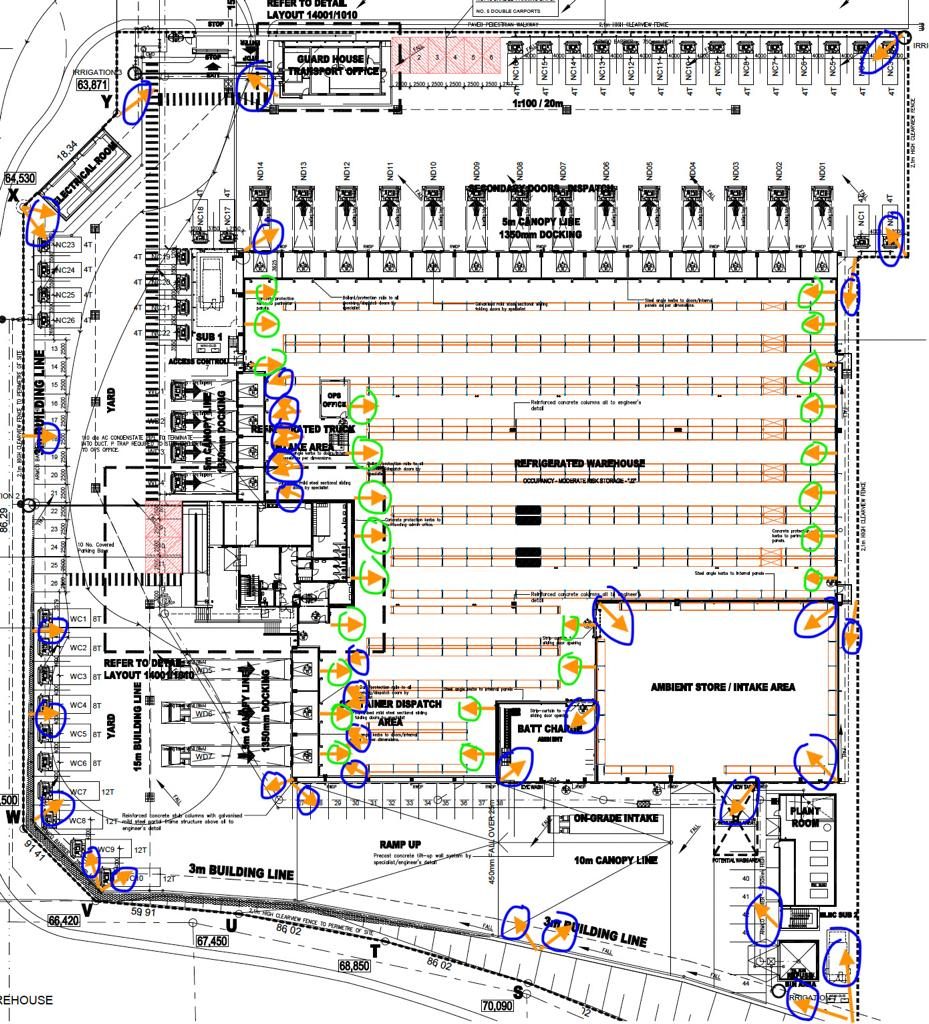
At C&J Services, for example, the useful part of the system was not only the camera list. The design also involved networked viewing, fibre-linked areas, cabinet work and dual monitor viewing from the office. At Ethekwini Cold Stores, the camera system had to support an industrial environment with many more operational and support considerations than a simple home package.
That is why I prefer to talk about installed CCTV system cost, not only camera price.
Why I do not price serious CCTV only per camera
A simple per-camera price can be useful for a quick conversation, but it can also hide the real cost.
One camera may be easy to install on a low ceiling near the recorder. Another may need high-reach access, a long cable route, weather protection, a PoE switch port, a junction box, surge consideration, night-view testing and a viewing angle that must be confirmed with the site manager.
Those are not the same job.
If a quote says “eight cameras” but does not explain the recording days, hard-drive size, cable route, viewing method, user permissions, UPS power or handover, the client is not really comparing eight cameras. They are comparing two different levels of responsibility.
For a deeper breakdown, see CCTV camera price vs CCTV installation cost.
Storage changes the cost quickly
CCTV storage is often underestimated.
The number of cameras, resolution, bit rate, frame rate, compression and recording schedule all affect how many days of footage the system can keep. A business may only discover this after it needs footage from two weeks earlier.
That is too late.
If the site needs proper retention, the recorder and hard drives must be sized for that requirement. A cheap recorder with a small drive may reduce the quote, but it may also reduce the usefulness of the system.
Cabling and access can cost more than expected
Commercial CCTV often costs more because the cable routes are harder.
Warehouses, factories, offices and schools can involve concrete beams, high ceilings, cable trays, long distances, working staff, restricted access, roof spaces, external routes and existing services.
The labour is not only drilling and mounting.
It is getting a stable cable path to the right position without leaving the client with a mess.
Network design matters
Modern CCTV is usually IP-based.
That means the network is part of the camera system.
The quote should consider PoE budget, switch capacity, IP addressing, remote access, fibre between cabinets where distances require it, and whether the recorder can reliably see every camera.
If the network is weak, the cameras get blamed.
Remote viewing is not free of responsibility
Most clients want phone viewing.
That setup needs account ownership, user permissions, secure access and a plan for what happens if the internet router is replaced.
I have seen systems fail remotely after router changes even though the cameras were still recording locally. That is not a camera fault. It is a network and documentation fault.
Access control changes the scope
Many office and commercial CCTV projects also need access control.
Door readers, tag access, intercoms, door locks and emergency release should be considered with camera placement. If a door has access control, the camera view should usually help confirm what happened at that door.
That is why CCTV and access control should be planned together.
What I would check before giving a serious price
Before pricing a commercial CCTV system, I would want to know:
- how many areas need coverage,
- what each camera must prove,
- how many days of footage are required,
- whether remote phone viewing is needed,
- whether a viewing monitor is needed,
- where the recorder will be installed,
- what cable routes are available,
- whether access control is part of the scope,
- whether UPS backup is required,
- and who will use the system after handover.
For clients searching for a quick number, that may feel like a lot of questions.
But those questions are what prevent the wrong price. They separate a basic camera package from a CCTV system that can actually support security, management and evidence retrieval.
That is the real cost discussion.
DG Technologies designs and installs CCTV systems around the site, not just the camera count. That usually produces a more useful result because each camera has a purpose and the system is easier to support later.
For more detail, see what CCTV installation pricing really includes for businesses in Durban, what to check before choosing CCTV installers near you and our C&J Services commercial CCTV case study.
