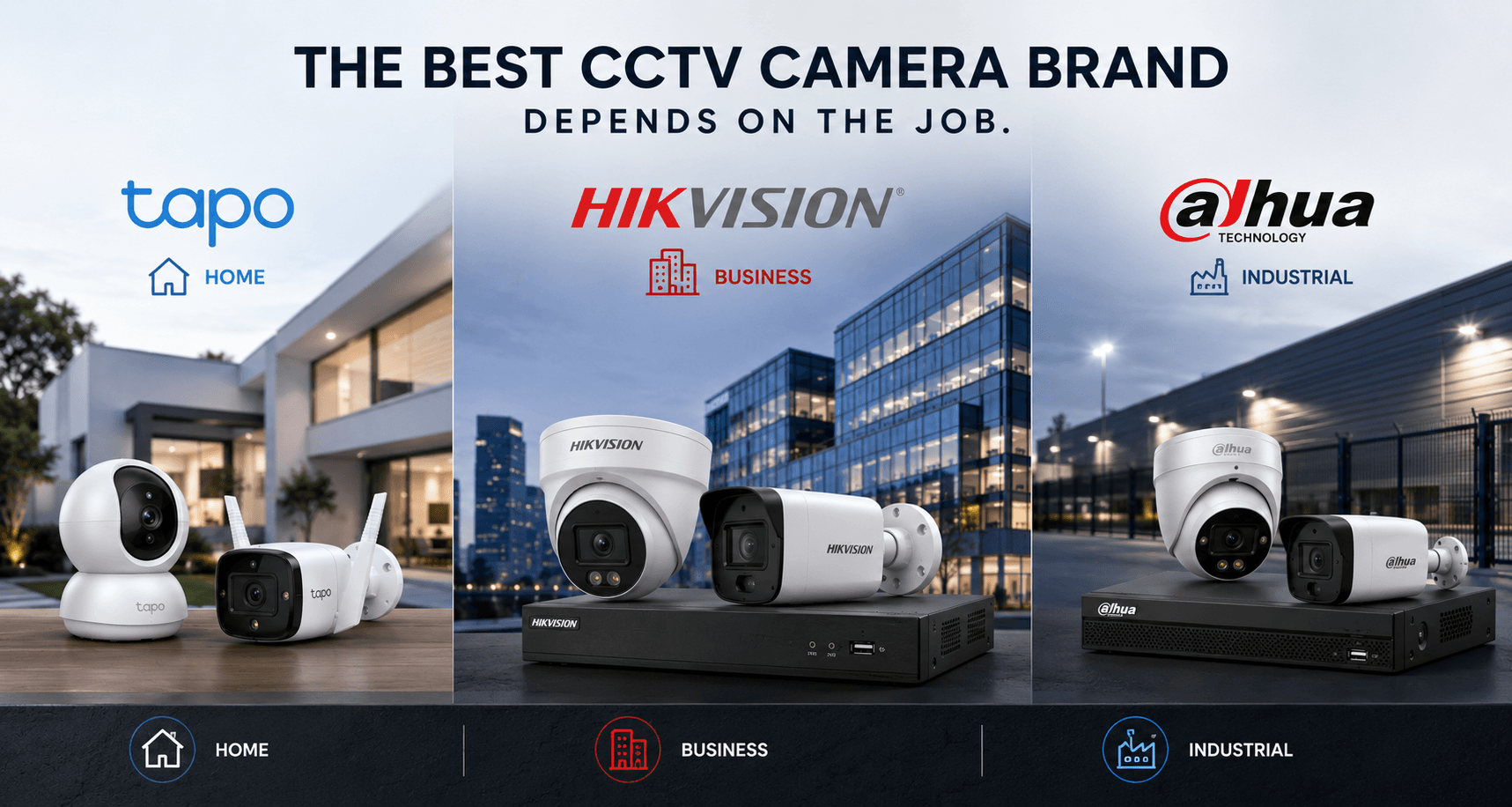
The best CCTV camera brand depends on the job. A small home does not need the same platform as an estate entrance or industrial site. A quick battery camera for a gate view is not the same decision as a 32-camera NVR system with fibre links, UPS backup and remote support. For DG Technologies, the three most practical brands to compare are Hikvision, Dahua and Tapo.
Tapo is the easiest brand to understand. It is cost-effective, simple to use and very friendly for homeowners who want cameras without a complicated installation. The app experience is one of its strongest advantages. A client can open the Tapo app, see cameras quickly, receive alerts and manage basic settings without needing to understand NVR architecture. Tapo is also useful where wiring is difficult, because selected models support wire-free or solar-assisted setups. That makes it a good option for patios, side passages, garages, driveways and quick add-on views where Wi-Fi coverage is strong.
The trade-off is scale. Tapo is not usually the best answer for a large commercial CCTV system, long retention periods, multi-cabinet network design or dozens of cameras across a site. It can be excellent for the right home brief, but the network still matters. If outdoor Wi-Fi is weak, a wire-free camera will not magically solve the problem.
Hikvision is a strong professional CCTV brand for wired IP systems. It is commonly chosen for NVR recording, high camera counts, analytics, night performance and integration with security equipment. Hikvision systems suit clients who want proper recording on site, remote playback through Hik-Connect, and a system that can grow over time. For larger homes in Durban, Umhlanga, Ballito, Hillcrest, Zimbali or Simbithi, a wired Hikvision system is often a better long-term answer than adding one Wi-Fi camera at a time.
Dahua sits in a very similar professional category. It offers strong IP cameras, NVRs, mobile viewing through DMSS and scalable system design. Dahua is a good fit for homes, businesses and industrial premises where the camera count can grow and where the recorder, storage and network backbone need to be planned properly. On commercial work, the brand decision is less about the logo on the camera and more about the complete design: fibre, switches, cabinet locations, storage, alert rules and documentation.
For most South African clients, the shortlist can be simplified without pretending there is one universal winner:
- Tapo often fits easy, affordable, app-first residential CCTV.
- Hikvision often fits robust wired CCTV requiring scalability and NVR recording.
- Dahua can fill a similar professional role, especially where system design and long-term support matter.
How I have made this decision on real briefs
The clearest examples in DG’s records are not arguments about which logo is better. They are decisions about what the client already owns, how the sites should be managed and what a particular camera must achieve.
Existing cameras can decide the recorder platform
In a 2022 design discussion covering two related industrial facilities, I gave two different answers depending on whether the installed cameras would remain.
If those cameras stayed, the sensible quotation was for a recorder compatible with the existing platform. If the cameras were also being replaced, my recommendation was to match the platform already used at the related facility so that both sites could be accessed through one app.
That is a practical brand decision. Standardisation can reduce the number of apps, accounts, interfaces and support paths a client has to understand. But it should not be used as an excuse to discard working cameras without first checking compatibility and condition.
A smaller brief can favour the simpler app
In a separate 2025 recommendation, compact Tapo cameras were considered fit for a small brief and the app experience was part of the reason. The requirement did not call for a multi-cabinet commercial design or months of central NVR storage. It needed cameras appropriate to the task and an interface the client could use comfortably.
That does not make Tapo the best platform for every property. It shows why an app-first system can be the correct answer when the scope is modest, the Wi-Fi is suitable and the recording expectations are understood.
The required view can decide the individual camera
A 2021 DG equipment request took a different approach. The requested Dahua camera was an outdoor-rated 8 MP motorised-varifocal model with wide dynamic range and a specified infrared range. Those characteristics mattered because the camera needed adjustable framing, exposure control and useful night coverage.
The lesson is that even after the platform has been chosen, every camera still has a job. A fixed camera and a motorised-varifocal camera from the same brand are not interchangeable merely because their badges match.
These examples are anonymised and limited to what DG’s dated correspondence and equipment requests establish. They record recommendations and design reasoning; they are not being presented as proof of an unrecorded installation outcome.
What changes the answer in South Africa
The brand shortlist is the easy part. Local conditions decide more of the outcome than the badge on the camera does:
- Load shedding means CCTV has to be planned with UPS backup, or the system is blind exactly when the risk rises.
- Coastal KZN humidity and salt air affect equipment and mounting choices. A housing that lasts inland does not automatically last in Umhlanga or Ballito.
- Long driveways and boundary walls may need trenching, fibre, wireless bridges or PoE switching before any camera decision matters.
- Remote viewing must be secured properly, not opened carelessly through the router.
- Storage must match the real risk profile, not just the cheapest hard drive on the shelf.
For owners monitoring a coastal property while living elsewhere, our guide to holiday-home CCTV, security and automation in KZN covers the absentee-owner case in more detail.
The wrong way to buy CCTV is to choose the cheapest camera with the highest megapixel number. The right way is to decide what each camera must capture: a face, a number plate, a gate, a driveway, a boundary wall or a general awareness view. Then the brand, lens and recorder can be selected properly.
DG Technologies designs CCTV installation around the property first and the product second. That is how you get a system that is reliable, easy to use and still supportable years later.
