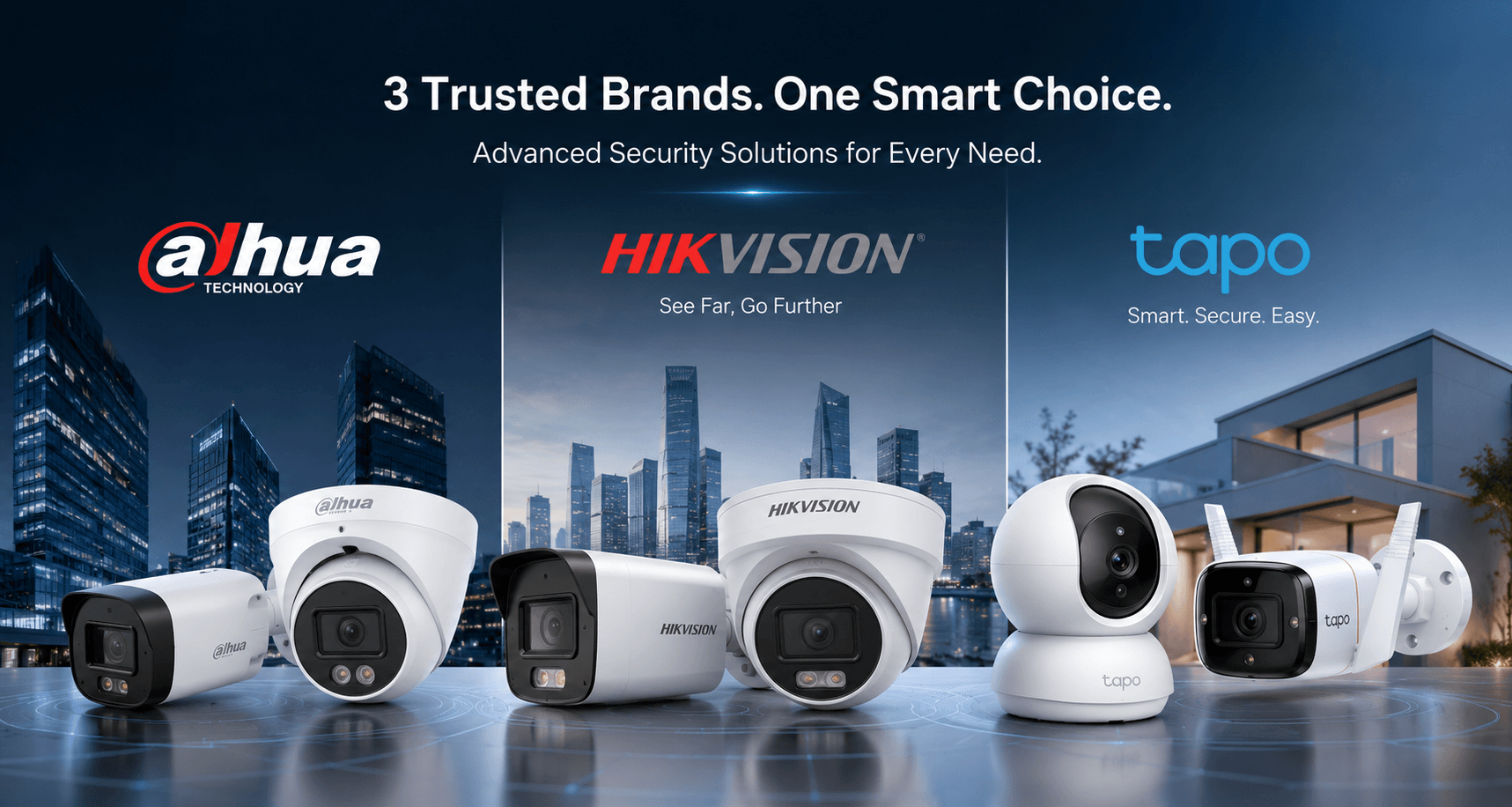
Choosing a CCTV brand should start with the property, not the logo on the box.
Dahua, Hikvision and Tapo can all be useful brands in the right situation. The mistake is treating them as if they are trying to solve exactly the same problem.
A small home that needs quick mobile viewing does not have the same requirement as a large estate property with many cameras. A business with 100-plus cameras does not need the same design as a house that only needs driveway, gate and patio coverage. A wire-free camera on solar power can be a brilliant solution in one place and the wrong solution in another.
DG Technologies installs CCTV systems across Durban and KZN with a practical view: the camera brand must fit the site, the network, the budget, the support requirement and the way the client will actually use the footage.
Tapo: simple, affordable and surprisingly useful
Tapo is often the most cost-effective of the three.
It suits homes where the client wants a simple app, quick playback, easy notifications and a neat solution without building a large NVR-based system. The Tapo app is one of its strengths. It is easy to use, playback is straightforward, and event detection can help the client find relevant footage without searching through hours of recording.
Tapo can be especially useful where:
- The budget is limited.
- The client wants simple mobile viewing.
- There is strong Wi-Fi coverage.
- Wire-free or solar-assisted cameras make installation easier.
- The camera count is modest.
- The system does not need enterprise-level recording capacity.
Battery-operated and low-voltage Tapo cameras can also solve difficult retrofit situations where running new cable would be disruptive.
The important warning is Wi-Fi. A wireless camera is only as good as the network it depends on. If the Wi-Fi is weak, badly placed or unstable, the camera will feel unreliable even if the camera itself is good.
That is why DG Technologies often treats Wi-Fi and networking as part of the CCTV design.
Hikvision: scalable and widely supported
Hikvision is a strong choice for more traditional CCTV installations.
It is well established, scalable and suitable for homes and businesses that need wired cameras, NVR recording, remote viewing and a more structured security design. It can support larger systems than a simple consumer camera setup and has a wide range of camera types, lenses and recorder options.
Hikvision often fits:
- Larger homes.
- Estate properties.
- Commercial premises.
- Wired IP camera systems.
- NVR-based recording.
- Projects needing multiple camera styles.
- Sites where long-term support and expansion matter.
For a premium home, the value is not just the brand. It is the design: lens selection, camera placement, cable routes, recording retention, night performance, app setup and serviceability.
Dahua: strong for larger and commercial systems
Dahua is also a serious CCTV platform and performs very well in larger installations.
It is similar to Hikvision in many ways: good camera range, scalable NVR options, solid build quality and suitability for structured IP CCTV systems. DG Technologies has used Dahua in large commercial-scale environments where the camera count and recording requirements are far beyond a small home system.
Dahua often fits:
- Businesses and industrial sites.
- Large CCTV deployments.
- Homes needing a proper wired security backbone.
- Sites with many camera zones.
- Projects where NVR capacity matters.
- Installations requiring professional design and support.
When the system grows, the recorder, storage, network switching, PoE budget and camera grouping become just as important as the camera model.
The app matters, but it is not the whole system
Many clients ask for the best CCTV app.
That is a fair question. If footage is difficult to find, the system becomes frustrating. A good app should make live view, playback, notifications and event search easy.
Tapo is strong here for smaller home systems because the app feels simple and approachable. Hikvision and Dahua also provide remote viewing and playback, but their strength is often the larger system architecture behind the app.
The right choice depends on whether the client needs simplicity, scale or both.
Wired is still best when reliability matters
Wireless cameras have their place, especially when installation speed and cost matter. But for permanent CCTV on premium homes, estates and businesses, wired IP cameras are still usually the more reliable foundation.
A wired camera receives stable power and data through proper cabling. It does not depend on battery charging, Wi-Fi strength or solar exposure. It is also easier to integrate into a structured NVR system with long-term recording.
That does not mean Tapo is wrong. It means the system must be honest about its purpose.
The design matters more than the brand
A badly placed expensive camera is still a bad camera.
Before choosing Dahua, Hikvision or Tapo, the installer should understand:
- What needs to be protected.
- Where people and vehicles move.
- What lighting exists at night.
- Whether faces, number plates or general awareness matter.
- How long footage must be stored.
- Whether Wi-Fi is strong enough.
- Whether cameras can be wired.
- How the client will search footage later.
That is why DG Technologies focuses on proper CCTV design before installation and camera placement over camera count.
The best CCTV brand is the one that fits the job. For some homes that may be Tapo. For larger homes and businesses it may be Hikvision or Dahua. For complex sites, the answer may involve different camera types, a stronger network and a proper recording strategy.