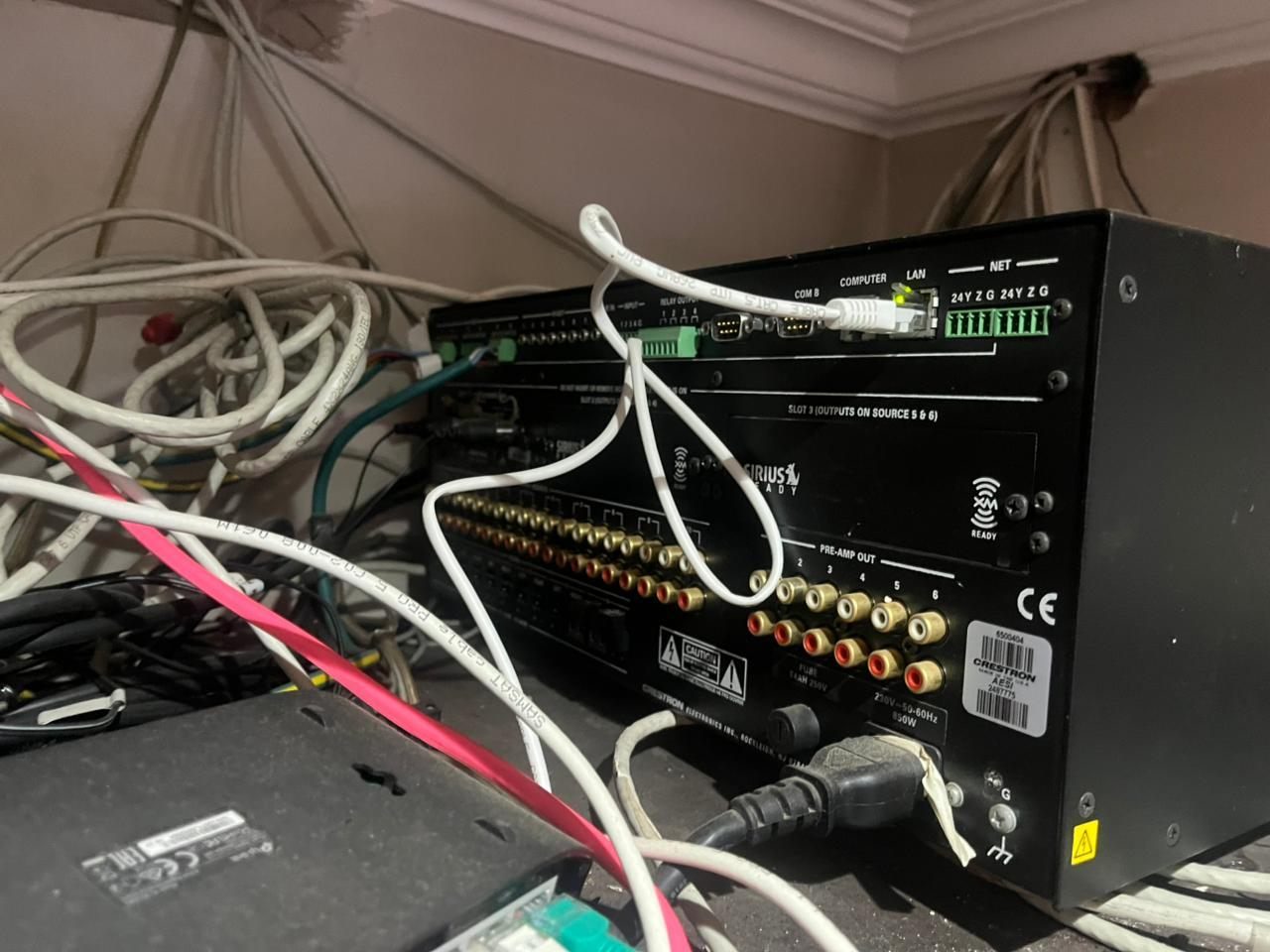
Many homes in Durban, Mount Edgecombe, Umhlanga, Zimbali and the wider KZN market already have Crestron systems installed.
Some are still excellent. Some are tired. Some have been modified by too many people over too many years. Some were never installed properly in the first place.
When those systems start giving trouble, the homeowner often asks a reasonable question:
Can this old Crestron system be upgraded to Crestron Home?
The honest answer is: sometimes, yes. But it should not be answered from a brochure. It should be answered after inspecting the actual house.
Crestron Home is often a sensible residential platform
DG Technologies likes Crestron Home for serious residential work because it brings Crestron’s reliability into a cleaner, more modern home interface. It can reduce unnecessary custom programming for many homes, gives clients a polished app and touchscreen experience, and makes common residential tasks faster to configure and maintain.
For many luxury homes, that makes sense.
But an upgrade is not only a software decision.
The existing system may include old processors, lighting modules, keypads, touchscreens, AV distribution, amplifiers, audio sources, remote controls, network switches, Wi-Fi equipment and cabling. Some of that may still have value. Some may be the reason the home is unreliable.
The job is not to sell a new platform blindly.
The job is to understand what should happen next.
Start with what the client actually uses
Before recommending hardware, DG Technologies prefers to understand the home.
Which rooms are used every day? Which audio zones naturally play together? Does the client still use touchscreens, or do they mostly use the mobile app? Are guests expected to control TVs themselves? Does the house manager need a simpler interface? Are certain lighting scenes used daily while others have not been touched in years?
Those questions matter because they can prevent waste.
An older custom Crestron system may have dozens of features that looked impressive when it was installed. Years later, only a small number may actually matter to the family.
That is not failure. That is real life.
An upgrade should preserve the experience the client values, remove the complexity they do not use, and improve the reliability underneath.
Some old equipment is worth keeping
Not every upgrade should be a clear-out.
A good power amplifier is still a good power amplifier if it is healthy, suitable and correctly integrated. Existing speaker cabling may still be useful. Some keypads may be in the right positions. Certain lighting circuits may be perfectly serviceable. Existing racks may be improved rather than discarded.
This is where experience saves money.
If a previous system has usable infrastructure, throwing everything away may not be the best engineering decision. It may simply be the easiest quotation to write.
DG Technologies prefers to separate equipment into categories:
- keep and recommission
- keep temporarily and plan a future phase
- replace because it is unreliable or unsupported
- remove because the client no longer needs it
- redesign because the original concept no longer suits the home
That approach gives the homeowner a clearer decision.
Lighting needs special care
Lighting is one of the most important parts of a Crestron upgrade.
Older homes may have lighting loads that have changed over time. Incandescent lamps may have become LED. Dimmable circuits may no longer need dimming. Some circuits may be better on relay control. Keypads may be labelled according to the old room layout. Exterior lighting may have changed after landscaping or renovations.
Before moving to a new control environment, the lighting design should be checked at circuit level.
The question is not only whether Crestron Home can control the lights.
The question is whether the lighting circuits, modules, loads and user interface still make sense for the way the home is lived in now.
The network may need to be upgraded first
A legacy Crestron system may have been installed before the home depended heavily on streaming, mobile apps, remote support, CCTV, cloud services and managed Wi-Fi.
That means the network may be the weak point.
Before upgrading control, DG Technologies checks whether the router, switches, access points, IP addressing, rack power and remote access path are suitable. A modern Crestron Home system should not be placed on top of an unmanaged, undocumented or unstable network.
This is why smart-home network planning is part of upgrade work, not a separate afterthought.
Missing source code changes the conversation
With traditional custom Crestron systems, the original program files matter.
If the homeowner does not have access to the source code, changes can become harder. In some cases, the system can still be supported. In other cases, the practical answer is to redesign and migrate in a controlled way.
This is one reason Crestron Home can be attractive for residential upgrades. It may simplify future changes and make long-term support less dependent on one person’s old custom program.
That does not mean every custom system should be abandoned. It means the support model should be considered honestly.
The best upgrade may be phased
Some homes should not be upgraded in one dramatic step.
A phased approach may be better:
- stabilise the network
- document the existing rack and lighting system
- repair urgent faults
- replace unsupported touch panels or processors
- simplify audio zones
- update lighting control where it matters most
- move selected areas into Crestron Home
- plan future improvements when the client is ready
Phasing is not always cheaper in the long run, but it can reduce disruption and help the client make better decisions.
For occupied luxury homes, that matters.
Upgrade for reliability, not novelty
The reason to upgrade an old Crestron system should not be that something newer exists.
The reason should be that the home will become easier to use, easier to support, more reliable and more aligned with how the family lives now.
Crestron Home can be a strong answer for many South African homes, but only when the existing system has been assessed properly.
Before replacing everything, ask:
- What still works?
- What still adds value?
- What causes support calls?
- What has become obsolete?
- What does the client actually use?
- What would we choose if this was our own home?
That last question usually cuts through the noise.
The best upgrade is not always the biggest one. It is the one that leaves the home working better years after the invoice has been forgotten.