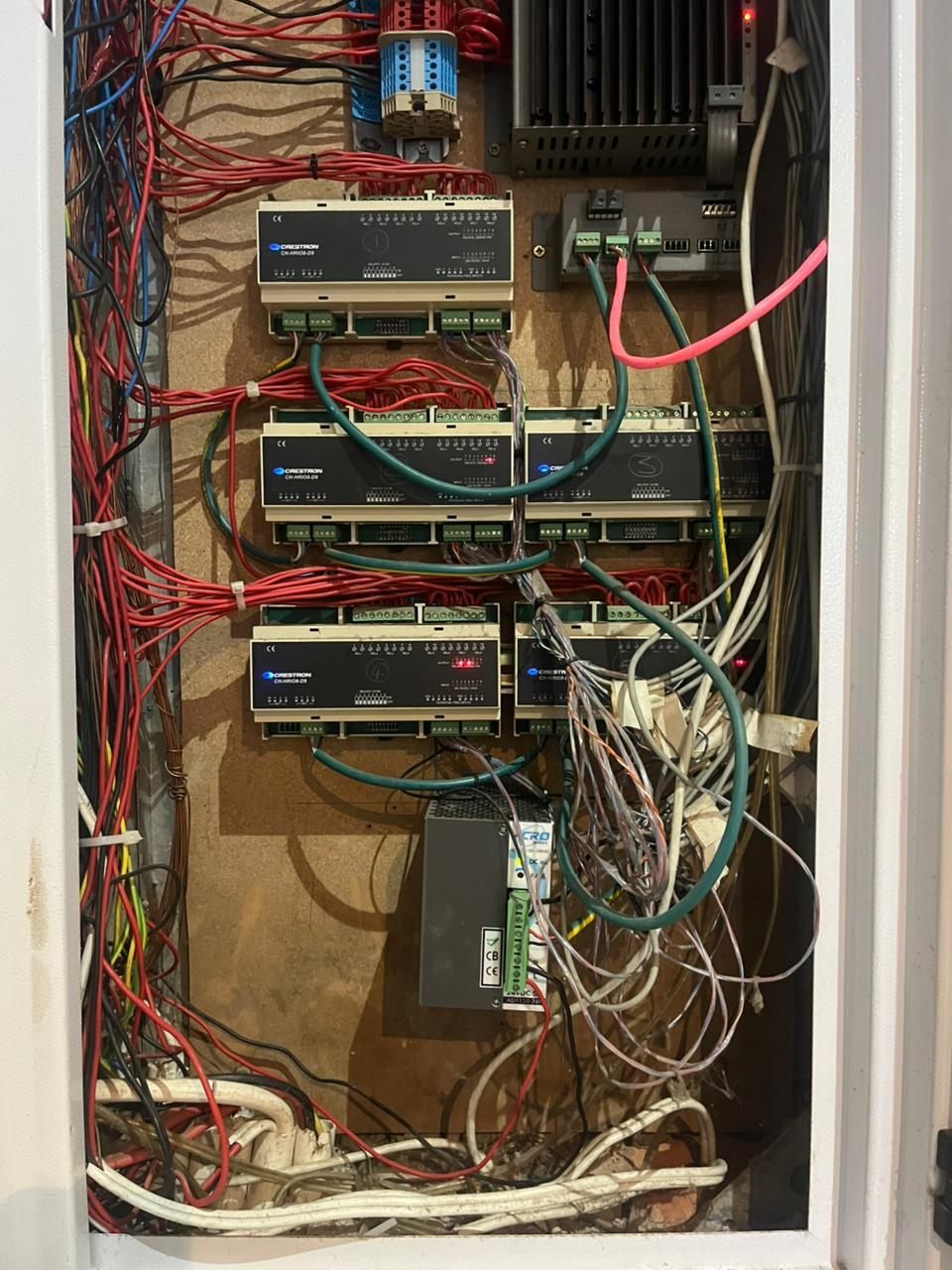
Buying a luxury home with Crestron already installed can be a major advantage.
It may mean the house already has structured lighting control, distributed audio, touchscreens, keypads, AV routing, CCTV, networking and a proper equipment rack. If the system was designed and maintained well, the new owner inherits infrastructure that would be expensive to recreate from scratch.
But if the system was neglected, undocumented or modified by too many people over too many years, the buyer may inherit a problem.
The tricky part is that a smart home can look impressive during a viewing.
The touch panel lights up. Music plays in one room. A few lights respond. The estate agent says, “It has Crestron.”
That is not enough.
Before buying a home with an existing Crestron system, the buyer should understand what they are taking ownership of.
Ask who installed and supported the system
The first question is simple:
Who knows this system?
If the original installer is still available, cooperative and able to support the home properly, that is useful. If the installer disappeared, retired, closed, refuses to assist, or never provided documentation, the new owner should know that before transfer.
An inherited system without support history is not automatically bad, but it needs inspection.
DG Technologies often sees homes where the Crestron equipment is not the weak point. The problem is the installation history around it: undocumented wiring, missing program files, changed routers, old media sources, ageing power supplies, unsupported touch panels and lighting loads that changed over time.
A proper Crestron assessment should separate those issues before anyone recommends replacement.
Ask whether the source files are available
For older custom Crestron systems, the source code or program files matter.
Without them, small changes can become harder. A room name change, keypad replacement, new amplifier, changed TV, failed touch panel or updated source may require work that is more difficult if nobody has the original project files.
That does not mean the system is worthless.
It means the support path changes.
If the source files are available, a qualified Crestron technician may be able to modify and support the system more easily. If they are missing, the buyer should budget for a deeper audit and possibly a controlled migration to Crestron Home or a redesigned control layer.
The important thing is not to discover this after moving in.
Ask what still works every day
A seller may demonstrate the best parts of the system. A buyer should ask about daily use.
Useful questions include:
- Which rooms are controlled by Crestron?
- Which rooms no longer work properly?
- Are all keypads labelled correctly?
- Do all touchscreens still respond?
- Does the mobile app work?
- Does remote access work?
- Does music work in every zone?
- Do TVs, Apple TVs, DSTV decoders and amplifiers switch on correctly?
- Are exterior lights and scenes still correct?
- Does CCTV recording actually work?
- Does the system recover after power failures?
The difference between “it worked once during a demo” and “the family uses it every day without issues” is significant.
Ask about the lighting system
Lighting control is one of the most expensive and important parts of an inherited Crestron home.
The buyer should know whether the lighting circuits are controlled by central modules, local switches, relays, dimmers or a mixture. They should also know whether the system was designed for older incandescent or halogen loads and later changed to LED.
Modern LED lighting can expose old dimming problems.
Flickering, buzzing, poor dimming, circuits that will not switch cleanly, or lights behaving differently after lamp changes may not be Crestron failures. They may be load compatibility issues.
This is why DG Technologies checks lighting at circuit level, not only from the keypad.
Ask about the network
Modern Crestron systems depend heavily on the network.
If the fibre router was replaced, if an IT company changed the IP range, if Wi-Fi access points were added without coordination, or if switches have failed ports, the automation system may become unreliable.
The buyer should ask:
- Where is the router?
- Is the network documented?
- Are important devices on reserved IP addresses?
- Are switches managed?
- Is Wi-Fi coverage measured or guessed?
- Can the automation provider access the system securely for support?
- Does CCTV remote viewing work from outside the home?
An inherited Crestron system sitting on an unmanaged network can feel slow, unreliable or confusing even when the Crestron hardware itself is still healthy.
Ask where the rack is and whether it is serviceable
The rack tells the truth.
If the equipment rack is neat, labelled, ventilated, powered properly and documented, the home is usually easier to support. If the rack is hidden behind furniture, overheated, unlabelled, full of temporary adapters and impossible to access, the buyer should be cautious.
A smart home is not only what appears on the touch panel.
It is also the wiring, power, network, cooling, labels and records behind the scenes.
Budget for an independent technology inspection
For a serious property purchase, a smart-home inspection should be treated like a pool, roof or electrical inspection.
The buyer does not need to know every technical detail. They need a clear report:
- what is working
- what is not working
- what is unsupported
- what is risky
- what can be kept
- what should be replaced
- what should be budgeted for later
That kind of report can prevent surprise costs and help the buyer negotiate properly.
It also prevents unnecessary fear. Some older Crestron systems are still worth saving. Some need careful recommissioning. Some should be upgraded in phases. Some are hiding major problems.
The value is knowing which one you are buying.
If you are considering a KZN home with an existing Crestron or smart-home system, involve a specialist before you inherit it blindly.
The system may be one of the home’s best assets.
But only if you understand it.