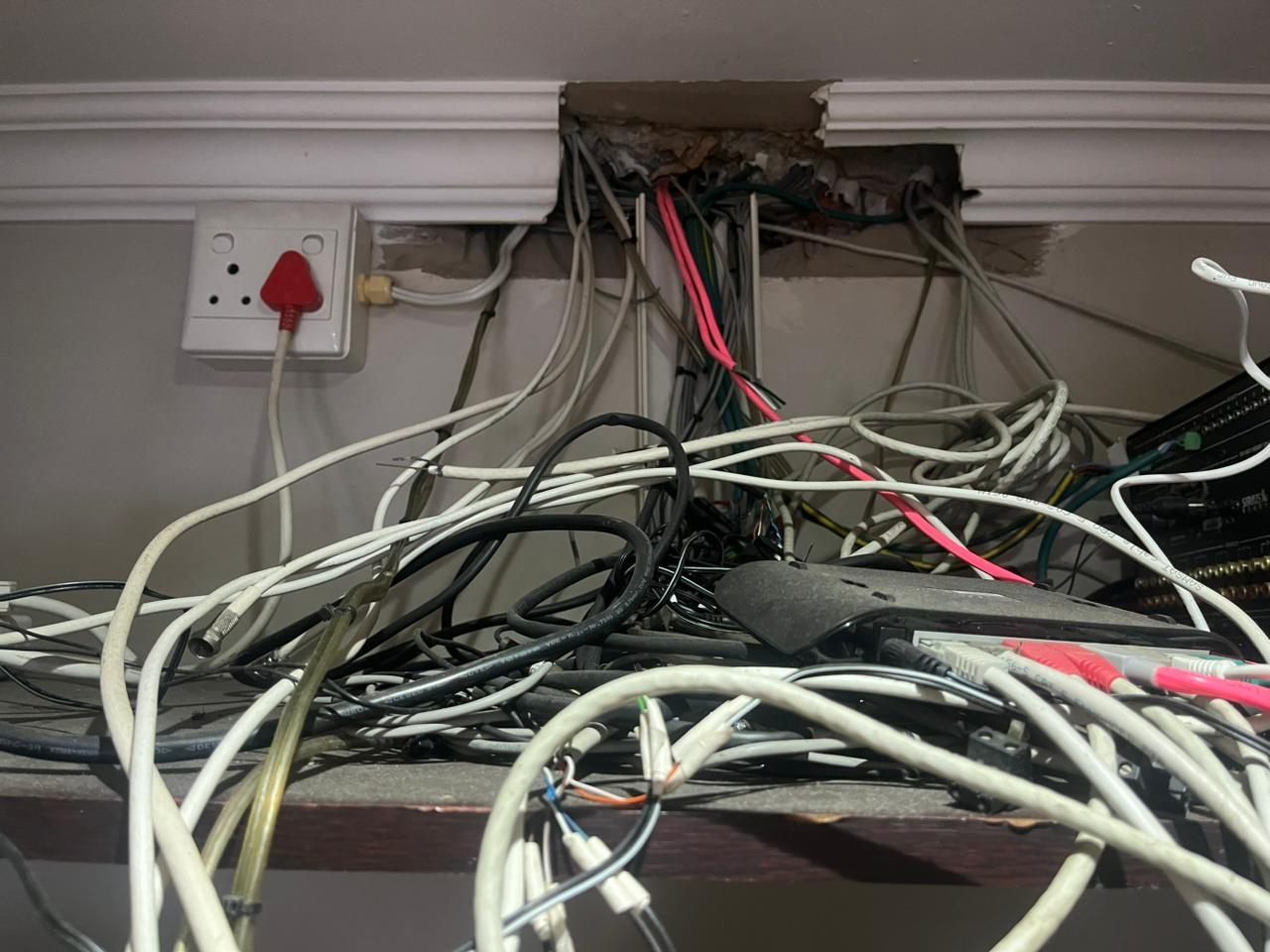
Temporary fixes are not always bad.
On real projects, they are sometimes necessary.
A client may be waiting for building approval. A renovation may be happening in phases. The fibre provider may have changed equipment unexpectedly. A room may need music for an event before the final rack is complete. A CCTV camera may need to be moved before the permanent conduit route is ready. A Wi-Fi access point may need to cover an area while ceilings are still open.
The problem is not the temporary fix.
The problem is when everyone forgets it was temporary.
In smart homes, temporary work can quietly become permanent if there is no plan, no label and no follow-up. A cable left loose in a ceiling. A small switch added behind equipment. A power supply plugged into a multiplug. A camera connected through a workaround. An access point placed somewhere “just for now.” A media source patched directly because the correct route was not ready.
Six months later, nobody remembers why it is there.
Three years later, it becomes the fault nobody can explain.
Temporary should mean controlled
A controlled temporary fix has three qualities.
It is safe.
It is documented.
It has a next step.
If a workaround is unsafe, it should not be done. If it is undocumented, it becomes future confusion. If there is no next step, it is not really temporary. It is an unfinished installation hiding inside the house.
This matters especially in high-end homes where home automation, CCTV, Wi-Fi, audio and lighting control depend on each other. One small network or cabling workaround can affect several systems.
Renovations create temporary pressure
Renovations are full of pressure.
Builders need to close ceilings. Painters need to finish. Joiners need dimensions. Interior designers need clean walls. Electricians need to move on. The client wants the room usable.
That is exactly when temporary technology decisions happen.
The AV team may not yet have the final cabinet. The new TV may not have arrived. The fibre line may be in the wrong place. The old speaker cables may be discovered behind plaster. A previous installer may have left volume controls, wall plates or unused cables that nobody expected.
In those moments, a good installer must think beyond the immediate fix.
If a cable route must remain accessible, it should not be buried. If a draw box is needed, it should stay reachable. If an access point is hidden in a ceiling, there must be a practical way to reach it later. If a cabinet is not final, the temporary equipment layout should not make the permanent rack harder to build.
Good renovation support is partly technical and partly defensive. It protects the future project from today’s rush.
Access must not be designed out
One of the biggest mistakes in retrofit work is losing access.
A speaker hole, ceiling trap door, service hatch, cabinet panel or accessible draw box may look like a small detail during construction. Years later, it may be the only reason a cable can be replaced without breaking open a finished room.
This is why DG Technologies thinks carefully about cable routes, speaker positions, access points and head-end locations. We do not only ask where the equipment goes. We ask how someone will reach it when the house is complete.
That applies to:
- Wi-Fi access points
- speakers
- TV conduits
- CCTV points
- fibre routes
- dish points
- rack cabling
- gate and intercom cabling
- outdoor audio
- ceiling-mounted devices
A hidden device is fine if it remains serviceable. A hidden device that nobody can reach is a future problem.
Temporary network changes need extra care
Network work is one of the most common areas where temporary fixes cause long-term trouble.
A router may be replaced “just to get internet back.” A temporary Wi-Fi name may be created. An extra switch may be added. A CCTV recorder may be moved to another port. A Sonos device may be connected wirelessly because the network point is not ready.
Each of those decisions can be reasonable in isolation.
But if the network is not updated properly afterwards, the house starts to lose its structure.
IP reservations disappear. Device names become unclear. Remote access fails. Cameras drop offline. Music zones behave strangely. The automation processor cannot find something it used to control.
Temporary network changes should be recorded and then cleaned up properly.
Phased upgrades are different from abandoned fixes
There is a big difference between a phased upgrade and a half-finished repair.
A phased upgrade is deliberate. It says:
“We are doing this now, because it solves the immediate problem. Later, when the ceiling opens or the cabinet is built or the budget allows, this is the permanent plan.”
That is responsible.
It can save money and reduce disruption.
An abandoned fix says:
“It works, so leave it.”
That can be expensive later.
DG Technologies often recommends phased work where it makes sense. Not every home needs to be rebuilt in one movement. But each phase should leave the system cleaner, better documented and easier to support than before.
The permanent plan should be written down
The simplest way to prevent temporary work becoming permanent by accident is to write down the plan.
The notes should include:
- what was changed
- why it was changed
- whether it is temporary or permanent
- what depends on it
- what still needs to happen
- where cables or devices are located
- what should not be covered or sealed
- who is responsible for the next step
This does not need to be a huge document. Even a clear support note and a few photos can save hours later.
Good support leaves fewer mysteries
Many smart-home faults become difficult because too much history is missing.
Someone changed a router. Someone moved a decoder. Someone removed a cable. Someone plastered over an old wall plate. Someone added a switch. Someone put an access point in a cupboard. Someone changed a password.
The work may have made sense at the time.
The problem is that the house forgot.
That is why support is not only about fixing what is broken. It is about preserving the story of the system so the next decision can be made intelligently.
Temporary fixes are allowed.
Unexplained temporary fixes are the problem.