Some smart-home delays start long before anyone arrives on site.
They start with stock.
Premium AV and automation projects depend on specific equipment arriving at the correct stage of construction. Processors, amplifiers, speakers, touch panels, network switches, access points, cameras, NVRs, screens, projectors, brackets, cables, power equipment and small accessories all have to line up with the programme.
If one important item is unavailable, the project can still move forward for a while. But eventually the missing part affects commissioning, handover, joinery, electrical completion or the client’s moving-in date.
This is why supplier stock and lead times are not admin details. They are part of the project design.
The right substitute is not always obvious
When equipment is out of stock, the quick answer is to choose an alternative.
That can be fine.
But in smart-home work, the alternative must be checked properly.
Will it fit in the same rack space?
Will it work with the same control system?
Does it need different power?
Does it require different cabling?
Does it change the user interface?
Does it affect the budget?
Does it have local support?
Does it create a future maintenance problem?
For example, replacing a speaker, amplifier, matrix, switch or camera with a different model may look simple on paper. In practice, it may change mounting depth, heat, programming, control drivers, PoE budget, audio performance or warranty support.
Good procurement is not only finding “something similar”. It is understanding what the substitution changes.
Construction timing makes procurement more important
During a new build or renovation, some decisions have physical consequences.
A TV bracket may affect noggins and wall reinforcement. A projector may affect ceiling position and cable length. A speaker may affect cut-out size and ceiling access. A touch panel may affect back-box depth. A rack may affect ventilation and cabinet dimensions. A screen may affect ceiling recesses and electrical supply.
If those items are chosen late, the builder may already have closed the wall or ceiling.
That is why DG Technologies pushes for early involvement with architects, builders and electricians. The technology specification should be aligned before first-fix work is finalised.
This links directly to AV planning before construction and the low-voltage first-fix guide for architects.
Local supplier support matters
South African projects need practical supplier thinking.
It is not enough for a product to look good online. It must be obtainable, supportable and sensible for the property.
For home cinema, suppliers such as Homemation, Planetworld and Alpha Technologies may be part of the wider supply picture depending on the product category and project requirement. For automation, networking, CCTV and AV, the installer needs to know which products are proven locally and which items may create unnecessary risk.
Local support matters when:
- A product fails under warranty
- A replacement is needed quickly
- Firmware support is required
- A driver or integration needs confirmation
- A model is discontinued
- A client wants long-term maintenance
The best product is not always the one with the most impressive brochure. It is the one that suits the system, has the right support path and can be maintained years later.
Lead times should be discussed honestly
Clients and professionals often want confident dates.
That is understandable.
But honest project planning should separate what is confirmed from what is assumed. If an item is in stock, that is different from “available soon”. If an imported item has a lead time, that should be discussed. If a project depends on a specific model, the risk should be known early.
This is especially important in large homes where several trades are working around each other. A delayed rack component can affect commissioning. A delayed speaker can affect ceiling closure. A delayed screen can affect joinery. A delayed camera can affect security handover.
Good communication prevents surprises.
It also protects trust. A client can handle a real lead-time conversation much better than a last-minute excuse.
Small items can stop big systems
One of the strange truths of AV work is that small items often matter.
A cable, bracket, emitter, adaptor, patch lead, keystone, power supply, rack shelf, connector or mounting accessory can hold up a room.
These items do not look important on the quotation compared to the main equipment, but they are part of the system. If they are wrong, missing or poor quality, the final installation suffers.
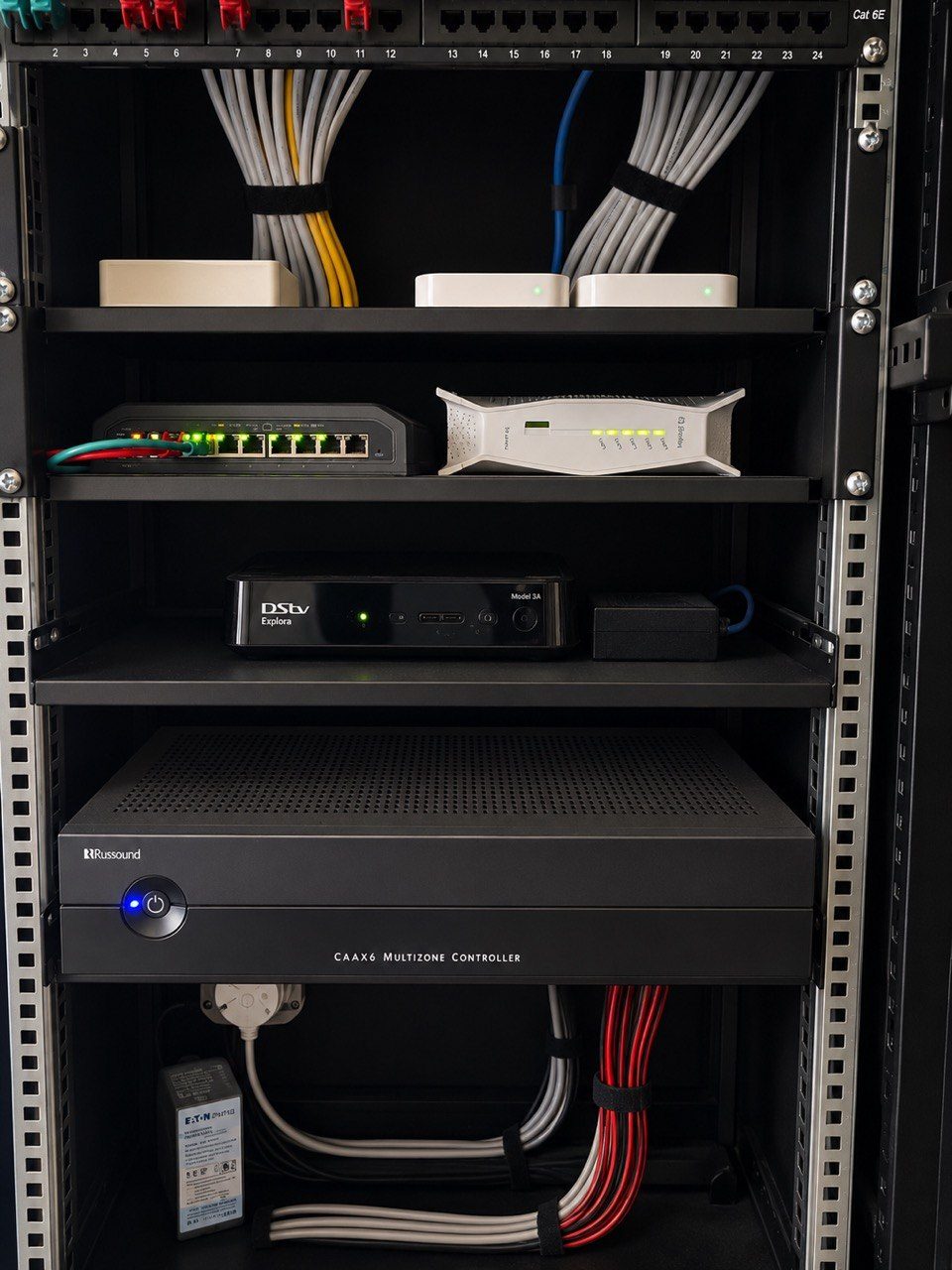
This is why a clean equipment rack is not only about the expensive hardware. It is also about the small decisions that make the system serviceable.
Procurement is part of engineering judgement
DG Technologies does not see procurement as separate from design.
The equipment list should support the design. The design should respect availability. Substitutions should be deliberate. Lead times should be communicated. The client should understand where timing risk sits.
That is not glamorous work.
But it is often the difference between a smooth project and a stressful one.
In premium smart-home projects, reliability starts before the first cable is pulled. It starts with the right decisions being made early enough for the rest of the build to succeed.