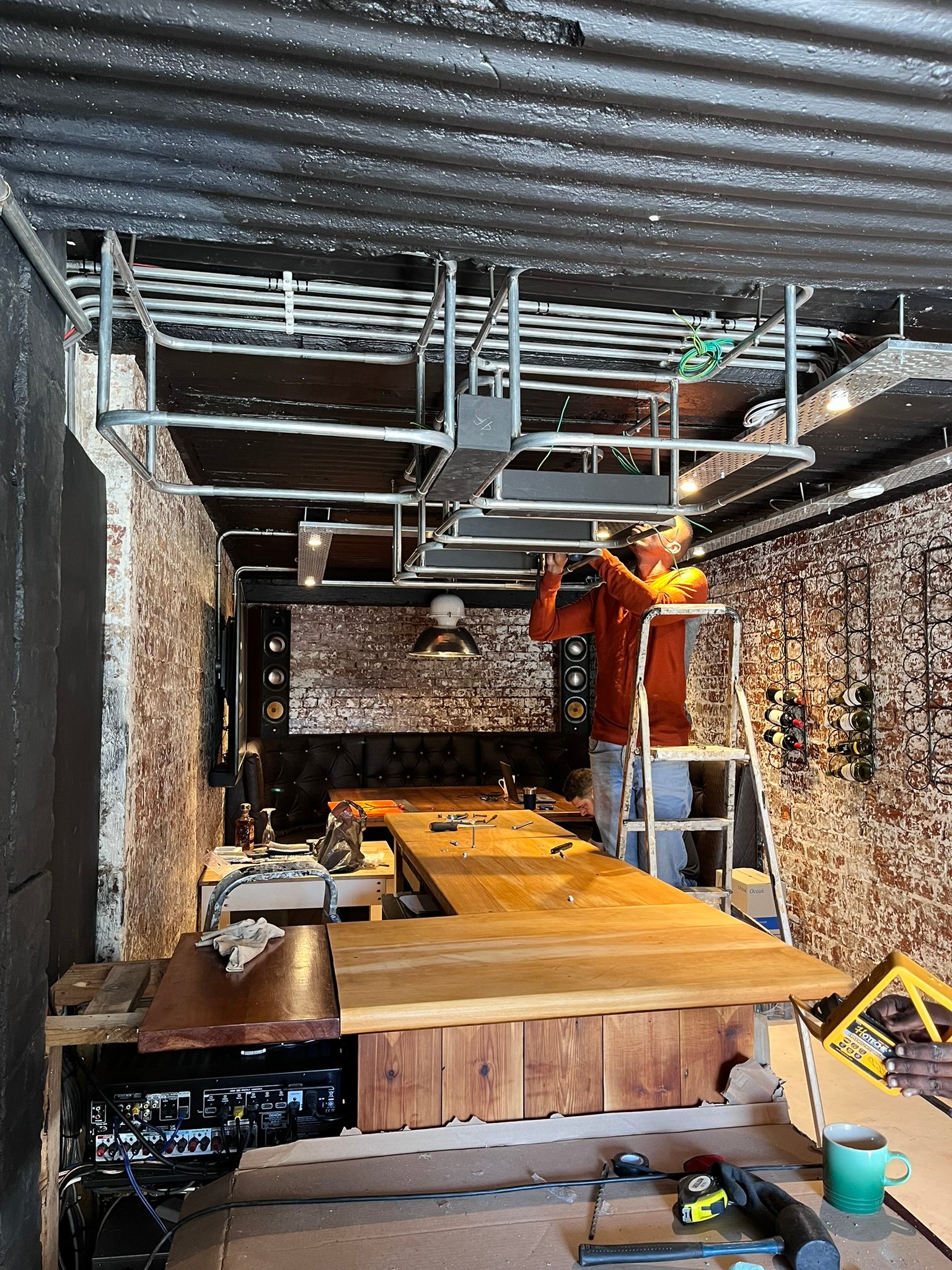
Supplier stock can delay a smart-home or AV project.
That is reality.
South African projects depend on local distributors, imported equipment, courier timing, product availability, warranty swaps, back orders and sometimes last-minute changes from the client or building programme.
But waiting for stock does not always mean waiting with tools down.
A good AV team knows how to use that time.
The difference between a reactive installer and a professional integrator often shows during delays. One team says, “We cannot do anything until the equipment arrives.” Another team walks the site, prepares the cabinet, finishes cable routes, updates the labels, checks the drawings and gets everything ready so the missing equipment can drop into place properly when it arrives.
That discipline matters.
There is always a readiness layer
Before a processor, amplifier, switch, access point, camera, projector or screen is fitted, the site can still be prepared.
The rack can be positioned.
Shelves can be measured.
Cables can be dressed.
Network points can be terminated.
Labels can be created.
Conduits can be checked.
Draw wires can be confirmed.
Power and ventilation can be reviewed.
The cabinet can be organised so the final equipment is not squeezed into chaos at the last minute.
This readiness layer is not glamorous, but it is what makes the final installation feel controlled.
A cabinet can be prepared before every device arrives
Many premium systems fail visually and mechanically at the rack.
The equipment may be excellent, but the cabinet becomes a collection of rushed decisions. Shelves are in the wrong places. Patch leads are too short or too long. Power bricks hang behind amplifiers. Network switches are added wherever space remains. Ventilation is forgotten. Cables are unlabelled because the team was under pressure.
Stock delays can be used to prevent that.
Even without every device on site, a team can often prepare:
- rack position and access,
- shelf spacing,
- cable entry,
- patching strategy,
- power distribution,
- network switch location,
- ventilation paths,
- service loops,
- labelling,
- spare capacity.
That way, when the equipment arrives, the installation is not being designed in panic.
Cable work should not wait for the last box
Most AV systems are built on cable, not boxes.
A cinema projector needs the correct cable route. A TV point needs a suitable conduit back to the head end. Wi-Fi access points need wired backhaul. Speakers need clean runs and sensible termination. CCTV cameras need data and PoE planning. Lighting control needs DB coordination. Audio zones need amplifier planning and speaker allocation.
If those physical routes are correct, the project can keep moving while equipment is still pending.
This is especially true during construction. Builders, electricians, ceiling installers, cabinetmakers and painters may all be working around the same spaces. If the AV team uses waiting time properly, they can protect the project from being trapped by closed ceilings, finished joinery or missing access.
Our low-voltage first-fix requirements for architects covers the conduit and cable side in more detail.
Stock delays expose poor planning
Every project hits pressure somewhere.
The question is whether the planning can absorb it.
If the design is vague, a missing amplifier can stop all decisions. If the rack layout is unknown, a delayed switch can delay everything around it. If labels do not exist, a final commissioning day becomes a guessing exercise.
But if the system is properly designed, the team can separate what depends on the missing item from what can still be completed.
For example:
- Network cables can be terminated before the final gateway arrives.
- Speaker cables can be tested before the amplifier arrives.
- Cabinet ventilation can be completed before the rack is populated.
- TV conduits can be confirmed before the screen is installed.
- CCTV routes can be labelled before cameras arrive.
- Drawings can be updated while waiting for final hardware.
The project keeps its shape.
Communication is part of the work
When stock is delayed, clients do not only need an apology.
They need clarity.
What is delayed?
What can still continue?
What decision is required?
Is there a sensible alternative?
Does the alternative affect performance, warranty, control, programming, rack layout or price?
When will the delayed item become critical?
Good communication protects trust. It shows the client that the project is still being managed, not abandoned until a courier arrives.
This is why supplier planning belongs inside the project conversation, not hidden in admin. We covered the procurement side separately in why supplier stock and lead times affect smart-home projects.
The best installers do not waste quiet days
Some of the best progress on an AV project happens when the site seems quiet.
That is when a technician can tidy a rack properly, correct cable routes, think through service access, sort labels, check drawings and prepare for commissioning without ten trades needing the same ladder.
Those jobs may not photograph as dramatically as a finished cinema or a wall of touchscreens, but they affect the quality of the final system.
When the equipment finally arrives, the team should not be starting from confusion. They should be placing each device into a prepared environment.
Professional AV is a sequence
A premium AV or home automation installation is not only a list of products.
It is a sequence of decisions.
Design.
Procure.
Prepare.
Install.
Terminate.
Label.
Program.
Test.
Document.
Handover.
Support.
Stock delays affect that sequence, but they do not remove the need for discipline. In many cases, they reveal whether the team has a real process.
At DG Technologies, we prefer to keep moving where it makes sense. If equipment is not yet available, we look for the work that prepares the system properly: the cabinet, the routes, the cables, the labels, the drawings and the supportability.
Because when the last box arrives, the project should already be ready for it.