Premium homes should not be quoted from a quick walk-through and a few assumptions.
That may sound obvious, but it happens often. A homeowner asks for “home automation”, “good Wi-Fi”, “cinema sound”, “security cameras” or “lighting control”, and the quote that follows becomes a list of products. A processor here, a few access points there, some speakers, a rack, cameras, keypads, remotes and cabling.
The problem is not that equipment lists are wrong. Every system eventually needs equipment. The problem is that a product list is not a brief.
For an affluent KZN home, especially in estates around Durban, Umhlanga, Mount Edgecombe, Zimbali, Simbithi and the North Coast, the technology has to work around architecture, interior design, daily routines, security expectations, household staff, guests, children, entertaining, privacy and long-term maintenance. That cannot be guessed accurately from floor plans alone.
A proper AV and home automation quote needs a written technology brief before the numbers are finalised.
A brief protects the homeowner from assumption-based quoting
Without a written brief, every contractor is quoting against a different idea of the home.
One company may assume every room needs audio. Another may include only the entertainment areas. One may assume basic lighting control. Another may allow for carefully designed scenes, dimming, keypad positions and integration with the automation system. One may assume the existing network can stay. Another may know that the network is the weak point, but not explain it clearly.
That makes comparisons difficult. The cheapest quote may simply be the one that left out the most thinking.
A technology brief gives the homeowner, architect, builder, interior designer and integrator a shared reference point. It defines what the home needs to do before anyone starts debating brands and model numbers. This is the same principle behind a good building brief or interior design brief: the better the intent is captured early, the less expensive confusion appears later.
At DG Technologies, our approach is judgement-led. We are not trying to force the maximum amount of equipment into a home. We are trying to understand what the house needs, what the client values, what will be used every day, what should remain simple, and what decisions will still make sense years after handover.
Room-by-room use matters
A premium home is not one system repeated room after room. Each space has a different job.
The main lounge may need discreet everyday television, strong music, simple lighting scenes and one remote or app experience that anyone in the family can use. The cinema or media room may need more serious acoustic, projection, screen, source and control planning. Bedrooms may need privacy, quiet control and less visible technology. Outdoor entertainment areas may need weather-aware speaker choices, lighting scenes that do not ruin the atmosphere, and Wi-Fi that remains stable when guests are outside.
The kitchen may be a family hub, a staff work area, or both. The gym, wine cellar, study, prayer room, guest suite, pool area and garages all have different requirements. A written brief records those differences.
This is why a professional quote should not only say “multiroom audio” or “smart lighting”. It should explain which rooms need what, how they will be used, and which rooms should deliberately stay simpler. That judgement is often where the real value sits.
Lighting expectations need to be written down
Lighting control is one of the areas where assumptions cause the most friction.
Some homeowners want practical control: all off, arrival, evening, entertain, pathway and security scenes. Others want a highly refined lighting experience where the architecture and interior design are supported by carefully layered scenes. Interior designers may have strong views on dimming, fitting types, colour temperature, keypad finishes and where wall clutter should be avoided.
Those expectations should be in the brief before the quote is final.
A proper lighting control discussion should cover which circuits are dimmed, which are switched, how exterior lights behave, what happens during load shedding, where keypads should be positioned, and how lighting scenes support the way the home is lived in. It should also identify risk early, such as incompatible LED fittings, poor circuit grouping, missing neutrals, or insufficient conduit.
If this thinking only starts after ceilings are closed and finishes are ordered, the choices become narrower and more expensive.
Security expectations are not just camera counts
Security in a premium home is not solved by asking, “How many cameras do you want?”
A better brief asks what the homeowner expects to see, when they expect alerts, who responds, how gate access works, how staff and visitors move through the property, what the estate security rules require, and which areas should remain private. It also asks whether CCTV, alarms, beams, intercoms, gates, garage doors and access control need to work together or remain separate.
For some homes, the priority is perimeter awareness. For others, it is entrance management, driveway visibility, domestic staff access, panic response, or being able to check the home while travelling. A camera schedule without that context can look complete while still missing the point.
Security also affects the user experience. A system that gives everyone full app access may be convenient but inappropriate. A system that is too restricted may frustrate the people who actually run the home day to day. The brief should define the balance before the system is specified.
Wi-Fi coverage must be designed around real use
Premium Wi-Fi is not about having signal bars in a few rooms.
The brief should identify where people actually use phones, tablets, laptops, streaming services, video calls, smart TVs, cameras, door stations, automation processors and cloud services. It should consider construction materials, garden areas, pool decks, staff accommodation, garages, boundary walls and future outbuildings.
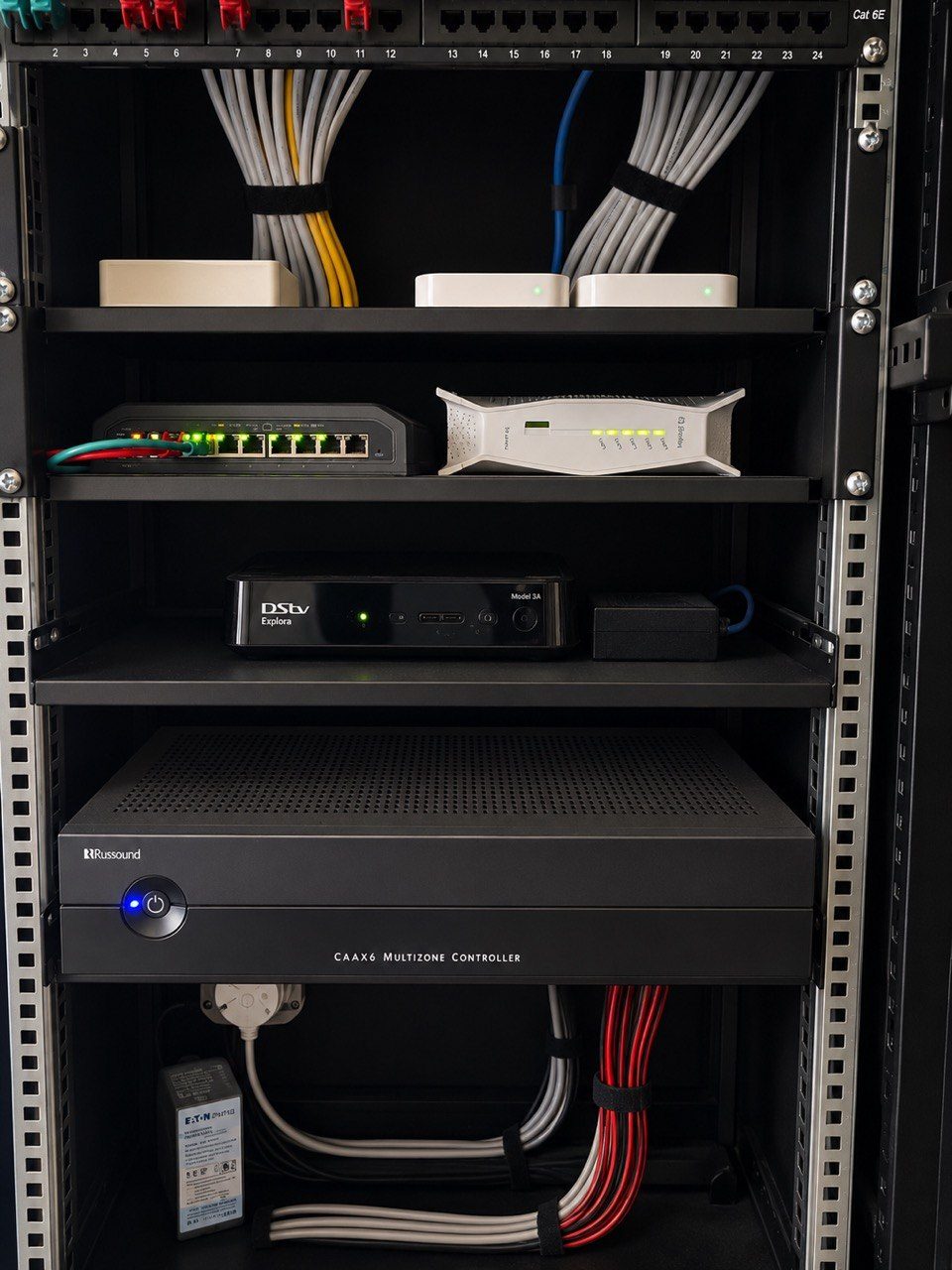
In KZN homes with concrete, glass, large floor areas and outdoor entertainment spaces, weak Wi-Fi planning shows quickly. A few consumer routers or extenders may work in a smaller property, but serious homes need a designed network: access point positions, cabling, switching, rack space, backup power, guest access and support.
This is central to home automation in Durban and KZN, because almost every modern subsystem depends on the network. If the network is unstable, the home feels unstable.
Audio zones need priorities
Multiroom audio is another area where a brief prevents overquoting and underquoting.
Not every room needs speakers. Not every speaker zone needs the same quality. The main entertainment areas, patio and cinema may justify better amplification and speaker placement, while guest bedrooms may only need simple television audio or no audio at all. Some homeowners care deeply about music. Others want background sound for entertaining and prefer invisible hardware.
A good brief captures source expectations too. Will the family use streaming services, local music, television audio, turntables, guest Bluetooth, or a mix? Should outdoor zones be independent? Should staff be able to control certain areas? Should guest access be available during weekends without exposing the whole system?
These details change the quote meaningfully.
Staff and guest access should be planned, not improvised
Many premium homes are not used only by the owners. They are used by family, guests, domestic staff, estate staff, maintenance contractors, house managers and sometimes short-stay visitors.
That affects technology design.
The brief should define who can unlock doors or gates, who can control lighting, who can use Wi-Fi, who can access cameras, who can play music, and who can change settings. It should also define what happens when staff change, when guests leave, or when a device is lost.
A smart home should feel simple for trusted users without weakening privacy or security. That requires planning. It is one of the reasons DG Technologies places so much emphasis on how a system will be lived with after installation, not just how impressive it looks at presentation stage.
Budget priorities should be honest
A technology brief is not only about features. It is also about priorities.
Some clients would rather spend more on lighting, Wi-Fi and reliability, and keep the cinema modest. Others want a serious cinema and are happy with simpler bedroom control. Some want a phased approach, where cabling and infrastructure are prepared now and certain rooms are completed later. Some need to protect the interior design above all else, which means decisions about speaker placement, keypad positions, visible cameras and rack locations must be made carefully.
Budget clarity helps the integrator make better recommendations. It also helps the homeowner understand why one item is essential, another is optional, and another should be left out. This connects directly to why a smart home quote should explain decisions, not just equipment.
What should be kept and what should be replaced
Many premium homes already have some technology in place: existing speakers, network points, cameras, a rack, conduits, TV locations, gate motors, intercoms, alarm infrastructure, lighting circuits or an older automation system.
The brief should record what exists and what is known about its condition.
Keeping equipment can be sensible when it is reliable, documented, compatible and still suits the client’s needs. Replacing equipment can be the better decision when it is unsupported, poorly installed, underpowered, undocumented, insecure or likely to make the new system unreliable.
The wrong approach is to keep everything to make the quote look cheaper, or replace everything because it is easier for the installer. DG Technologies looks for the practical middle ground: keep what still earns its place, replace what compromises the system, and explain the reasoning clearly.
The best time to brief is before quoting
For architects, builders and interior designers, the technology brief should start early. Ideally it sits alongside architectural layouts, electrical planning, reflected ceiling plans, joinery drawings and interior finishes. That allows conduit routes, rack space, keypad positions, access point locations, speaker placements, camera views and TV provisions to be coordinated before expensive work is closed up.
For homeowners, the brief brings calm to the process. It gives the project team something concrete to discuss. It helps avoid vague promises. It makes quotes easier to compare. It also makes the final system more likely to feel natural in the home.
This is why we encourage clients and project teams to understand working with DG Technologies before treating the quote as the starting point. For construction teams, our guidance for builders and architects explains why early coordination makes the finished home cleaner, more reliable and easier to support.
A premium home deserves more than a collection of devices. It deserves a clear technology brief, careful judgement and a quote that reflects how the home will actually be used.