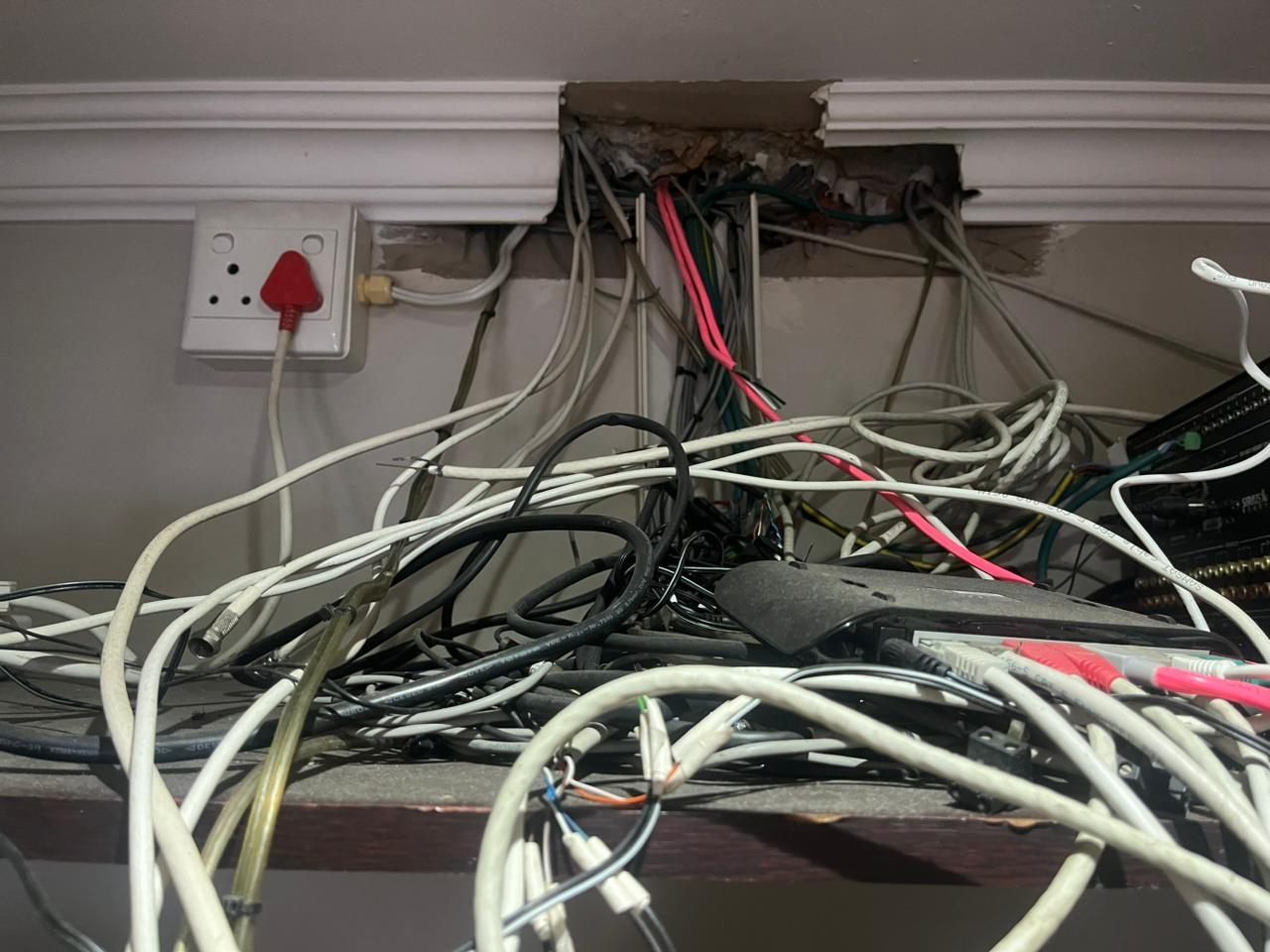
During a renovation, old wall controls can look like clutter.
An old speaker volume control. A blank plate. A redundant audio keypad. A wall box from a previous system. To the eye, it may seem obvious: remove it, plaster over it, make the wall clean.
Sometimes that is the right thing to do.
Sometimes it is a mistake.
In retrofit AV work, those old positions often reveal something valuable: a cable route.
Once that route is plastered over permanently, the home may look cleaner for a while, but future servicing, upgrades and cable replacement can become much harder.
This is why DG Technologies is careful before removing or closing old AV points.
Old controls may be sitting on useful wire ways
Older audio systems often used local wall-mounted volume controls.
Those controls may no longer be required if the home is moving to Sonos, Crestron, central amplification or app-based control. But the cables behind them may still tell us how the original system was wired.
They may show:
- where speaker cables pass through the wall
- which route reaches the ceiling
- whether there is conduit or only loose cable
- whether the route can be reused
- whether the wall box gives future access
- whether a new cable can be pulled without chasing
If the point is closed without checking, we may lose one of the few clean ways back into the cabling system.
Blank plates are not always ugly decisions
Clients and interior designers understandably want clean walls.
We do too.
But there is a difference between ugly and serviceable.
Sometimes a neat blank switch cover, matched to the rest of the electrical accessories, is the most sensible solution. It closes the old control position visually while preserving access to the route behind it.
That may not sound exciting, but it can save major frustration later.
If a speaker cable fails, if an audio zone changes, if an access point needs to move, or if a future system upgrade needs a route through the same wall, that blank plate can become extremely useful.
Good design is not only about what the room looks like on handover day.
It is also about how intelligently the home can be supported later.
Renovations expose decisions from previous installers
AV retrofits often reveal the history of a home.
You may find old speaker controllers, undocumented cables, hidden joins, strange routes, redundant TV points, cables that disappear into brickwork, or conduits that do not go where everyone assumed they went.
This is normal.
It is also why smart home rescue work starts with investigation, not assumption.
Before we close anything, we want to understand what value it still has.
The previous system may be obsolete, but the route it created may still be useful.
Plastering over access can make future work expensive
The cheapest decision during renovation is not always the cheapest decision over the life of the home.
Plastering over a wall box may take minutes.
Reopening a finished wall later can involve dust, paint, trades, delays, furniture moving and upset clients.
This is especially true in premium homes where wall finishes, wallpaper, stone, cabinetry or specialist paintwork may be involved.
If preserving a neat access point avoids that future disruption, it is often the more professional decision.
The same thinking applies to ceilings
Access is not only a wall issue.
Ceiling speakers, access points, downlights and grilles can sometimes become useful service openings. In South African homes with concrete walls and complex ceilings, the ability to reach a cable route later can be incredibly valuable.
This is why we often coordinate speaker positions, access point positions and service routes together.
A speaker aperture can sometimes help as a future access hatch if planned properly.
That does not mean technology should dictate the interior design.
It means the design should understand the technology before everything is permanently closed.
A clean finish should still be supportable
The best retrofit work is not the work that hides every sign of the past without thinking.
The best retrofit work understands what to remove, what to reuse, what to label, what to cover neatly and what to keep accessible.
That judgement is difficult to see in a quotation.
But it matters years later.
At DG Technologies, we do not want to leave behind a home that only looks finished.
We want to leave behind a home that can still be understood, serviced and improved.