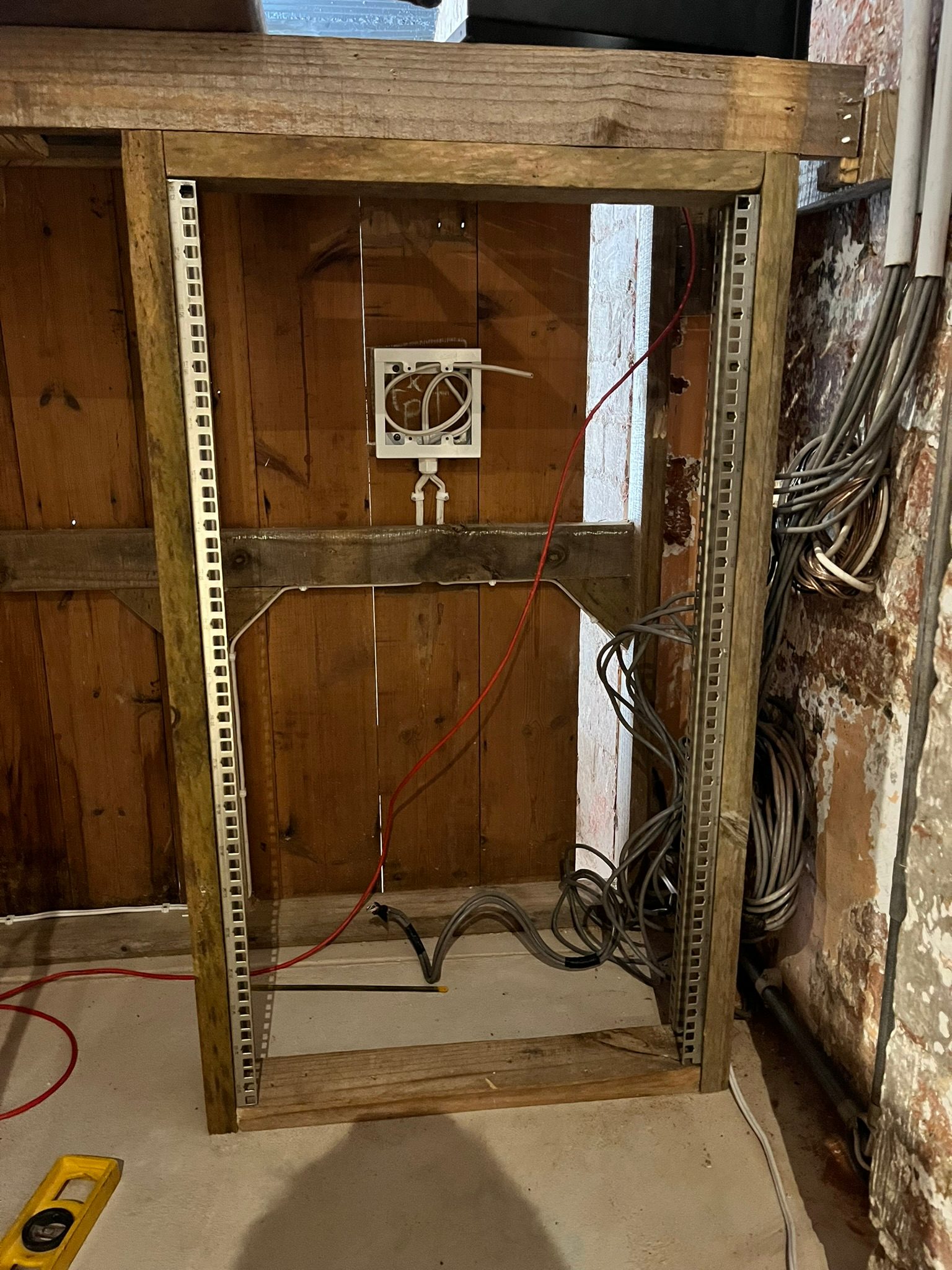
Building an AV rack into furniture can look brilliant.
It can also become a service nightmare.
A bar, feature wall, cabinet or bespoke unit may be the perfect place to hide technology, but the equipment does not stop being technical because it is surrounded by beautiful timber, glass or stone. Amplifiers still produce heat. Network switches still need access. Sources still need to be replaced. Cables still need bend radius. Power still needs to be safe and reachable.
For home automation and premium AV systems, joinery and engineering must be designed together.
Furniture is not naturally equipment-friendly
Most furniture is designed around appearance and storage.
AV equipment needs different things:
- airflow,
- rear access,
- cable space,
- power,
- network points,
- separation between power and signal,
- service clearance,
- and enough depth for real connectors.
If those details are not planned, the rack may look excellent from the front and be almost impossible to work on from the back.
That is not luxury.
That is a future problem hidden behind a beautiful panel.
Heat must have somewhere to go
Amplifiers, receivers, matrixes, network switches, NVRs, control processors and power supplies generate heat.
A closed cabinet traps that heat. Heat shortens equipment life, creates intermittent faults and makes diagnosis harder because problems may only appear after the system has been running for a while.
Ventilation can be passive or active depending on the load, but it must be considered.
Slots, grilles, fans, open backs, controlled airflow and equipment spacing are part of the design. A rack built into furniture should not rely on the hope that the cabinet doors will be opened often enough.
Cable access decides whether servicing is sane
An AV rack is not finished when the front looks neat.
The back matters.
Technicians need to reach HDMI cables, speaker cables, network leads, IR emitters, power cables, control wiring and patch panels. If the furniture blocks access, every fault becomes slow. If cables are too short, equipment cannot be pulled forward. If there is no service loop, a simple replacement becomes risky.
Good rack design respects the person who will maintain it later.
That person may be DG Technologies.
It may be another technician years from now.
Either way, the system should make sense.
Power should be planned before the cabinet is made
Power is often treated too casually in AV furniture.
The cabinet needs enough outlets, correct positioning, surge or UPS strategy where appropriate, access for isolation and enough separation so power bricks do not crush signal cables.
For sensitive AV and network equipment, power protection also matters. A beautiful rack connected through poor power design can still be unreliable.
The joiner, electrician and AV team need to coordinate before the cabinet is built.
The rack should tell a story
A well-built rack reveals how the system was thought through.
It shows what is connected, where it goes, how it is powered, how it is labelled and how it can be serviced. When a rack is built into furniture, that discipline becomes even more important because the technical space is constrained.
The goal is not to impress clients with complicated equipment.
The goal is to make the complexity controlled.
Built-in can be excellent when it is honest
There is nothing wrong with building technology into furniture.
In fact, it can be one of the best ways to make a premium room feel finished. The client gets the performance of a serious AV system without loose boxes and visible clutter.
But it only works when the furniture is designed around the equipment’s needs.
Ventilation, access, power, cable routes and future replacement must be part of the drawing.
The best built-in rack is the one that looks calm from the front and still makes complete technical sense behind the scenes.