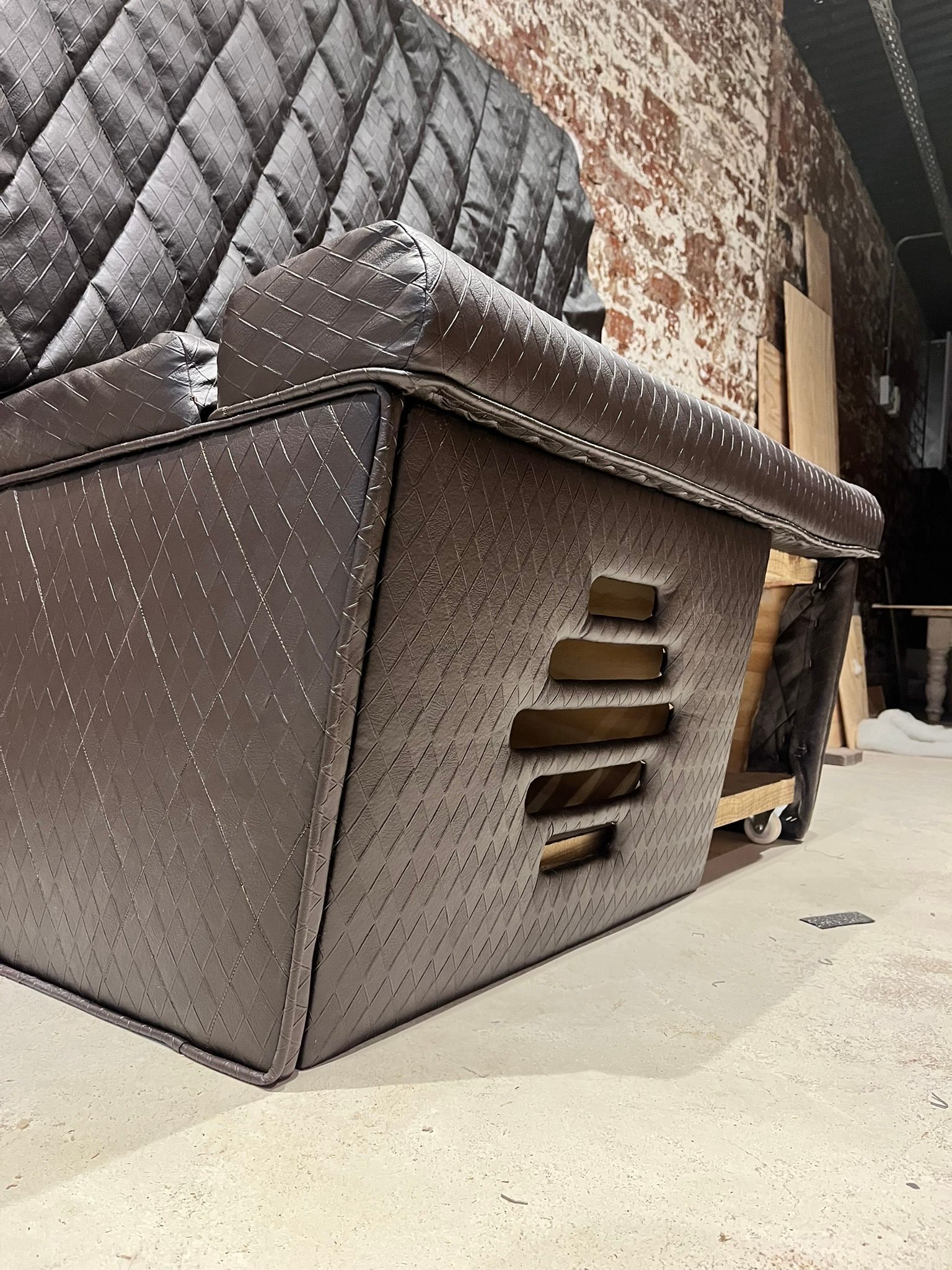
Most clients like the idea of hidden audio.
That is understandable. A premium room should not look as if it was designed around boxes, cables and speaker grilles. Technology should support the room, not dominate it.
But a subwoofer is not a normal speaker.
It moves air. It creates pressure. It can vibrate furniture. It can excite walls, cabinets, floors and loose panels. If it is hidden without planning, it can become boomy, rattly, hot, difficult to service or simply ineffective.
For home cinema and premium audio rooms, hiding a subwoofer is possible, but it has to be engineered.
A subwoofer needs to breathe
Low-frequency sound is physical.
A subwoofer cannot be completely sealed behind solid joinery and expected to perform properly. The sound needs a path into the room. The amplifier section may also need ventilation, depending on the type of subwoofer being used.
That does not mean the subwoofer has to be ugly.
It means the grille, vent, opening or acoustic path must be part of the design. A carefully built vent can look intentional. A last-minute hole cut into a cabinet usually looks like a compromise.
This is where AV planning and interior design need to speak early.
Vibration is part of the design
Subwoofers expose weak construction quickly.
A loose cabinet panel may buzz. A glass shelf may rattle. A lightweight door may vibrate. Decorative metalwork, downlights, handles and loose cable covers can all become noise sources when bass is active.
The client hears a rattle and assumes the subwoofer is faulty.
Often the subwoofer is doing exactly what it should do.
The room around it was not prepared for it.
Good installation considers fixing points, cabinet stiffness, isolation, airflow and how the subwoofer will behave at normal listening levels.
Hidden does not mean inaccessible
A hidden subwoofer still needs service access.
It may need adjustment. It may need replacement. A cable may need checking. A fault may need diagnosis. If the only way to reach it is to break joinery, the design has failed.
The same principle applies across multiroom audio, AV racks and smart-home equipment. Discreet is good. Buried is not.
A serviceable hidden detail is far better than a perfectly invisible detail that punishes the homeowner later.
The room decides the bass
Subwoofer placement is strongly affected by the room.
Corners, walls, openings, seating positions, floor construction and furniture all change how bass behaves. Hiding the subwoofer in the nearest cabinet may suit the interior design, but it may not suit the sound.
Sometimes the answer is a different position.
Sometimes it is more than one subwoofer.
Sometimes it is a smaller subwoofer used more carefully.
Sometimes it is a custom furniture detail that allows the correct position without making the equipment obvious.
The point is to design around the room, not force the room to accept a poor bass position.
Good bass should not announce itself
A well-integrated subwoofer should not constantly draw attention to itself.
In a cinema, it should add weight, impact and scale. In a music room, it should support the lower frequencies without making the system sound slow or heavy. In an entertainment area, it should make the music feel fuller without shaking everything loose.
Many people think they dislike subwoofers because they have only heard badly placed or badly configured ones.
Good bass feels natural.
It gives the room confidence without becoming a party trick.
Detail is what makes hidden technology work
Hiding a subwoofer is not about pretending physics does not exist.
It is about respecting physics while protecting the design.
That means planning the grille, airflow, vibration control, cable route, access panel, amplifier load, room position and final tuning. It also means being honest with the client and interior designer when a proposed hiding place will damage performance.
The best result is when the client enjoys the room and stops thinking about where the bass is coming from.
That is when hidden audio has been done properly.