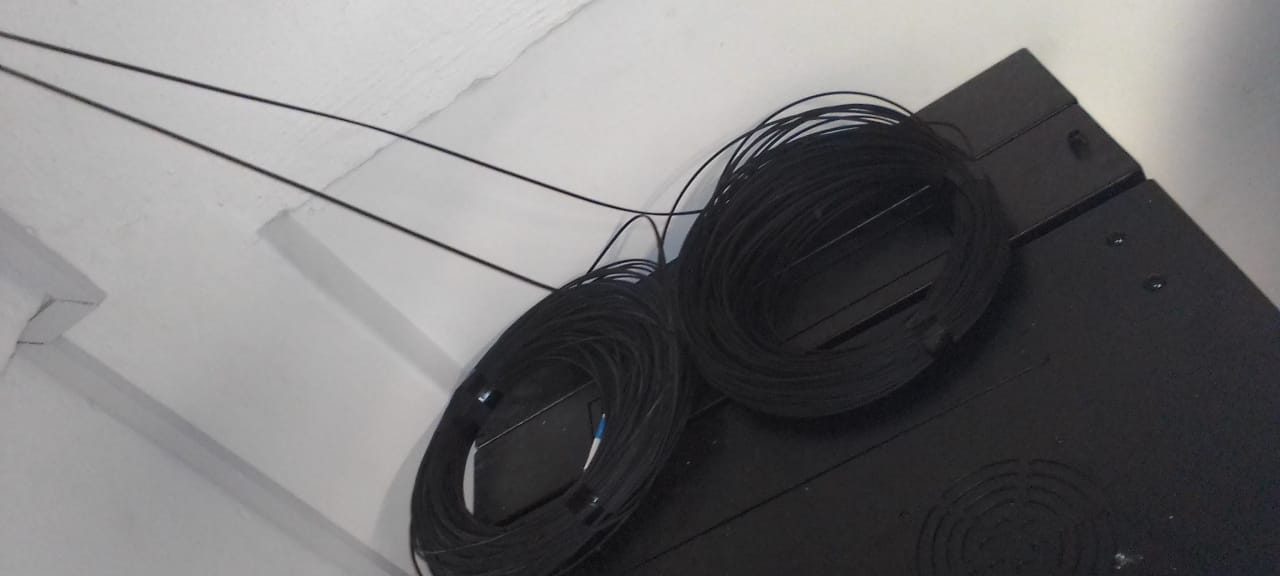
On a real building site, your cable is not the only work happening.
Electricians are pulling power. Builders are chasing walls. Ceiling teams are closing boards. Joiners are fitting cabinets. Painters are preparing surfaces. Other contractors may be removing old equipment. Everyone is trying to finish their own scope.
That is exactly why low-voltage cables get damaged.
Cable damage is not always dramatic
Sometimes a cable is cut cleanly and everyone can see the problem.
Often it is less obvious.
A cable may be nicked, kinked, stretched, crushed, stapled, pulled through a sharp edge or disconnected from a temporary route. A bundle may be moved so aggressively that terminations become unreliable. A cabinet may be shifted without checking what has already been dressed inside it.
The system may still appear to work at first.
Then cameras start dropping, access points behave strangely, HDMI extenders become unreliable or control devices go offline.
Decommissioning is a high-risk moment
Renovations and commercial takeovers often include removal of old systems.
That work must be controlled carefully.
If one contractor is removing the previous tenant’s cabling while another contractor has already installed new cabling, the risk is obvious. Without clear marking, protection and communication, new work can be mistaken for old work.
This is not theoretical.
It is one of the reasons DG Technologies prefers clear labelling, cabinet discipline and communication between trades.
The protection plan should be part of the project
Low-voltage cabling should be protected like any other critical building service.
That may include:
- clear cable labels,
- marked routes,
- photographs before ceilings close,
- cabinet sign-off,
- temporary protection where other trades are still working,
- clear instructions about what must not be moved or cut,
- a responsible person for technical queries,
- testing after risky work has happened.
The goal is not to blame other trades.
The goal is to prevent avoidable damage.
Labels must be visible at the right time
A label hidden inside a cabinet is useful later.
It may not protect a cable during construction.
On active sites, temporary labels, warning notes and physical separation can matter just as much as final labels. If a cable bundle is crossing a work area, the person working near it needs to know whether it is live, new, spare, old or scheduled for removal.
Assumptions are expensive.
Damage must be found before handover
If a cable is damaged, it should be found before the client depends on the system.
That means testing after major site events:
- ceilings closing,
- cabinetry installation,
- stonework,
- old-system removal,
- painting and sanding,
- equipment relocation,
- electrical changes,
- site clean-up.
Testing once at first fix is useful. Testing again after risk points is better.
DG Technologies’ view
DG Technologies has worked on enough large homes, commercial sites and retrofit projects to know that good cabling is not only about pulling cable neatly.
It is about protecting the cable until the system is complete.
A professional low-voltage installation needs planning, communication and proof. The best cable in the world cannot help a client if another trade cuts it before commissioning.
That is why cable protection is a project-management issue, not only an installation issue.