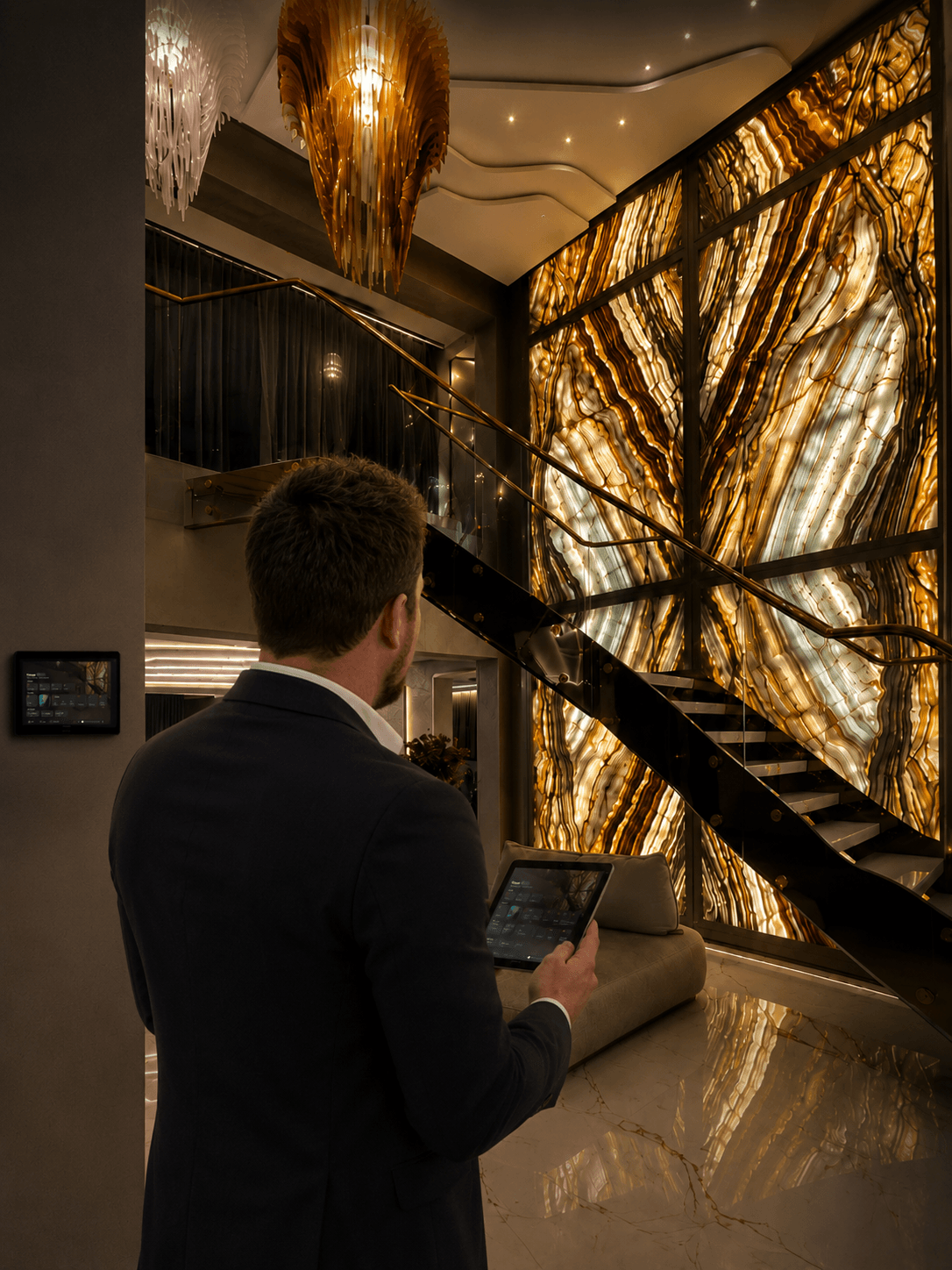
The best private-home technology is often the technology visitors do not notice.
That may sound strange in an industry that loves showing hardware, touch screens, racks, cinema rooms, speakers and lighting scenes. But in a truly private home, the aim is not to advertise the system. The aim is to make the home easier, calmer and more secure without making the technology the centre of attention.
For high-value homes in Durban, Umhlanga, Mount Edgecombe, Zimbali, Simbithi, Ballito and the KZN North Coast, discretion is not just a design preference. It is part of the service.
Owners of private homes often care deeply about who enters the property, what is visible, what is documented, what is shared, and how respectfully contractors behave in personal spaces. The technology contractor is not simply working with walls and wires. They are working inside someone’s private life.
That changes the standard.
Discretion starts before the installation
Discreet work begins long before a keypad is installed.
It starts with how the project is discussed, how photographs are handled, how drawings are stored, how team members behave on site and how the design is coordinated with the architect, builder and interior designer.
A private client may not want their home displayed online. They may not want the project named. They may not want certain areas photographed. They may not want visitors, staff or suppliers seeing more than they need to see.
That should be respected without drama.
This is why DG Technologies treats private home automation differently from ordinary residential work. The goal is to deliver a professional system while protecting the dignity and privacy of the home.
Technology should not clutter the interior
In a private luxury home, visible technology must earn its place.
A touch screen on the wrong wall can interrupt an important interior detail. A speaker grille in the wrong ceiling line can disturb the room. A camera can feel aggressive if it is placed without thought. A Wi-Fi access point can become visual noise. Too many keypads can make a beautiful room feel busy.
The answer is not to hide everything at the expense of performance. The answer is to coordinate properly.
Device placement should be discussed early. Keypads should align with the way the room is used. Touch screens should be placed where they are useful, not where they look impressive in a proposal. Speakers should be positioned for performance and architectural balance. Racks, power, ventilation and cable routes should be planned so the visible spaces remain clean.
That is why architect and builder coordination is so important. Discreet technology is usually the result of early planning, not late compromise.
Privacy is not only about cameras
When people talk about privacy in technology, they often think only of cameras.
CCTV matters, of course. Camera positions should be deliberate. App access should be controlled. Passwords should be managed. Footage should be available to the right people, not everyone. Staff and guest permissions should be considered carefully.
But privacy goes further than CCTV.
Who can control the gate? Who can see the intercom? Who can access the smart home app? Which rooms appear on a staff-facing control point? Can a guest operate the entertainment area without seeing private bedroom controls? Can a house manager manage what they need without being given unnecessary access?
These are design questions.
They matter in access control, lighting scenes, audio zones, Wi-Fi networks, remote support and system documentation. A private home should not expose more control than each person needs.
Quiet control feels more luxurious
Private-home automation should reduce effort, not create a performance.
The owner should not need to explain the system constantly. Guests should not need a lesson to turn on basic lights. Staff should have simple controls for the areas they use. The family should be able to enjoy the home without feeling surrounded by technology.
This is why scene design matters.
A good evening scene, arrival scene, entertaining scene, goodnight scene or away mode can make the home feel calmer. Instead of showing off dozens of functions, the system quietly handles the decisions that repeat every day.
We wrote about this in why luxury home automation should make the home quieter, not busier. In private homes, that principle is even more important. Luxury is not always more control. Often it is less friction.
Confidentiality builds trust
Some of the most significant private residential work will never appear in a public portfolio.
That is normal.
The client is not paying for the contractor’s marketing. They are paying for a trusted team to work inside a private environment and leave behind a system that improves the home.
This is why working with DG Technologies is as much about judgement and conduct as it is about equipment. Technical ability matters, but so does the way the team communicates, enters the property, protects information, explains decisions and handles the owner’s concerns.
In private homes, the contractor’s manner can be as important as the equipment specification.
A private portfolio should not behave like a public gallery
There is a reason DG Technologies maintains a deliberately quiet private portfolio doorway.
It is not there to publish sensitive work. It is there to communicate the opposite: some commissions are handled by invitation, direct referral or private introduction, and the details are protected because that is part of the value.
For the right client, that matters.
A public case study can show the type of thinking behind a project. It can discuss Crestron Home, lighting control, networking, cinema, CCTV, audio distribution, estate coordination and technical planning. It can explain how DG Technologies approaches private residential technology.
But it should not casually expose the client, the address, the security layout, the family’s living pattern, private rooms, staff movement, rack locations, camera coverage or access-control strategy.
That is why a discreet technology practice needs two kinds of proof:
- public proof that demonstrates capability
- private proof that is only shared when the client relationship allows it
- enough judgement to know the difference
In our view, that separation is not a marketing trick. It is a professional boundary.
Discreet does not mean under-specified
Discreet technology still needs to be engineered properly.
The network must be strong. The rack must be serviceable. The lighting modules must match the loads. The CCTV must capture useful evidence. The audio must perform. The control system must be reliable. Remote support must be planned. Documentation must be accurate.
Discretion is not an excuse for weak design.
It is a higher standard: make the system strong, but make it feel calm.
For DG Technologies, that is the ideal result in a private home. The owner feels protected. The family can use the home easily. Guests and staff have sensible access. The interior is respected. The technology works quietly in the background.
That is what discreet design should mean.