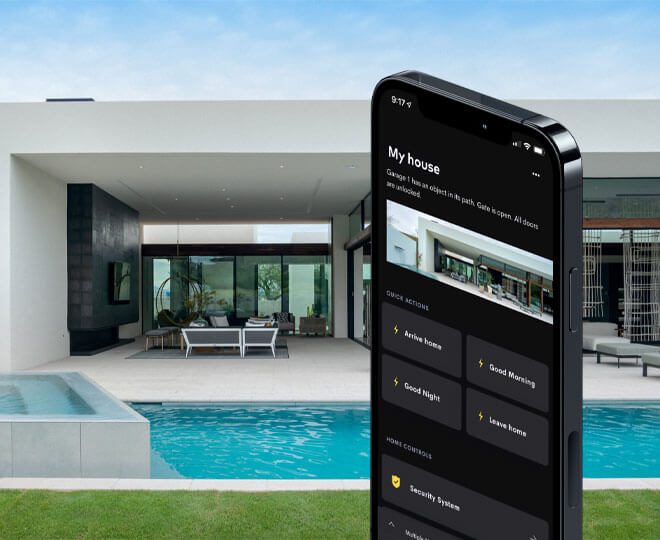
Luxury home automation should not make a home feel busier.
It should make the home feel quieter.
That does not mean silent in the literal sense. It means visually quieter, mentally quieter and easier to live in. A premium home should not feel like a showroom for technology. It should feel considered, calm and beautifully resolved, with the important systems working in the background until they are needed.
For affluent homeowners in Durban, Ballito, Umhlanga, Zimbali, Simbithi, Mount Edgecombe and the wider KZN market, this distinction matters. Many luxury homes already have architectural complexity, layered lighting, large entertainment areas, home cinemas, security systems, Wi-Fi infrastructure, gates, intercoms, audio zones and guest accommodation. Adding automation should bring those pieces together. It should not add another layer of confusion.
At DG Technologies, our philosophy is simple: technology should disappear into the home. The homeowner should feel the benefit, not the machinery.
Quiet luxury is about restraint
Quiet luxury is not about hiding value. It is about removing noise.
In interior design, that may mean better materials, cleaner detailing, fewer visible compromises and a more confident sense of proportion. In automation, it means fewer unnecessary controls, clearer room logic, better scenes, discreet hardware placement and a user experience that does not demand attention every time someone wants to switch on a light.
The most impressive smart home is not always the one with the most buttons, screens or apps. Often, the better home is the one where people do not have to think about the system at all.
The lights feel right when guests arrive. The patio is ready for an evening outside. The cinema starts without a sequence of technical decisions. The home can be put into an away state without walking from room to room. Staff can use the functions they need without seeing private controls. Guests can find the basics without asking for a tutorial.
That is luxury.
It is not technology shouting for attention. It is technology behaving with manners.
Fewer controls can create a better home
There is a common misunderstanding that more control always means a better smart home.
More control can be useful for the installer, during commissioning, or for an owner who wants deeper access to the system. But daily living usually needs the opposite. Most people want the right few actions available at the right places.
A bedside keypad should not feel like an aircraft panel. A kitchen touch panel should not be full of rooms the person never controls from the kitchen. A guest suite should not expose whole-home scenes, security states or private areas. A mobile app should be organised in a way that makes the home easy to understand, not in a way that mirrors the equipment rack.
This is why good private home automation in Durban and KZN starts with how people use the property. The design should ask practical questions. Which entrance does the family use? Where do guests arrive? Which lights are used together? Which rooms need music most often? Where should a homeowner have whole-home control? Where should controls be deliberately limited?
When those questions are answered properly, the system often becomes simpler. Not less capable. Simpler to live with.
Scene design is where calm UX begins
Scenes are one of the most important parts of luxury automation, but they are also one of the easiest things to overdo.
A good scene is not just a preset. It is a decision made in advance so the homeowner does not have to make it repeatedly.
For example, an evening scene may lower selected lights, bring warm accent lighting forward, keep circulation areas safe, prepare exterior areas and avoid glare on glass. An entertaining scene may balance kitchen, dining, patio and audio zones so the spaces flow naturally. A goodnight scene may switch off selected areas, leave low-level pathway lighting and prepare the home for rest.
These scenes should feel obvious after handover. They should be named clearly. They should be adjusted after the family has lived with them. They should reflect the architecture, not fight it.
This is especially true for lighting control. Luxury lighting is rarely about turning every fitting on or off. It is about layers, mood, task lighting, art, exterior presence, safe movement and the way the home changes between morning, afternoon, evening and night.
When lighting scenes are designed well, the home becomes calmer because fewer decisions are required.
Discretion matters in premium homes
Technology has a physical presence. Touch panels, keypads, speakers, access points, cameras, racks, remotes, sensors and intercom stations all affect the final feel of a home.
In a premium interior, placement matters as much as performance. A badly positioned touch panel can interrupt a carefully detailed wall. A visible access point in the wrong ceiling bay can draw attention for the wrong reason. Too many keypads can make a new home feel busy before anyone has even used the system.
Good automation design works with the architect, builder, electrician, lighting designer and interior designer early enough to make the technical requirements feel intentional. Cable routes, back boxes, rack space, ventilation, power, network points and device positions should be planned before finishes are closed.
That is why the process matters as much as the product. Our approach to working with DG Technologies is built around careful assessment, clear decisions and practical coordination, because the best result is rarely achieved by adding technology late and hoping it blends in.
Discreet does not mean underpowered. It means the visible parts are reduced, refined and placed with care.
Reliability is part of the luxury experience
A calm smart home must be reliable.
If a scene works only sometimes, it creates doubt. If audio zones take too long to respond, people stop using them. If Wi-Fi drops in important areas, every app-based control becomes frustrating. If the gate, intercom, lighting and security systems behave unpredictably, the home no longer feels premium.
Luxury is not only about what the system can do on the day of demonstration. It is about how it behaves months and years later.
This is one reason Crestron Home can be a sensible platform for many residential projects. Used appropriately, it gives a structured control environment for common home functions such as lighting, scenes, audio, climate, shading and touch panel or app control. It still needs professional design, correct installation and proper support, but it gives the homeowner a consistent experience instead of a collection of disconnected controls.
The important point is not to claim that one platform magically solves every problem. It does not. The design, network, wiring, device selection, commissioning and support still matter. But a well-planned platform can help the finished home feel more joined up and easier to maintain.
For broader context, we have also written about why a smart home should be designed around the people who live in it. That thinking is central to quiet automation.
The technology should disappear
The best automation does not ask the homeowner to admire it every day.
It supports the routines of the home. It reduces repetitive decisions. It makes entertaining easier. It helps the property feel secure. It gives the owner confidence that the home can be controlled clearly, whether they are in the main bedroom, on the patio, in the cinema, at the gate or away from the property.
For DG Technologies, home automation in Durban and KZN is not about making a house feel more technical. It is about making a serious home easier to live in, easier to support and more aligned with the way the owner actually wants to use it.
That is the real promise of luxury automation.
Not more screens.
Not more buttons.
Not more noise.
A quieter home.
A calmer experience.
Technology that does its job, then gets out of the way.