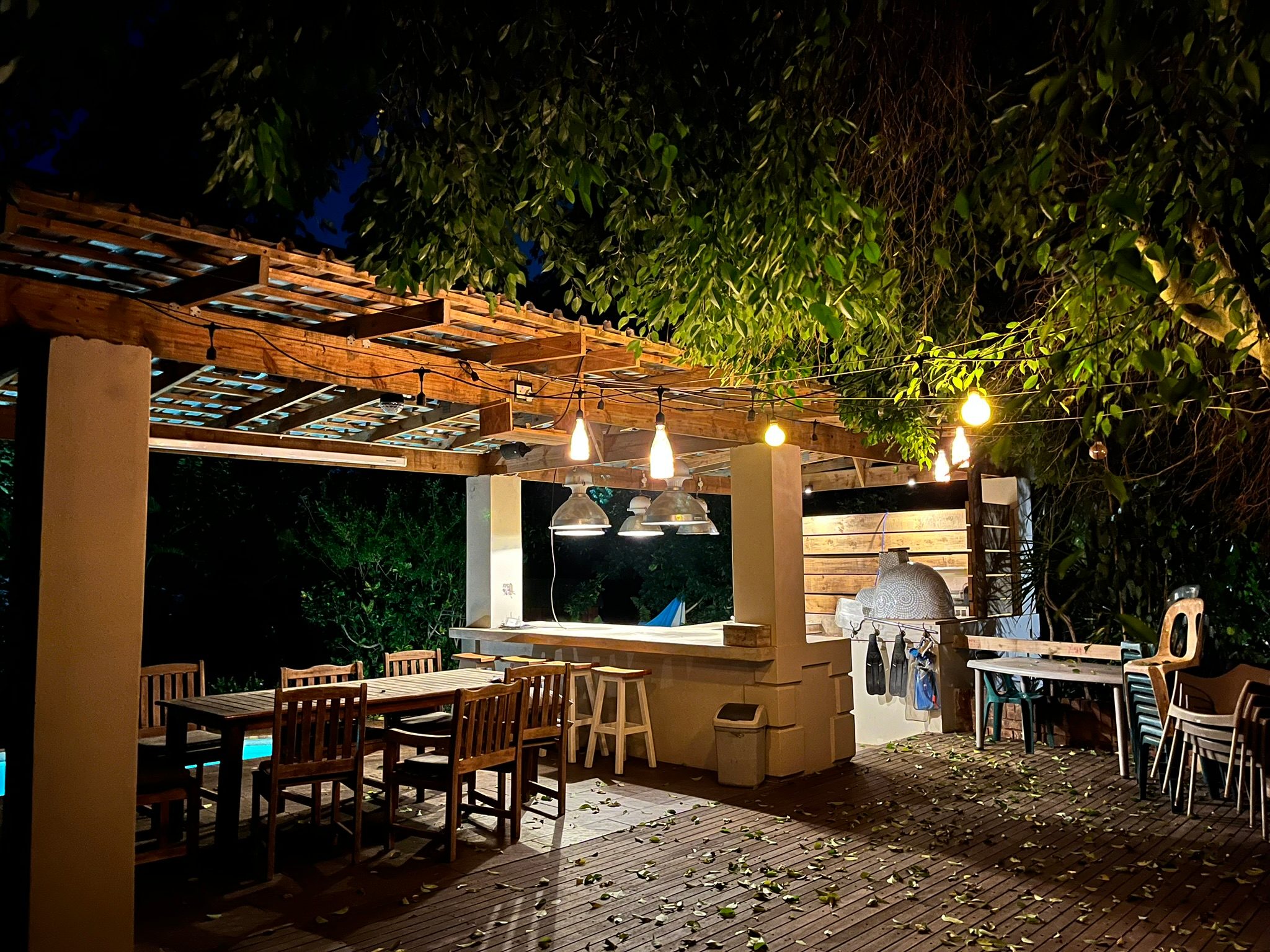
Outdoor services are often remembered late.
The house lighting is discussed. The keypads are discussed. The cinema is discussed. The Wi-Fi is discussed. The cameras are discussed.
Then, once the project is deeper into site work, someone asks:
“Can we put the pool lights on automation?”
“Can the geyser be controlled?”
“What about the garden spikes?”
“Can the garage door motor be included?”
“Should the pathway lights come on from a day/night sensor?”
Those are reasonable requests, but they should not be afterthoughts.
They affect the automation DB, relay capacity, cable routes, electrical returns, contactors, sensor logic and future support.
Outdoor circuits are still real electrical loads
From a client point of view, a pool light or garden light may feel like a small item.
From the automation side, it still needs a controllable circuit.
The return has to land in the correct place. The relay must have capacity. The load must be suitable. The circuit must be protected properly. The electrician and integrator need to agree where control happens. If the load is heavy or not suitable for a relay, a contactor or different design may be required.
That is why DG Technologies wants outdoor services listed before the automation DB is designed.
The earlier they are listed, the cleaner the solution.
Pool and pump areas need route planning
Pool areas can be awkward after the fact.
The pump room may be away from the main DB. The return may run through a cluster switch. The pool light circuit may not come back to the automation DB. The cable route may require conduit between the electrical DB, pump area and automation point. Outdoor conditions also introduce moisture, corrosion and access issues.
If that route is planned early, it can be simple.
If it is discovered late, the team may need to find a new route, reuse a spare cable, install a remote module or add visible containment that nobody wanted.
That is not ideal in a premium home.
Geysers and heavy loads need careful switching
Geyser control is a good example of why “just automate it” is not enough.
The load matters. The switching method matters. The electrical protection matters. The location of the circuit matters. The client expectation matters. The automation system may need to trigger a remote relay, communicate with a module in another location or control through properly rated electrical equipment.
Putting a heavy load through the wrong control path is not clever.
It is poor engineering.
DG Technologies would rather ask the hard questions early than create a system that is impressive in the app but weak in the DB.
Outdoor lighting should have a logic brief
Garden and exterior lighting can be controlled in many ways.
Some lights should follow a day/night sensor. Some should be part of an entertaining scene. Some should remain manual. Some should be security lights. Some should never be left on all day. Some should recover in a specific way after load shedding. Some should be separated so the client can control areas individually.
That means outdoor lighting needs a logic brief.
Not just a circuit list.
DG Technologies wants to know how the homeowner expects the property to behave at night, when guests arrive, when staff leave, when the family goes to bed, when security needs visibility and when the inverter is carrying the home.
The answer affects the DB.
The outdoor list prevents relay surprises
Crestron relay channels are physical resources.
When they are used, they are used.
If outdoor services are added late, the system may run out of spare relay capacity. Then the project needs more hardware, a remote relay module, a different circuit strategy or a compromise.
That is why a proper automation brief should include the hidden service list:
- pool lights;
- pool pump controls where applicable;
- geysers;
- circulation pumps;
- garden lighting;
- driveway and pathway lights;
- garage door motors;
- gate-related controls;
- water-feature pumps;
- exterior feature lighting;
- day/night sensors;
- motion-triggered exterior scenes.
Not all of these should be automated.
But all of them should be discussed.
Good automation starts with knowing what not to include
The point of listing outdoor services is not to automate everything.
It is to make informed decisions.
Some circuits should be automated. Some should remain electrical-only. Some need provision for future control. Some need a separate route. Some need a contactor. Some are not worth the complexity.
That judgement is where a professional integrator adds value.
DG Technologies does not want the client discovering late that a simple outdoor request now needs extra hardware, cutting, conduit or compromise.
We would rather identify the services early and design the DB around the home as it will actually be used.