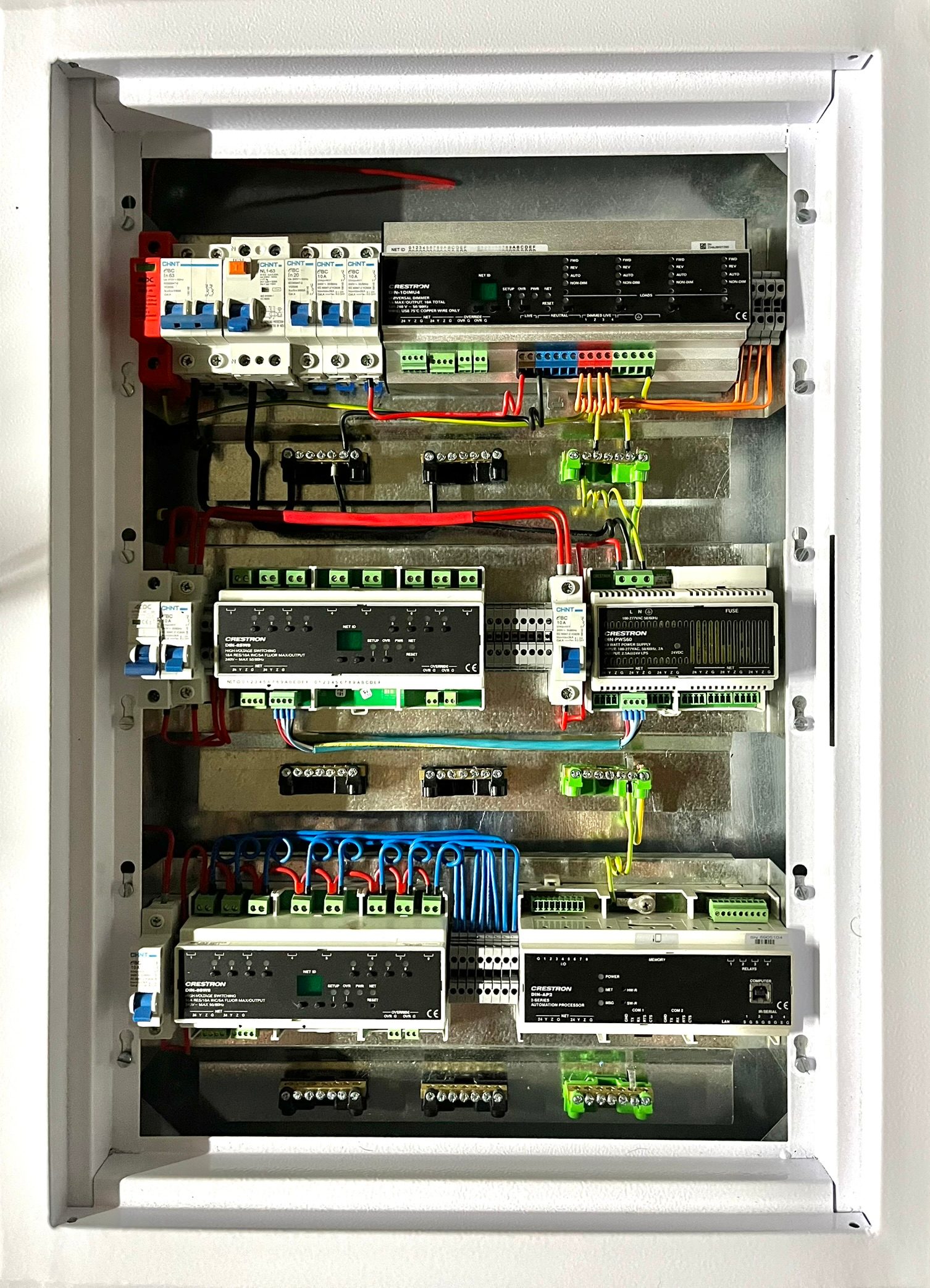
A Crestron lighting-control DB is not just a box full of smart hardware.
It is the meeting point between electrical design and automation design.
That is why it cannot be planned properly by one trade working in isolation.
The electrician understands the loads, circuits, breakers, returns and compliance requirements. The automation integrator understands the relays, dimmers, processor logic, keypad behaviour, scene programming, remote modules and how the client expects the home to work.
Both sides matter.
If the coordination is weak, the problem does not usually show up as a neat technical error. It shows up as confusion on site: unlabelled returns, unclear breaker requirements, not enough relay capacity, circuits that should have been separated, loads that should not be placed on a small relay, or a client request that sounds simple but needs additional hardware.
A lighting return is not useful if nobody knows what it is
Labelling sounds basic.
It is not.
On a lighting-control project, labelled returns are essential.
If the return wires are not clearly identified in the DB, every later task becomes slower. Commissioning takes longer. Fault finding becomes harder. Programming scenes becomes more uncertain. A small change can require unnecessary tracing because the system does not clearly tell the technician which physical circuit is being controlled.
In a standard electrical installation, a switch wire may only affect one local switch.
In a Crestron system, that return may be part of a wider scene: entrance lighting, pathway lighting, garden lighting, pool lighting, stair lighting, security lighting, night mode, entertaining mode or a load-shedding recovery routine.
The label is therefore not only for neatness.
It protects the logic of the home.
Breaker decisions need both load knowledge and system knowledge
Breaker sizing is not something the AV integrator should guess casually.
The electrician needs to calculate or estimate the lighting loads correctly. At the same time, the integrator needs to understand how the Crestron hardware is being fed, protected and grouped.
Those are different forms of knowledge.
The automation equipment itself may draw very little current, while the lighting loads connected through it may be significant. Some circuits may be suitable for relay control. Others may require dimming. Some loads may need contactors or a different control approach. Some items should remain direct-fed because putting them through automation hardware would create unnecessary risk or exceed sensible design limits.
That is why DG Technologies prefers direct coordination with the electrician before the DB is finalised.
The question is not only, “Can we switch this?”
The question is, “Should this be switched this way?”
Relays run out because decisions accumulate
Clients often experience automation as simple control.
They ask for another light, another pump, another geyser, another outdoor circuit, another handrail light, another pathway, another pool light or another feature to be added to the app.
From the client side, it sounds like a programming request.
From the integrator side, it may be a hardware-capacity request.
If all relay channels are already used, there is no spare output waiting in the DB. If a return does not come back to the automation DB, it may need a new cable route. If the load is too heavy for the relay, a contactor may be needed. If the circuit is in another location, a remote module may be a better solution.
This is why a professional integrator is careful about promising “we can just add it”.
Sometimes we can.
Sometimes we need to add the right hardware first.
Not every load belongs on a relay
One of the most useful parts of automation design is knowing where not to automate.
That sounds strange, but it matters.
Some loads are better left direct. Some require contactors. Some are not worth the complexity. Some should be controlled by the equipment designed for that purpose. Some may create support headaches if they are placed behind automation simply because the client asked whether it was possible.
The goal is not to put everything through Crestron.
The goal is to make the home reliable.
If a load exceeds what is sensible for a relay, DG Technologies would rather explain the reason than quietly build in a future failure. If a bedside lamp is better left locally switchable because of how the room is used, that may be the better decision. If a pool, geyser, pump or heavy external load needs control, the electrical design must support that properly.
Good automation is not reckless control.
It is controlled control.
The DB should make future support easier
The automation DB is one of the first places DG Technologies looks when supporting a smart home.
If the DB is organised, labelled and designed with enough space, the system can be understood quickly. If it is cramped, undocumented and full of unclear returns, the home becomes harder to maintain.
That matters because lighting control is not an accessory.
It is part of daily life.
When a client presses a keypad, the light must come on. When the home enters night mode, the correct circuits must respond. When a fault appears, the support technician needs to isolate it without guessing.
The quality of that experience starts inside the DB.
Not on the app screen.
That is why DG Technologies takes lighting-control DB coordination seriously. Relays, dimmers, breakers, returns, labels and load decisions are not small details.
They are the hidden structure behind a home that feels simple.