There is a point where a CCTV job stops being a camera job.
It becomes a network design.
Large sites quickly reach that point. A warehouse may have several buildings. A cold store may have offices, yards, dispatch areas and remote doors. An estate home may have a gate, boundary walls, garages, staff areas, outbuildings and a long driveway. A commercial site may need cameras in places that are simply too far from the main rack.
Trying to pull every camera cable back to one cabinet is not always the right answer.
Sometimes the better answer is fibre between cabinets.
Copper has distance limits
Standard network cabling has practical distance limits.
Once camera runs become too long, the system can become unreliable or non-compliant with good network practice. Long copper routes can also create installation problems when they pass across large yards, between buildings or through areas where future access will be difficult.
For short, sensible runs, copper is excellent.
For long backbone links, fibre is often better.
The design should choose the right medium for the job, not force one method everywhere.
A local cabinet can simplify the site
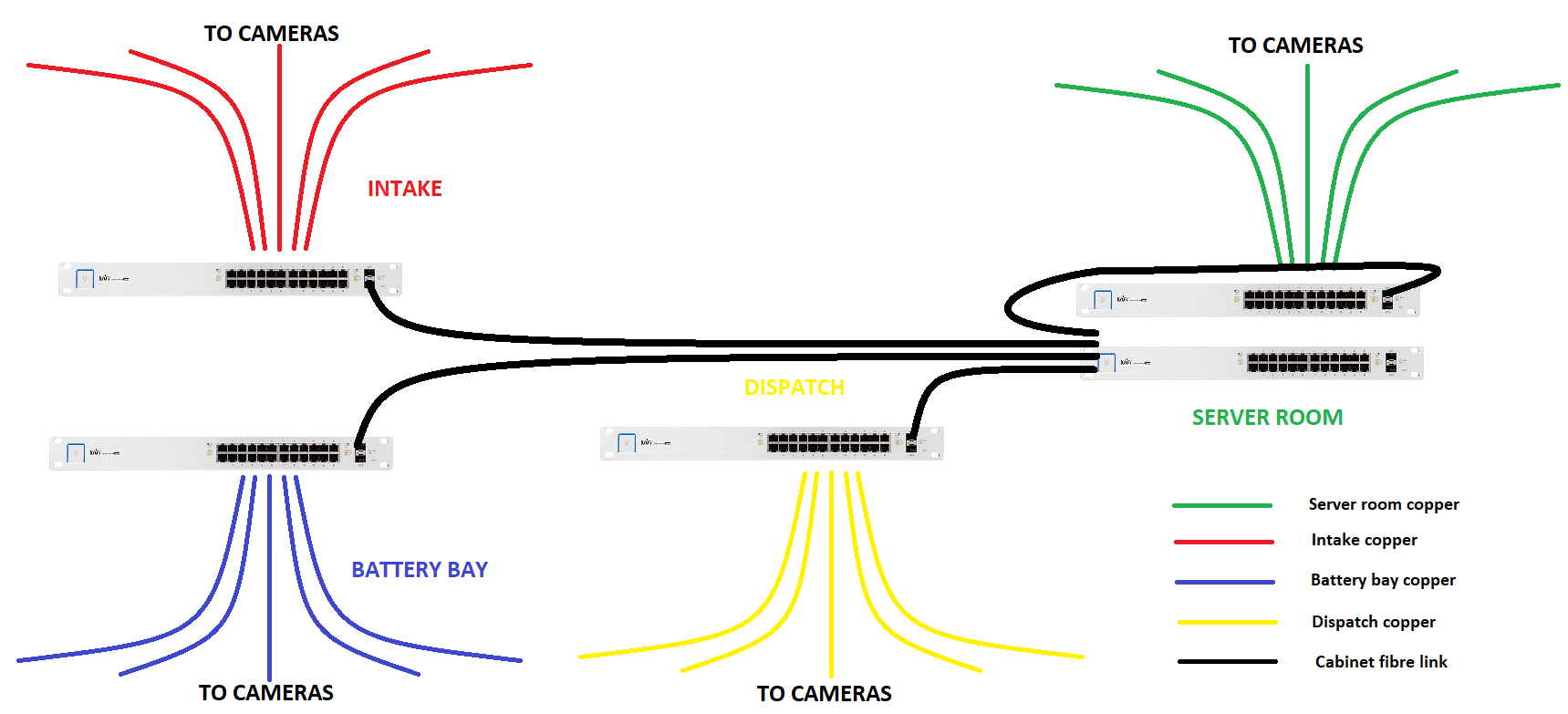
Instead of dragging every camera back to the main rack, a remote cabinet can serve a group of nearby cameras.
That cabinet may contain:
- a PoE switch,
- fibre termination,
- patching,
- local power,
- UPS support where required,
- surge protection where appropriate,
- labelled camera routes.
From there, a fibre link connects the remote cabinet back to the main network or recorder location.
This can make the installation cleaner and more supportable.
It also gives future expansion somewhere to land.
Fibre helps with electrical separation
CCTV often spans areas with different electrical conditions.
Gates, warehouses, outbuildings and external routes can introduce risks from distance, storms, grounding differences and electrical noise.
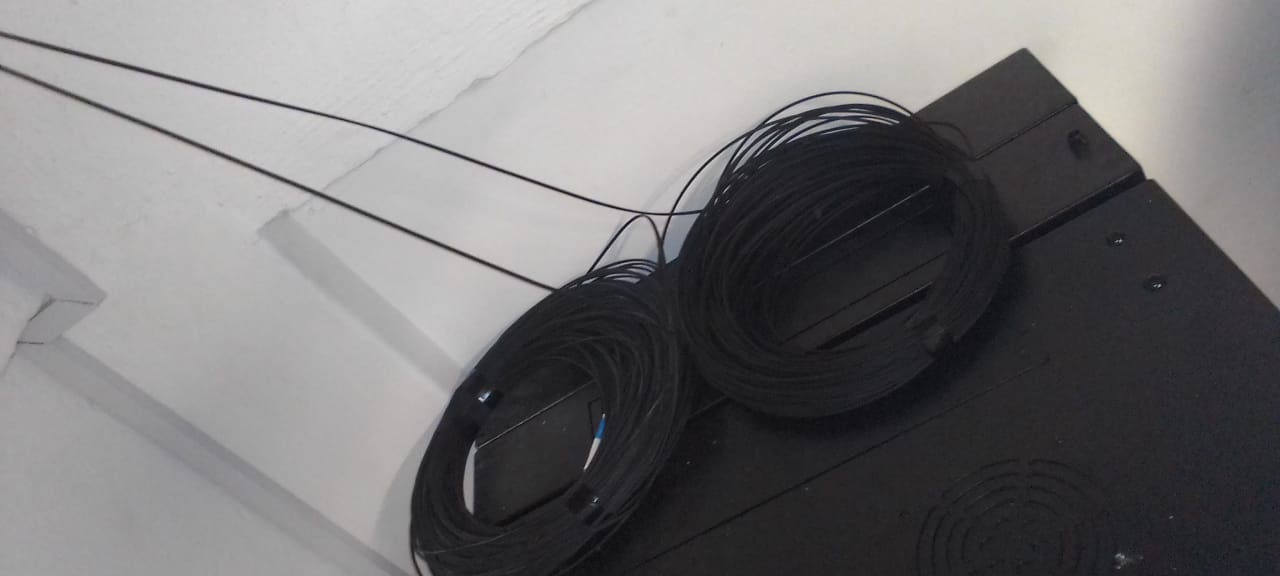
Fibre does not carry electrical current in the same way copper does. That can make it useful as a backbone between cabinets, especially where long outdoor or inter-building links are involved.
That does not remove the need for good power design, surge protection or correct installation.
It simply gives the backbone a better foundation in many large-site scenarios.
Commercial sites need cabinet planning
On industrial and commercial work, cabinet positions should be planned around the building.
Where are the loading bays?
Where are the offices?
Where are the cold rooms?
Where does the yard camera group sit?
Where will future cameras probably be added?
Where can technicians safely access equipment later?
Those questions affect the cabinet design. They also affect how the NVR, network switches and power equipment are specified.
DG Technologies used this kind of thinking on ECS commercial CCTV, where the system required more than cameras. The work included cabinet planning, network structure and a fibre-backed approach to support the scale of the site.
Fibre does not replace documentation
Fibre makes the backbone cleaner.
It does not remove the need for labels and records.
A large CCTV system should document:
- cabinet names,
- fibre routes,
- switch locations,
- uplink ports,
- camera groups,
- IP ranges,
- recorder allocation,
- UPS coverage,
- spare capacity.
Without documentation, a fibre-backed system can still become confusing later.
With documentation, it becomes easier to support, expand and fault-find.
The recorder still needs the full picture
The NVR or recording platform depends on the network delivering camera streams reliably.
If the fibre link between cabinets is unstable, overloaded or undocumented, the recorder may lose groups of cameras. If a remote cabinet has weak power, those cameras may disappear together. If the uplink is not planned, expansion can overload the path.
That is why fibre design must include bandwidth, topology, switch selection and power planning.
It is not just about pulling a fibre cable.
The DG Technologies view
For small homes, a simple camera cable route may be enough.
For larger homes, estates, warehouses and industrial sites, CCTV should be designed like infrastructure.
That may mean remote cabinets, PoE switching, fibre backbones, labelled patching, UPS planning and proper network segmentation.
For Durban and KZN sites where camera distances and building layout matter, DG Technologies designs the CCTV network so the cameras have a stable path back to the recorder.
Good footage starts with a good route.