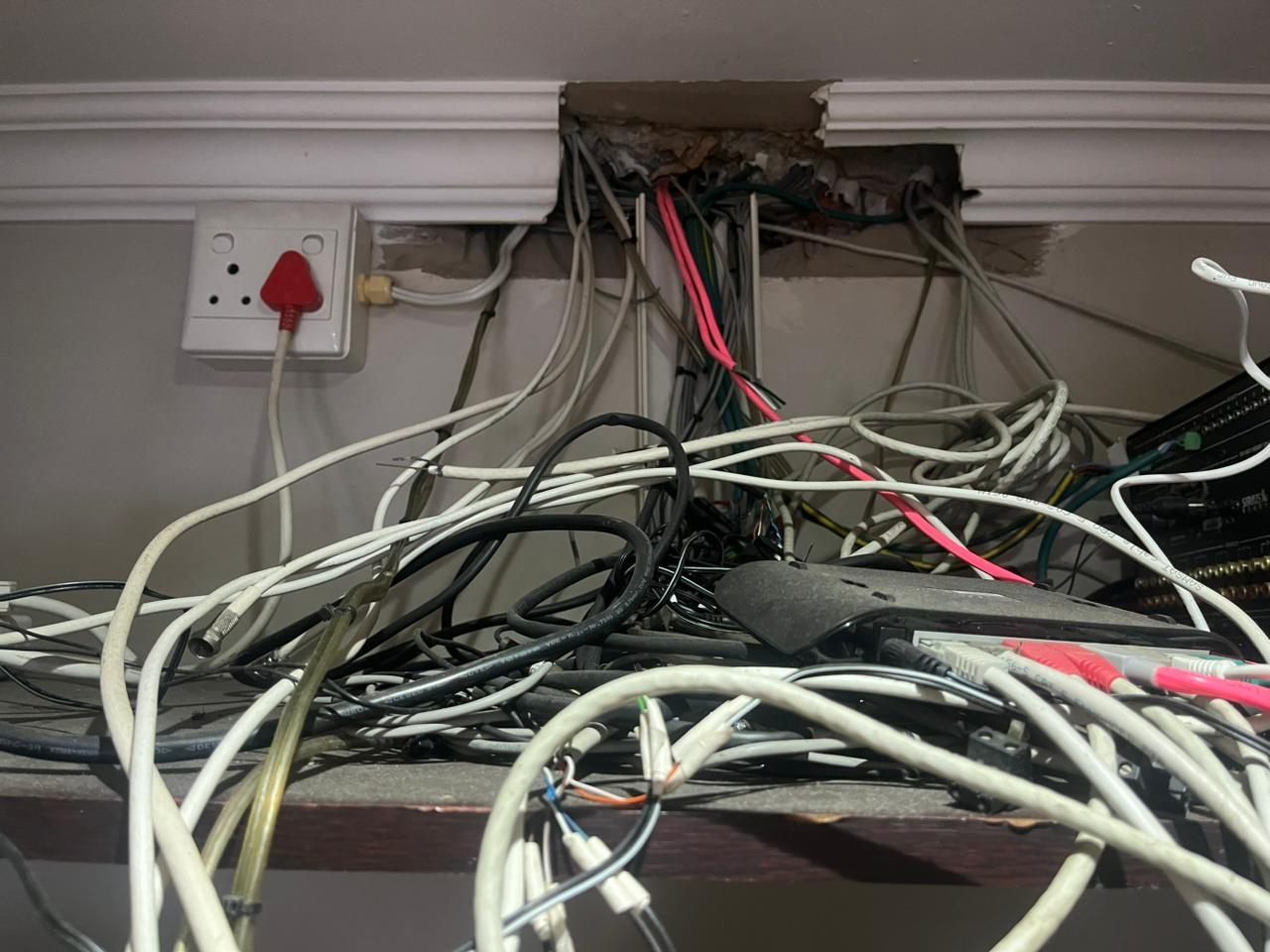
When a smart home stops behaving properly, the visible symptom is rarely the full story.
A keypad may not trigger the right lights. A touch panel may be slow. Cameras may fail to load. Audio may work in one room and not another. Wi-Fi may drop in certain areas. The app may show rooms that no longer match how the home is used.
It is tempting to start replacing equipment immediately.
But on a complex home, that can be an expensive guess.
A smart home rescue assessment should first answer a more important question: what is actually wrong, and what still has value?
We start with the system as it exists
The first step is to understand what is already there.
That includes:
- control processors
- lighting modules
- keypads and touch panels
- audio amplifiers and sources
- network switches and routers
- Wi-Fi access points
- CCTV recorders and cameras
- rack layout
- cable routes
- power supplies
- room naming and user expectations
This may sound basic, but it is where many rescue projects are won or lost.
If nobody understands the existing system, every recommendation becomes weaker. Replacing one visible part may leave the real fault untouched.
We look for the foundation problems
Many smart-home issues are foundation issues.
The control system may be blamed when the network is unstable. Lighting may be blamed when LED loads no longer suit the old dimmers. CCTV may be blamed when the NVR is fine but the network path is poor. Audio may be blamed when the amplifier works but the source and control routing are confusing.
That is why the assessment looks underneath the symptom.
We want to know whether the system has:
- stable power
- a supportable network
- labelled cabling
- correct lighting load control
- sensible rack ventilation
- documented equipment
- reliable source paths
- usable control logic
The goal is not to find someone to blame. The goal is to find the real cause.
We separate urgent faults from design debt
Not every problem has the same priority.
Some faults need immediate repair because the home depends on them. Gate access, security cameras, main Wi-Fi, key lighting circuits and core control may need attention first.
Other problems are design debt. They may not stop the home from working today, but they make future support harder: unlabelled cables, unknown IP addresses, messy racks, undocumented changes, old equipment in hot cupboards, or confusing room names.
A good rescue assessment separates those two categories.
The homeowner should know what must be fixed now, what should be planned next, and what can wait.
We identify what can be kept
Rescue work is not automatically replacement work.
There may be equipment worth keeping:
- amplifiers that still perform well
- speakers that are correctly positioned
- cabling that can be reused
- lighting circuits that only need recommissioning
- access points that are fine but badly placed
- cameras that need better network support rather than replacement
Keeping good equipment is not a compromise if it is tested and documented.
At the same time, keeping weak equipment because it saves money today can be a mistake. The assessment must be honest about both sides.
We check whether the home still matches the system
Homes change.
Rooms are renovated. TVs move. Fibre routers are replaced. New devices are added. Outdoor areas become more important. Children grow up. Guest use changes. Staff requirements change. Security concerns change.
Sometimes the old smart-home design was right for the house as it was, but not for the house as it is now.
That is why we ask how the home is actually being used today.
The system should support the current household, not only the original installation brief.
We document before we disturb too much
On a messy or undocumented system, pulling equipment apart too quickly can create more confusion.
Where possible, we prefer to identify, photograph, label and understand before making major changes. That helps preserve clues about how the original system worked.
Documentation may include:
- rack photos
- cable notes
- equipment lists
- room relationships
- lighting circuit observations
- network device information
- fault symptoms
- recommended next steps
This documentation becomes valuable even if the client chooses to phase the repairs over time.
The final recommendation should be practical
At the end of a rescue assessment, the homeowner should not receive vague technical language.
They should understand:
- what is causing the main problems
- what is safe to keep
- what should be replaced
- what can be phased
- what the risks are
- what documentation is missing
- what will make future support easier
That clarity is part of the value.
The DG Technologies approach
DG Technologies handles legacy Crestron and smart-home rescue work across Durban, Mount Edgecombe, Umhlanga, Zimbali, Simbithi and the wider KZN coast.
Our approach is to assess first, then repair or upgrade properly.
Sometimes that means replacing equipment. Sometimes it means saving the client from replacing equipment unnecessarily. Often it means fixing the foundation so the system can be trusted again.
A rescue assessment should leave the homeowner with more confidence, not just another list of boxes to buy.