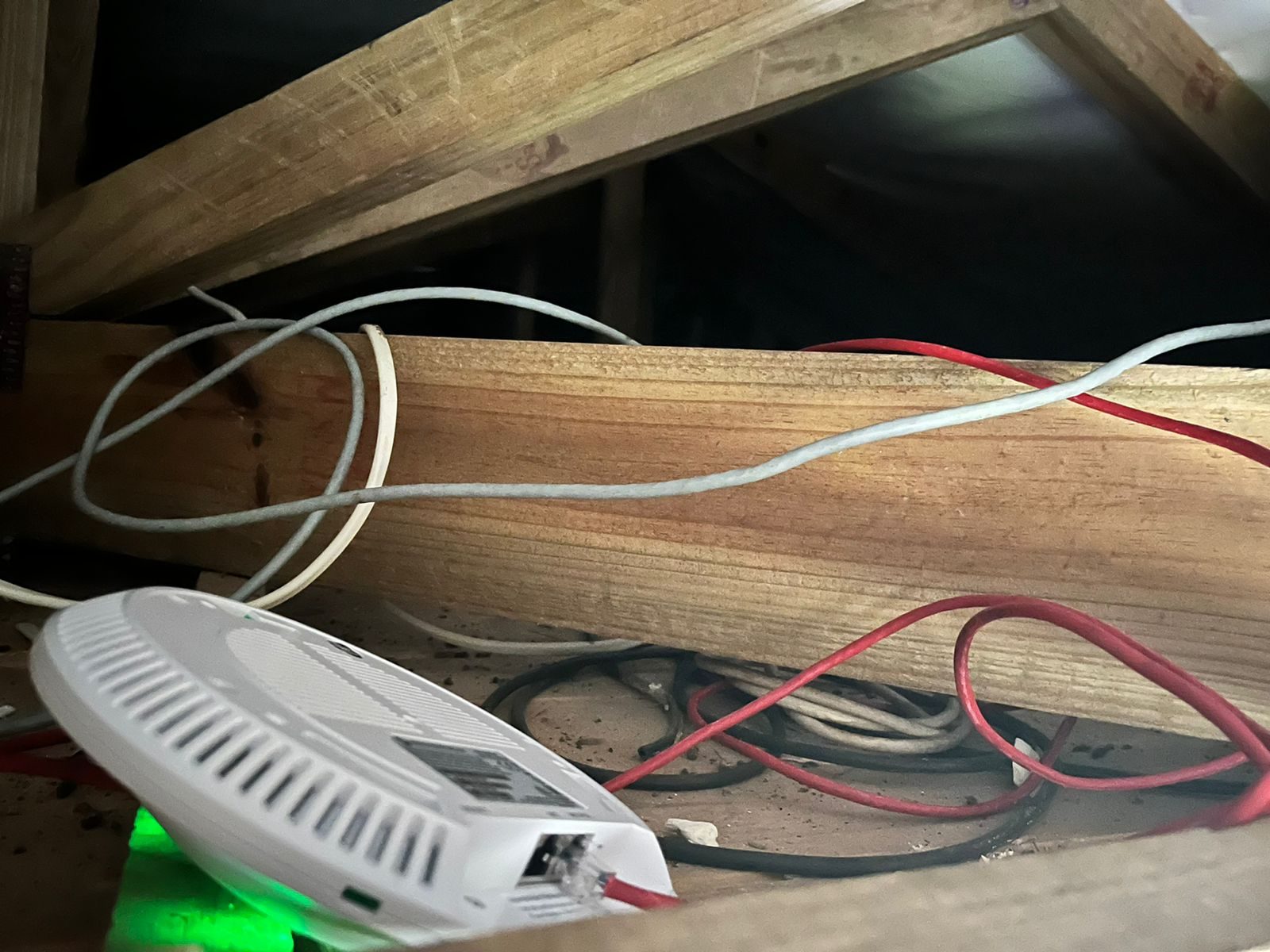
An access point can disappear from the network even though the unit itself is healthy. A damaged RJ45 termination or broken pair along the cable route can stop data, PoE or both. Before replacing the AP, we test the path that feeds it.
On one residential call-out, an offline AP did not respond when we changed its PoE supply. A spare AP also failed on the installed cable. The cable tester indicated a broken pair, while a short known-good lead brought the AP online. That narrowed the fault to the installed route. Changing equipment at the ceiling would not have repaired it.
Pair order and continuity matter
Network cable is not just a group of coloured wires.
The pairs are arranged for a reason. If they are split, out of sequence or open, the cable may fail completely or negotiate at a lower speed. A basic continuity tester can identify some faults; intermittent faults may need closer inspection or more capable testing.
This is especially frustrating on access points because the symptom often looks like a device or Wi-Fi issue.
The AP does not power up.
It powers up but drops.
It negotiates at the wrong speed.
It adopts, then disappears.
It works until touched.
Before blaming the access point, the cable needs to be tested.
A bad crimp can survive long enough to confuse everyone
Some bad terminations fail immediately.
Those are easy.
The harder ones work just enough to create confusion.
They pass a quick glance. The plug clicks in. The lights flash. The system seems alive. Then the AP behaves badly under load or drops offline later.
That is why proper cable testing matters, not just visual inspection.
PoE makes termination quality more important
Most professional access points use PoE.
That means the same cable carries data and power. If the connector is poor, the access point may receive unstable power, poor data performance or both.
A Wi-Fi system can be undermined by one damaged termination.
In a large home, that one plug may be hidden in a ceiling, cupboard, roof space or wall plate where nobody wants to go back later.
Ceiling access points should remain serviceable
Access points can be hidden carefully, but they must remain accessible.
If an AP is above a ceiling, behind an access hatch or near a speaker cutout, someone must be able to reach it later. Otherwise a small termination fault becomes a ceiling-opening exercise.
This is why we care about service access during the design stage.
The AP position is not only about signal.
It is also about future maintenance.
Termination should be part of commissioning
Commissioning a Wi-Fi system should include more than seeing SSIDs appear.
The installer should confirm:
- the AP is adopted properly,
- the switch port is stable,
- the cable tests correctly,
- the AP negotiates at the expected speed,
- PoE is stable,
- the AP name matches the room or floor,
- and the device remains online after reboot.
If those checks are skipped, the client may inherit a fault that only appears later.
Small workmanship becomes long-term reliability
RJ45 terminations are small, repetitive tasks.
That makes them easy to treat casually.
But in smart homes, CCTV systems, Wi-Fi networks and AV racks, those terminations are the nervous system of the installation.
One poor crimp can create hours of support.
One broken pair can make good equipment look bad.
Before replacing the AP, test the cable
When an access point fails, the first instinct should not always be replacement.
Test the cable.
Check the connector.
Check the patch point.
Check the switch port.
Check PoE.
Only then decide whether the AP itself is faulty.
Good Wi-Fi depends on invisible workmanship.
The client sees signal bars.
The installer should be thinking about copper, pairs, crimps, PoE and service access.
Related reading: premium Wi-Fi and networking guide and why damaged RJ45 connectors can take CCTV cameras offline.