App control is useful.
I use it, I specify it and I expect a modern smart home to have it. But I do not believe every important function in a home should depend only on an app.
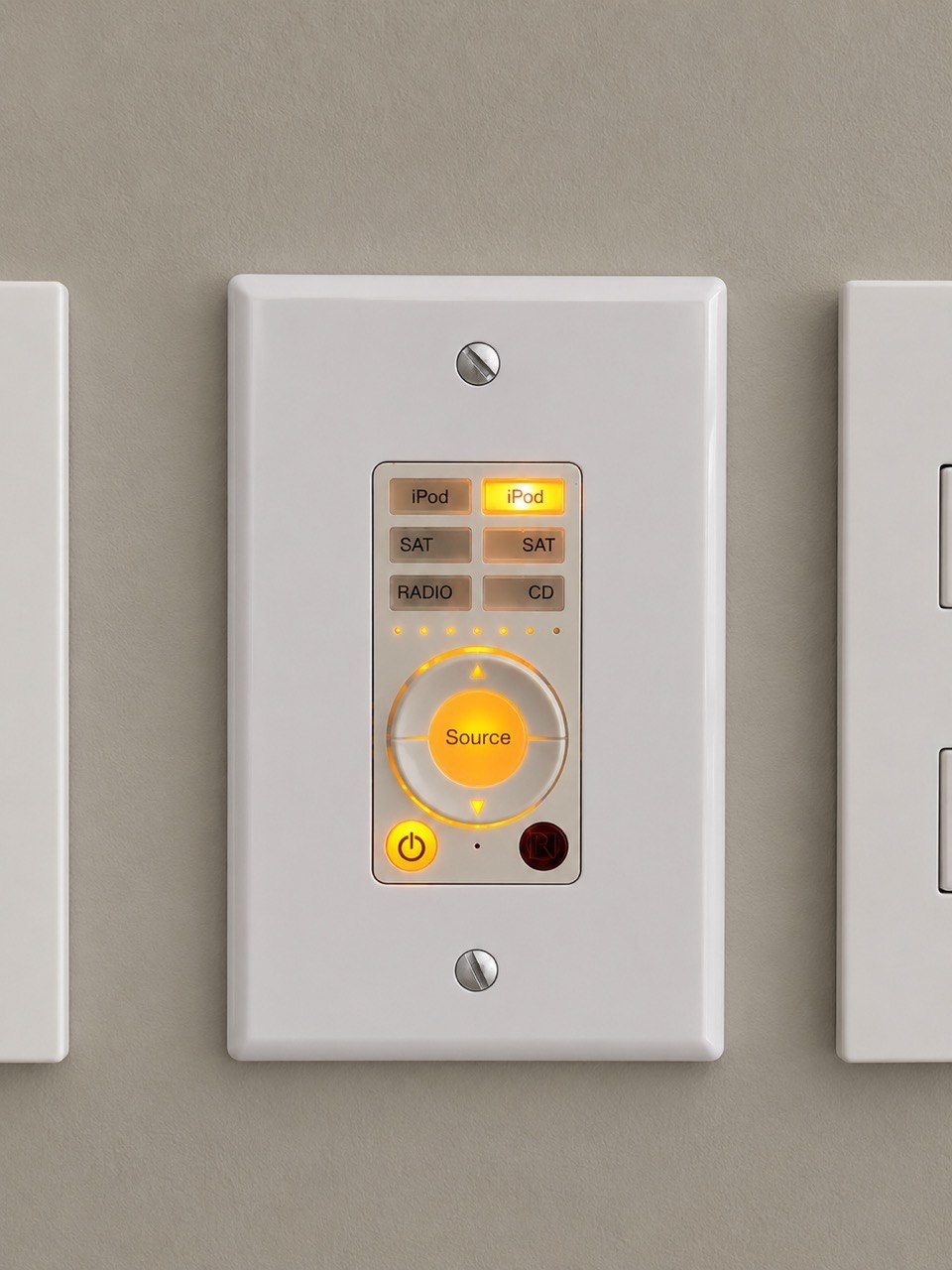
There are still places where a physical keypad is the better answer.
Not because it is old-fashioned.
Because it removes friction.
The phone is not always ready
A phone may be upstairs, charging, flat, locked, in another person’s hand or connected to the wrong Wi-Fi network.
An app may need an update. A guest may not have access. A staff member may not have permission. The homeowner may simply want to press one button while walking through a room.
For daily control, those small moments matter.
If every basic action requires finding a phone, unlocking it, opening an app, choosing a room and choosing a source, the system starts to feel heavier than the old switch it replaced.
That is not good automation.
Keypads are strongest for repeated actions
I like keypads for actions people repeat often:
- turning a room on,
- selecting a normal music source,
- changing volume,
- activating a lighting scene,
- switching everything off,
- opening or closing a simple zone,
- or giving a guest one obvious button to press.
The keypad does not need to do everything.
It needs to do the few things that should never feel complicated.
App-only control can work in the wrong room and fail in the right one
In a casual room, app-only control may be fine.
In a main living area, entertainment room, guest suite, patio or kitchen, it can become irritating. Those are spaces where people move, talk, cook, entertain, host and hand control between family members.
The more people who use the room, the less I want the room to depend on one person’s phone.
A keypad gives the room its own control point.
That matters.
A keypad is also a fallback
Wi-Fi and apps are part of the system, but they are not the whole system.
If an app is slow, a phone is missing or a network setting changes, the room should still have a simple way to perform its normal functions.
This is especially important for music and lighting.
Nobody wants to troubleshoot an app just to lower the volume during dinner.
The mistake is overloading the keypad
A keypad should not become a wall full of confusing buttons.
The best keypads are simple. They match how the room is used. The labels make sense. The actions are predictable. The homeowner knows what will happen before pressing the button.
In many rooms, that may mean only a few commands:
- on,
- off,
- volume up,
- volume down,
- favourite scene,
- or one normal source.
The app can still handle deeper control.
The keypad handles the daily actions.
Keypads protect guests and staff from complexity
Large homes often have guests, house managers, cleaners, security staff or family members who do not want to learn the full automation system.
They should not need to.
A keypad can make a room usable without giving every person app access. It can also keep control limited to what that person should reasonably use.
That is cleaner than handing out full app control and hoping nobody changes the wrong thing.
The decision is not keypad or app
The best systems use both.
The app is excellent for browsing, configuration, room selection and deeper control. The keypad is excellent for fast, local, repeated actions.
The design question is simple:
Which actions should be one press, and which actions can live inside the app?
When that question is answered properly, the smart home feels calmer.
It stops feeling like a technical product and starts feeling like part of the room.
Related reading: smart home vs home automation and why smart home interfaces sometimes need to be customised.