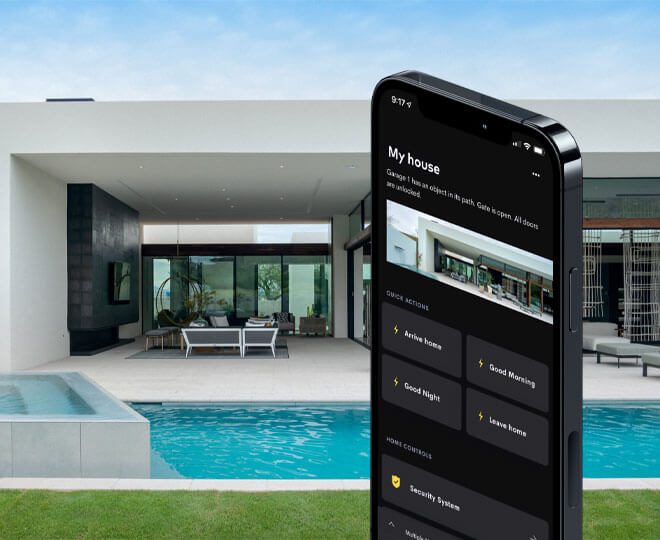
In a large private home, the owner is not always the only person interacting with the technology.
There may be a house manager, domestic staff, security staff, maintenance contractors, visiting family, guests, drivers, gardeners, estate security, rental managers or caretakers. Each person may need the home to do something, but very few of them need full control.
That is why smart-home design for large residences should include roles, routines and boundaries from the beginning.
DG Technologies designs private home automation with discretion and daily practicality in mind. A system is not successful only because the owner can open an app. It is successful when the whole home can function calmly without exposing private controls or confusing the people who help run the property.
The owner is not the only user
Many automation systems are designed around one perfect user: the homeowner with the app.
That is too narrow for large homes.
A house manager may need to check exterior lights, open gates, view selected cameras, reset an audio zone or report a fault. Staff may need cleaning scenes, basic lighting, intercom routines or access to service areas. Guests may need room lighting, Wi-Fi and TV control without access to the whole house.
Those requirements should not be improvised after handover. They should be part of the design.
Control should be limited by purpose
Not everyone should see everything.
That is not a distrust issue. It is a privacy and usability issue.
If a guest only needs control of a bedroom, they should not see security cameras, private areas or whole-home settings. If staff need cleaning scenes, they do not need access to owner-only entertainment controls. If a house manager needs operational oversight, their interface should be practical and controlled.
Crestron Home can support a more thoughtful control strategy when the integrator plans the system properly. The point is not to make the system restrictive. The point is to make every user’s control clear.
Routines matter more than features
The best way to design for multiple users is to ask how the home actually runs.
For example:
- Who opens for deliveries?
- Who prepares the entertainment area before guests arrive?
- Who checks whether exterior lights are off?
- Who helps a guest connect to Wi-Fi?
- Who reports if CCTV is offline?
- Who knows what to do after a power failure?
- Who needs access while the owner is away?
Those questions lead to better scenes, better labels and better handover.
They also prevent the owner from becoming the help desk for the house.
Large homes need simple control points
In a large home, too many control options can become a problem. If every room has a different interface and every function is named differently, people stop trusting the system.
Good design uses consistent logic:
- Similar keypad layouts where possible.
- Clear room names.
- Simple scene names.
- Reliable Wi-Fi coverage.
- Practical app organisation.
- Touchscreens only where they genuinely help.
- Documentation that support teams can understand.
This is part of the reason DG Technologies talks so much about handover and supportability. The system must remain understandable after the installer leaves.
Security and access need careful boundaries
Access control and CCTV are especially sensitive in private homes.
The owner may need full visibility. A house manager may need selected views. Staff may only need gate or intercom workflows. Guests may need no security access at all.
If this is not planned, the system can either become too open or too difficult to use.
DG Technologies treats access control and CCTV as part of the home’s operating model, not just devices on a wall. The question is not only “where is the camera?” The question is “who needs to see it, when, and why?”
Discreet homes need discreet technology teams
In high-end private residences, technical work happens inside personal spaces. That requires a different level of conduct from the installation team.
The team must work neatly, respect privacy, avoid unnecessary disruption and understand that not every project detail belongs in public. The system itself should follow the same principle: strong where it needs to be, quiet where it should disappear.
That is the type of automation DG Technologies aims to deliver in Durban, Umhlanga, Mount Edgecombe, Zimbali, Simbithi and other premium KZN homes.
The best smart home is not the one with the most visible technology. It is the one that lets the property run properly for the owner and the trusted people around them.