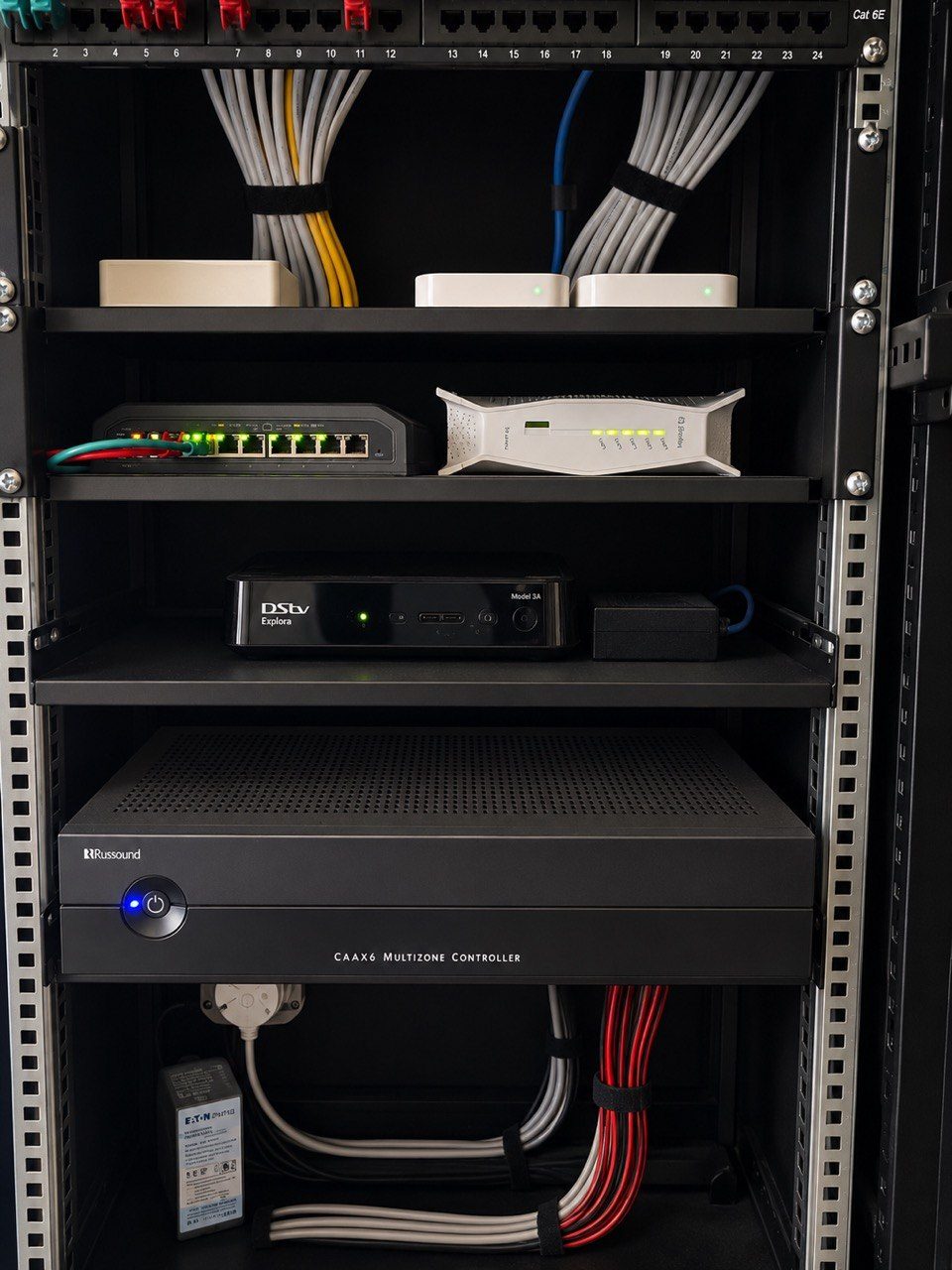
One Sonos speaker in a kitchen is simple.
Eleven audio zones across a large home is not the same thing.
That distinction matters. Many people first experience Sonos as a consumer product: buy a speaker, connect it to Wi-Fi, open the app and play music. For a small apartment or one room, that may be perfectly fine. In a large KZN home with multiple access points, hardwired network points, portable speakers, soundbars, amplifiers, outdoor areas and guest Wi-Fi, the network underneath the music system becomes part of the audio system.
If the network is wrong, the symptom is rarely described as a network problem.
The client says:
- the music keeps stopping
- one room disappears from the app
- the volume control goes grey
- the speakers grouped together and then dropped
- the soundbar works but the dining room does not
- everything was fine until someone changed the router
That is why DG Technologies treats multiroom audio and network infrastructure as connected disciplines.
Sonos can connect in more than one way
Sonos systems are flexible. That is one of their strengths.
But flexibility also creates risk in a large installation.
Some Sonos devices may be wired. Some may be on Wi-Fi. Some may create their own mesh-style paths. A soundbar may be connected one way, an amplifier another way, and portable speakers another. If the network equipment does not manage those paths correctly, the system can create loops or instability.
In plain English, a network loop is when traffic keeps circulating instead of travelling cleanly from one device to another.
The result can be dramatic. Music drops. Wi-Fi slows down. Other devices on the network become unstable. The homeowner experiences it as a bad audio system, even though the real issue may be switching, topology or unmanaged network paths.
This is one reason we favour managed networking platforms such as Ubiquiti UniFi in larger homes. It gives us visibility, control and the ability to apply proper network practices instead of hoping that everything behaves.
STP, loop prevention and proper switches matter
In a serious home network, the switch is not just a box with ports.
Managed switches can support features that help prevent network loops and instability. Spanning Tree Protocol, switch priorities and loop prevention may sound like IT language, but in a smart home they directly affect whether the client can play music reliably on a Friday night.
If a speaker or audio device misbehaves, a properly managed network can help isolate the problem instead of allowing it to affect the whole property.
That is not over-engineering.
It is the difference between a system that works when the installer is standing there and a system that keeps working after months of daily use.
Wi-Fi access points are not all equal
Large South African homes are hard on Wi-Fi.
Concrete walls, multiple floors, garages, entertainment areas, staff areas, outbuildings and inverter rooms all make coverage more complicated. A phone may show signal bars, but that does not prove the network is good enough for streaming audio, smart home control and remote support.
For audio, consistency matters more than a speed-test screenshot.
The question is not only, “Can I get internet here?”
The better questions are:
- is the device connected to the right access point?
- does roaming behave properly?
- is the backhaul stable?
- are audio devices isolated from guest traffic?
- are wired and wireless Sonos devices being managed correctly?
- can the installer see what is happening remotely?
This is why we are cautious when inheriting unknown access point brands on larger homes. We need to test throughput, roaming, device behaviour and switch compatibility before we can be confident in the whole solution.
Audio zones should follow real use
Another mistake is treating every speaker or amplifier as an isolated purchase.
In practice, every Sonos amplifier, soundbar, speaker or portable unit effectively becomes part of a zone strategy. A large home may have the kitchen, dining room, lounge, verandah, pool, bedrooms, study, gym and firepit all behaving differently.
Some zones should be independent.
Some should naturally play together.
Some should be easy for guests to use.
Some should be mostly controlled by the homeowner.
Good audio design is not only about how many speakers are installed. It is about how quickly the right music plays in the right part of the home without a complicated explanation.
The network is part of the product
When DG Technologies quotes a managed network as part of an audio system, it is not an unnecessary extra.
It is part of the reliability of the installation.
If the music system depends on IP communication, then the person responsible for the audio experience needs proper involvement in the router, switches, access points and IP planning. Otherwise, a beautiful audio installation can be undone by a router change, missing reservation, unmanaged switch or poorly positioned access point.
That is why we prefer to own the technical backbone of the systems we install.
Not because we want to control everything.
Because when the client says, “The music is not working,” we need to be able to find the real reason quickly.