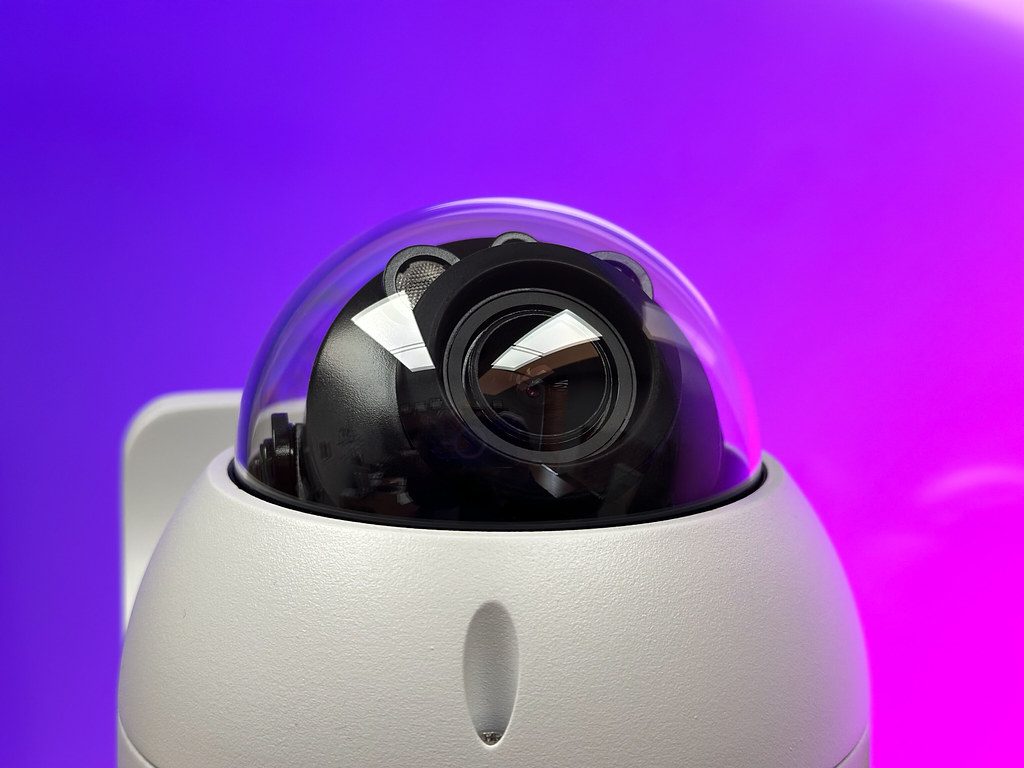
A CCTV camera is easy to judge in daylight.
The picture looks bright, the view appears clear, and the client can see the driveway, loading bay, gate, passage or boundary. On many sites, that is where the installation is treated as finished.
That is not enough.
Many important security incidents happen at night, early morning or during low-light conditions. A camera that looks perfect at 2 pm may be almost useless at 2 am.
Night changes the whole image
At night, the camera has to deal with different problems.
Infrared reflection, headlights, wet paving, bright security lights, dark clothing, deep shadows, insects, dust and glass can all change the result. A view that seemed balanced during the day can become washed out, overexposed or too dark after sunset.
The only honest way to know is to test it.
Infrared is not magic
Infrared helps, but it does not automatically produce usable evidence.
If a wall, soffit, pillar or eave is too close to the camera, infrared light can bounce back into the lens and ruin the image. If the camera is looking too wide, the infrared may not reach the important area properly. If the target is too far away, the picture may show movement without enough detail.
Night vision must be checked against the actual scene, not only the camera specification.
Security lighting and CCTV must work together
Sometimes the answer is not a better camera.
It may be better lighting, a different angle, a narrower lens, a lower mounting position or a second camera covering the identification shot. CCTV and lighting should be designed together, especially at gates, driveways, loading bays, staff entrances and estate perimeters.
A camera should not only show that something happened.
It should help identify what happened.
Headlights can destroy the evidence
Vehicle entrances are a good example.
A wide camera facing a driveway may look impressive during the day, but at night a set of headlights can blow out the image. Number plates, faces and vehicle details may disappear at the exact moment the footage is needed.
For serious properties, vehicle coverage often needs more than one view. One camera may capture the wider event while another is positioned for the useful detail.
DG Technologies’ view
DG Technologies treats night testing as part of professional CCTV commissioning.
The question is not whether the camera produces a picture.
The question is whether the picture is useful when the client actually needs it.