When a guest bedroom TV will not change channel, the TV is often blamed first.
In many homes, the real problem is somewhere else.
It may be the decoder. It may be the IR bug. It may be the remote mode. It may be a shared source. It may be a relay setting on a decoder in the rack. It may be that a fibre provider, IT technician or previous installer changed equipment without understanding how the television distribution system was originally designed.
That is why guest-bedroom TV control needs more than a TV on the wall and a remote in the drawer.
It needs a proper control path.
A guest room may not have its own decoder
Large South African homes often distribute DSTV from a central rack or equipment cupboard.
That can be a sensible design. It keeps decoders, power supplies, splitters, modulators, amplifiers and network equipment out of bedrooms. It also makes support easier because the equipment is in one place.
But it means the guest room is no longer a simple one-TV-one-decoder setup.
The room may be viewing a decoder located somewhere else. The remote signal has to travel back to that decoder. If that signal path is wrong, the guest can see the channel but cannot control it.
To the guest, it feels broken.
To the installer, it is a control-path fault.
Remote modes matter
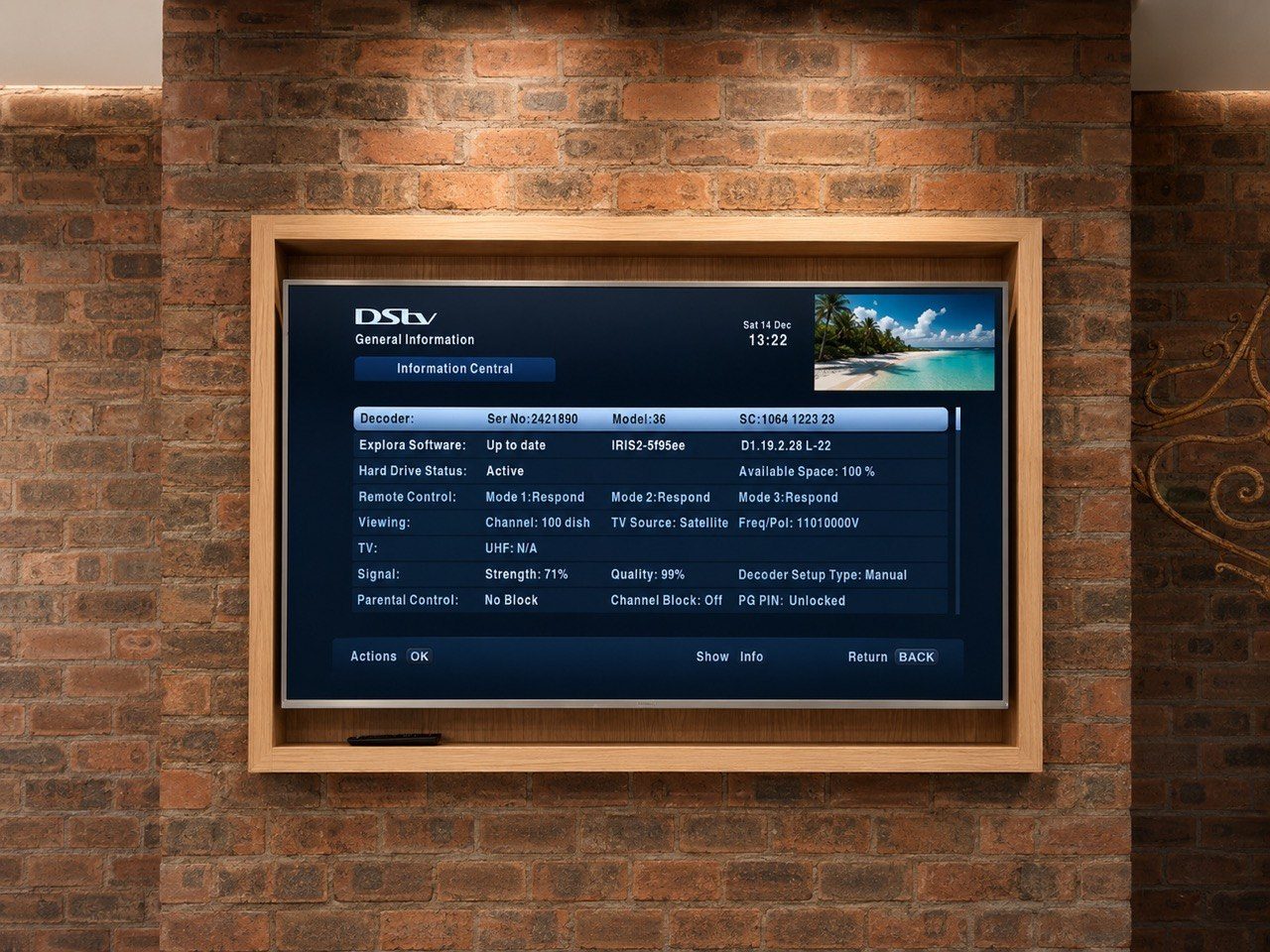
DSTV remote modes are one of those small details that can quietly make or break a distributed system.
Where multiple decoders are installed, remotes and decoders cannot all respond in the same way. If they do, one room may control the wrong decoder, or a decoder may respond when it should only be relaying a command for another room.
The installer needs to know:
- which remote mode each room uses,
- which decoder responds to which mode,
- which decoder must relay other remote commands,
- where the IR receiver is positioned,
- where the IR emitter or bug is fixed,
- whether the guest room is sharing a decoder with another area.
This is not a cosmetic setting.
It is part of the system design.
IR bugs must be treated as critical components
An IR bug is small. That is part of the problem.
Because it is small, people treat it casually. It gets bumped. It falls off. It is stuck in the wrong place. It is hidden behind a cabinet. Someone cleans around the equipment and moves it. A decoder is replaced and the bug is never positioned correctly again.
Then the guest room stops changing channel.
The picture may still be there. The TV may still be on the correct input. The decoder may still be working. But the command from the room never reaches the equipment.
On a proper DSTV distribution installation, the IR path should be tested room by room. Not only at the rack. Not only with the installer standing beside the decoder.
Stand in the guest room. Pick up the remote. Change channel. Open the guide. Adjust volume. Switch off. Switch on again.
That is the test that matters.
Shared sources need clear rules
Not every room needs a dedicated decoder.
In some homes, a guest bedroom, secondary lounge or staff area may share a source. That can save money and simplify the rack, but only if everyone understands the behaviour.
If two rooms share the same decoder, one room may change the channel for the other. That may be acceptable in a rarely used guest wing. It may be completely unacceptable in a main bedroom or entertainment area.
This decision should be made deliberately.
It should not be discovered by accident after guests arrive.
For premium homes, DG Technologies tries to match the source design to how the home is actually used. Some areas need dedicated control. Some areas can share. Some guest rooms need familiar operation more than advanced automation. Some owner areas can be integrated more deeply into home automation.
The important thing is that the decision is understood before handover.
Guest-room faults often happen after something changed
A guest room TV fault often begins with a sentence like:
“It used to work.”
That is usually true.
Then something changed.
A decoder was swapped. A fibre router was replaced. The rack was cleaned. A TV firmware update changed an input. A remote was moved from another room. A modulator was restarted. A power supply failed. Someone unplugged equipment during load shedding. A source was reconnected to a different HDMI port.
The fault is not always dramatic.
It is often one small change in a system where the original logic was not documented clearly enough.
That is why source labels, remote modes, IR paths and decoder allocation should be recorded as part of the handover. We covered the broader handover issue in why TV brackets, remotes and source control need handover.
This article is the deeper technical reason behind that advice.
The house manager should know the first checks
In a large home, the owner should not be the only person who knows how the guest TV system works.
A house manager or trusted staff member should know the basic checks:
- Is the TV on the correct input?
- Is the decoder powered?
- Is the correct remote being used?
- Is the remote in the correct mode?
- Is the IR receiver visible?
- Has the IR bug moved on the decoder?
- Is the guest room sharing a source with another room?
- Has anyone changed equipment in the rack?
This does not mean giving staff full technical control.
It means giving them enough practical knowledge to avoid unnecessary panic before guests arrive.
For homes that entertain often, this becomes part of normal support discipline.
The best guest-room control feels ordinary
The technology behind the room may be complicated.
The guest experience should not be.
If the system uses a rack, shared decoders, IR distribution, remote modes, HDMI distribution and automation logic, that complexity should be handled by the design. The guest should not have to understand it.
They should pick up the correct remote and use the TV.
That is the standard.
The work behind the wall, inside the rack and at the decoder is what makes that simple moment possible.