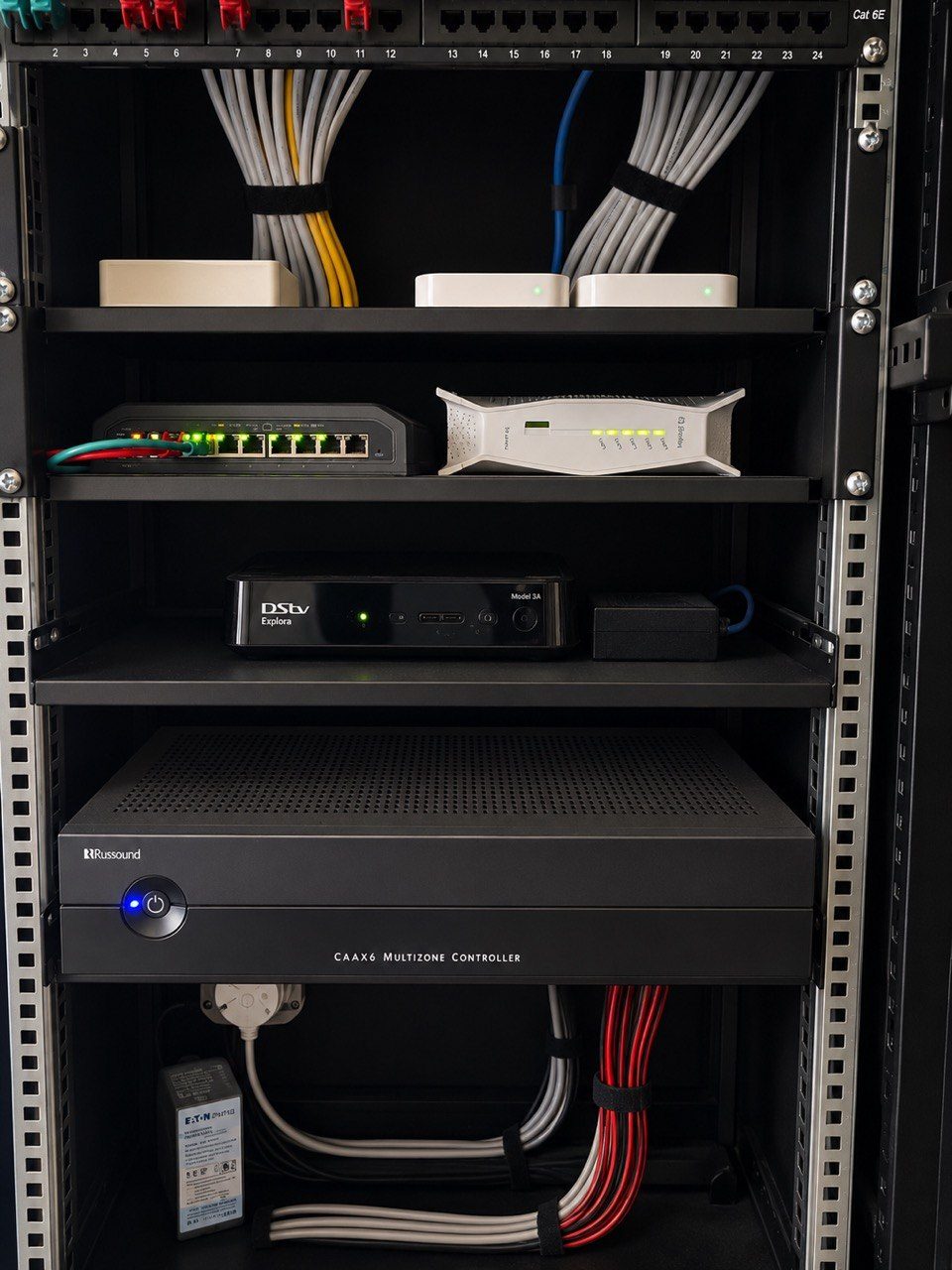
Crestron DM NAX is one of the most important changes in modern Crestron multiroom audio.
Not because it is simply another amplifier.
Because it changes the architecture.
In older multiroom audio systems, streaming was often added from the outside. If a client wanted AirPlay, Spotify, internet radio or app-based music in different rooms, the system usually needed external streamers, additional inputs, source switching, power supplies, network points, audio patching and programming around those devices.
That could work, but it created more places for the system to fail.
With DM NAX, Crestron has moved much of that streaming and routing intelligence into the audio platform itself. That makes a serious difference in a modern Crestron Home installation.
What DM NAX is doing differently
Crestron describes DM NAX as an Audio-over-IP platform that puts multiroom audio distribution onto the network. The larger DM-NAX-8ZSA provides eight amplified stereo zones, while the DM-NAX-4ZSA-50 provides four amplified zones plus an additional line-level zone.
The important part is that streaming is built in. Crestron’s own product information confirms that DM NAX includes dedicated streaming service player access for the zones, with support for services and casting such as AirPlay 2, Apple Music, Amazon Music, Spotify Connect, internet radio, TIDAL, Deezer, Qobuz, Podcasts and more.
That changes the design conversation.
Instead of adding a separate streaming box for every group of rooms, the amplifier itself becomes the streamer, router, DSP and amplifier.
Why external streamers caused problems
Before products like DM NAX, a multiroom audio system often needed extra devices to add modern streaming.
For example, a system might have:
- External AirPlay receivers.
- Separate music streamers.
- Extra power supplies.
- Extra patch leads.
- Extra network points.
- Extra source inputs.
- Extra programming logic.
- Extra places for someone to unplug the wrong thing.
Each device had to be named correctly, connected correctly, updated, powered, routed and controlled. If the client changed Wi-Fi, upgraded a phone, replaced a router or moved a streamer, the audio system could start behaving unpredictably.
The client did not see that complexity. They only saw music dropping, a room missing from AirPlay, the wrong source playing, or the app not behaving as expected.
That is why fewer boxes can be a better design.
Built-in streaming reduces failure points
When streaming is built into the DM NAX platform, the system becomes cleaner.
There are fewer devices in the rack. There are fewer power supplies. There are fewer analogue audio links. There are fewer source-name problems. There are fewer little boxes that depend on someone remembering what they do.
This does not mean a DM NAX system has no complexity. It still needs proper network design, correct configuration, good rack practice and thoughtful commissioning.
But the complexity is moved into a professional Crestron platform instead of being scattered across several consumer or semi-consumer devices.
That is a major advantage for long-term support.
Each zone can be more independent
One of the strongest benefits of DM NAX is zone flexibility.
The DM-NAX-8ZSA has streaming player access for each of its eight zones. The DM-NAX-4ZSA-50 has dedicated streaming player access for its four amplified zones, with an extra line-level zone available for feeding another amplifier or active audio path.
In practice, that means different rooms can play different content without needing a large stack of external players.
A kitchen can play one stream. A patio can play another. A bedroom can use AirPlay. A dining area can use internet radio. The system can also group zones when the client wants the same audio across multiple areas.
That is exactly how multiroom audio should work in a premium home: flexible when needed, simple when used.
The 8-zone unit and passive subwoofer nuance
The larger DM-NAX-8ZSA is an eight-zone amplifier by default, but its 2.1 and bridged configurations can consume additional speaker outputs.
Crestron’s documentation explains that certain 2.1 configurations use more than a normal stereo pair. For example, a bridged 2.1 arrangement can reduce the practical number of available zones because it uses multiple output pairs for left, right and subwoofer channels.
This is probably why installers sometimes talk about the larger unit as effectively becoming fewer zones when passive subwoofer or bridged 2.1 configurations are used.
That is not a weakness. It is a design decision.
If a room needs proper 2.1 audio with a passive subwoofer, the installer must account for how many amplifier channels that configuration consumes. The quote should explain that clearly, because a “zone count” is not always the same as a “room count.”
The 4+1 unit is useful where eight zones are overkill
The DM-NAX-4ZSA-50 is especially interesting because it fits smaller projects and expansion scenarios.
Crestron’s product information describes it as four amplified stereo zones plus one line-level stereo output. That extra output can be useful where one area needs to feed an external amplifier, active speaker system or another downstream audio path.
For a smaller home, apartment, entertainment area, office, restaurant, dental practice or expansion to an existing system, an eight-zone amplifier may be too much. The 4+1 unit gives a more compact way to bring DM NAX streaming and routing into the project.
This fits DG Technologies’ wider approach: do not sell the biggest product when the right-sized product does the job properly.
DM NAX still needs a proper network
The “N” in NAX matters.
DM NAX is network audio. That means the network becomes part of the audio system.
Crestron’s own documentation notes that DM NAX devices use network audio traffic and should be installed with proper network design. In a premium home, that means managed switching, sensible network structure, correct configuration and rack documentation.
If the network is poor, a networked audio system will be blamed for problems that actually sit underneath it.
This is why DG Technologies treats network infrastructure and multiroom audio as connected parts of the same design.
Why this matters in real homes
In a real home, the client does not care how many source boxes are in the rack.
They care that the patio plays music when guests arrive. They care that the kitchen can stream from a phone. They care that the bedroom can play something different. They care that the app makes sense. They care that the system still works after a power failure.
DM NAX helps because it reduces the number of separate moving parts required to deliver that experience.
Older systems often had good amplifiers, good speakers and good intentions, but streaming was added as a layer on top. DM NAX makes streaming native to the Crestron audio platform.
That is the real shift.
Better for support, better for the client
From a support perspective, fewer external devices means cleaner fault finding.
Instead of asking whether the AirPlay box is powered, whether it is still on the network, whether its analogue output is patched correctly, whether the right input has been selected and whether the control system still knows what it is called, the installer can work inside a more unified Crestron audio platform.
That does not remove the need for skill. It makes the system more coherent.
For DG Technologies, that is the value of DM NAX in a modern Crestron Home system. It supports the kind of design we prefer: fewer unnecessary boxes, cleaner racks, clearer control, better documentation and fewer failure points for the client.
For related reading, see why multiroom audio should follow how the home is actually used and when existing amplifiers are worth keeping.