Most clients judge a CCTV installation by the cameras they can see.
That is understandable. Cameras are the visible part of the system. They sit on walls, under eaves, near gates, in corridors and above loading areas. They are what people point at when they ask whether the property is protected.
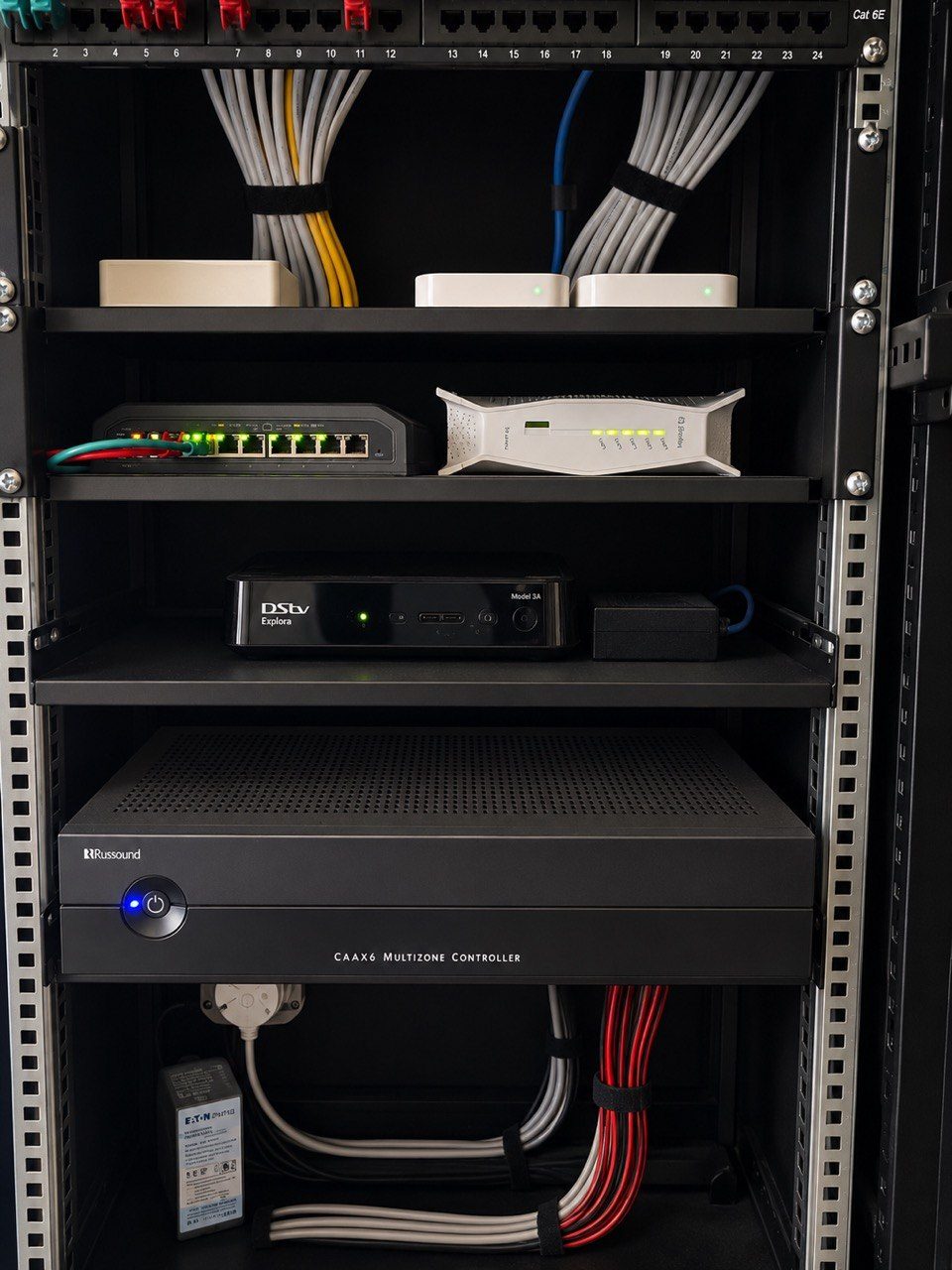
But the long-term quality of a CCTV system is often decided by the parts the client does not see: cabling, conduit, cable trays, junction points, cabinets, labels, patch panels, PoE switches and documentation.
Those details do not look exciting on a quotation.
They are also the details that decide whether the system can be supported properly years later.
DG Technologies treats CCTV installation as infrastructure. A good camera in the wrong cable route, with no label, poor containment and no record of where it goes, becomes a future problem waiting to happen.
A camera cable is part of the security system
A CCTV cable is not just a way to get signal from one place to another.
It carries power, data and reliability. If it is damaged, poorly terminated, routed badly, exposed to weather, pulled through a tight conduit or left unlabelled in a rack, the camera becomes harder to trust.
This matters in homes, but it matters even more in larger properties and commercial sites.
A single camera offline at the wrong time can create a real problem. If that camera watches a driveway, gate, loading bay, storeroom, staff entrance or cold-room passageway, the issue is not only technical. It affects security and operations.
When a technician arrives, the first questions should be easy to answer:
- Which cable feeds this camera?
- Which switch powers it?
- Which cabinet does it return to?
- Which NVR records it?
- Is the route protected?
- Is the camera on the correct network?
- Has the cable been damaged, disconnected or repatched?
If the installation was not labelled and documented, those questions become a hunt.
Labels save time when something goes wrong
Cable labelling is not there to make the rack look clever.
It is there to reduce uncertainty.
In a professional CCTV installation, a label should help connect the field device to the infrastructure. The technician should be able to look at a camera, the drawing, the patch panel or the switch and understand the relationship between them.
That is especially important where there are multiple cameras, multiple switches, multiple buildings or more than one cabinet.
Without labels, every support task becomes slower:
- tracing an offline camera
- replacing a faulty camera
- moving a camera to a new switch
- checking PoE power
- changing recorder settings
- confirming whether a route is still active
- adding cameras later
- removing old cabling safely
Clients do not usually see the value of labels on day one. They see it on the day something fails.
Containment protects the system and the building
Good containment keeps CCTV routes clean, protected and serviceable.
In homes, that may mean conduit, ceiling routes, accessible junction points, careful entry through exterior walls and neat termination into a cabinet.
In commercial environments, it may mean cable tray, trunking, conduit, weather-protected enclosures, cabinet mounting and labelled route sections. It may also mean keeping CCTV routes separate enough that another contractor does not accidentally treat them as random spare cables.
The route should be practical, not only neat.
If a cable tray is used, the CCTV route should be identifiable. If a conduit has too many bends, draw points should be allowed. If a cabinet is outside or near an exposed area, weather protection and safe mounting matter. If old CCTV cabling is abandoned, it should be identified before anyone assumes it still serves the system.
These are the details that make future support possible without pulling a building apart.
Existing cabling is not always a saving
Many CCTV upgrades start with a reasonable question:
“Can we use the existing cables?”
Sometimes the answer is yes.
Sometimes using old cabling is the most expensive cheap decision in the project.
Existing cable may be damaged, badly routed, too short, incorrectly terminated, unsuitable for IP cameras, exposed to moisture, impossible to trace, or installed for a different system entirely. It may also create hidden limits. For example, the client may want four camera feeds where only two usable cables exist.
In those cases, the honest answer is not to pretend the old infrastructure will do the job.
The honest answer is to explain the limitation and design around it properly.
That may mean new cable, new conduit, a new junction point, a local cabinet, a fibre link, a PoE switch or a reduced scope that the client understands clearly.
The worst outcome is a system that works on handover but becomes unreliable because the hidden infrastructure was never suitable.
CCTV cables need future access
A sealed cable route is only acceptable if the system has been planned with care.
In real buildings, cameras move. More cameras get added. A wall is repainted. A gate is changed. A driveway is altered. A fibre provider installs new equipment. A recorder is upgraded. A switch fails. A bracket rusts. A camera needs replacement.
If the cable route cannot be accessed, every one of those normal changes becomes more expensive.
That is why CCTV conduit, draw boxes, ceiling access and cabinet access are part of the design. It is also why camera mounting height matters. A camera that is impossible to reach without major equipment may be protected from tampering, but it may also be harder to clean, adjust or replace.
Professional design balances security, aesthetics and maintenance access.
The rack tells the truth
Open the rack or CCTV cabinet and you can usually tell how the job was approached.
A supportable CCTV cabinet has logic:
- cables are labelled
- patching is understandable
- PoE switches have enough capacity
- power supplies are not buried
- ventilation is considered
- the NVR is accessible
- there is space to work
- spare capacity is visible
- old equipment is not left connected without purpose
A messy cabinet may still work for a while, but it makes every future fault harder to diagnose.
This is why DG Technologies also writes about why smart-home racks should be designed for the next technician. CCTV is no different. The person supporting the system later might be the original installer, another DG technician, an IT team member, an estate contractor or the next owner of the property.
The system should make sense to them.
Documentation protects the client
Documentation is not paperwork for paperwork’s sake.
It protects the client from dependency on memory.
A CCTV system should leave behind enough knowledge that future work is not guesswork:
- camera names
- camera locations
- cable routes where practical
- switch and port references
- NVR location
- network settings
- app ownership notes
- retention assumptions
- login custody handled securely
- support notes
That does not mean publishing sensitive details or leaving passwords in unsafe places. It means creating a controlled record so the client is not trapped when a phone changes, a router is replaced or a camera drops offline.
The DG Technologies approach
For DG Technologies, a professional CCTV installation is not finished when the last camera is mounted.
It is finished when the system records reliably, the cabling is protected, the rack is understandable, the client can use the app, the installer can support the system, and the future technician has a fighting chance of understanding what was built.
That discipline matters in estate homes, businesses, warehouses, hospitality sites and large properties across Durban and KZN.
If you are comparing CCTV quotations, do not only compare camera count. Ask how the cables will be routed, labelled, protected, recorded, powered and supported.
That is where the real quality of the installation lives.